Part Number: MSP430F5529
Other Parts Discussed in Thread: LM75A
Hi, I'm using a custom board with msp430f5529. The msp has multiple i2c slave devices (single on-board LM75A and two off-board LM75A connected via LTC4315f bus buffer).
The MSP itself is also a slave for Raspberry Pi4. I2c master and slave are USCI_B0 and B1 correspondingly.
The issue is: Raspberry launches a cyclic (while true) command, asking, for example, an off-board LM75A. System works properly for some time (like 5 cycles or 6 minutes non-stop, it's not fixed) and then it hangs. Host waits for 10 sec timeout, but msp hangs busy.
I2C_master code for msp is copied from MSP430F55xx_usci_i2c_standard_master.c from official library.
Master Init code below. clock is sourced from SMCLK:
void I2C_init()
{
    //initClockTo16MHz();

    I2C_init_GPIO();

    UCB0CTL1 |= UCSWRST;                      // Enable SW reset
    UCB0CTL0 = UCMST + UCMODE_3 + UCSYNC;     // I2C Master, synchronous mode
    UCB0CTL1 = UCSSEL_2 + UCSWRST;            // Use SMCLK, keep SW reset
    UCB0BR0 = 10;//160;              //1.01/10 ~100khz      // fSCL = SMCLK/160 = ~100kHz
    UCB0BR1 = 0;
    UCB0CTL1 &= ~UCSWRST;                     // Clear SW reset, resume operation
    UCB0IE |= UCNACKIE;

}
I2C slave is custom:
void initGPIO()
{
    //I2C Pins
    P4SEL |= BIT1 | BIT2;
}

void initI2C()
{
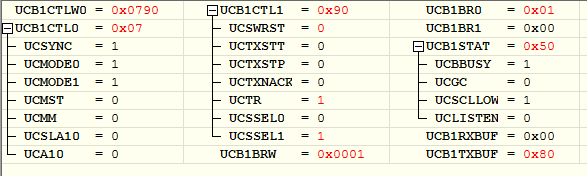
    UCB1CTL1 |= UCSWRST;                      // Enable SW reset
    UCB1CTL0 = UCMODE_3 + UCSYNC;             // I2C Master, synchronous mode
    UCB1CTL1 = UCSSEL_2 + UCSWRST;            // Use SMCLK, keep SW reset
    UCB1I2COA = SLAVE_ADDR;                   // Own Address
    UCB1BR0 = 1;//160;
    UCB1BR1 = 0;
    UCB1CTL1 &= ~UCSWRST;                     // Clear SW reset, resume operation
    UCB1IE |= (UCRXIE | UCTXIE| UCSTPIE | UCSTTIE | UCALIE | UCNACKIE);
}

int I2C_slave_init(void) {
    initGPIO();
    initI2C();
    return 0;
}


//******************************************************************************
// I2C Interrupt ***************************************************************
//******************************************************************************

enum i2c_slave_stage{WAITING_FOR_START, RECEIVE_REG_ADDR,
WAITING_FOR_DATA_OR_RESTART, TRANSMIT_DATA, WAITING_FOR_STOP};
enum i2c_slave_stage stage = WAITING_FOR_START;

void read_i2c_data() {
  uint8_t temp = UCB1RXBUF;
  if (stage == RECEIVE_REG_ADDR) {
    i2c_offset = (temp > sizeof(i2c_interface_struct))? sizeof(i2c_interface_struct) : temp;
    stage = WAITING_FOR_DATA_OR_RESTART;
  } else if (stage == WAITING_FOR_DATA_OR_RESTART) {
    (*(((uint8_t*)(&i2c_interface_struct))+i2c_offset)) = temp;
    stage = WAITING_FOR_STOP;
  } else {
    // generate NAK
    UCB1CTL1 |= UCTXNACK;
  }
}

#if defined(__TI_COMPILER_VERSION__) || defined(__IAR_SYSTEMS_ICC__)
#pragma vector=USCI_B1_VECTOR
__interrupt void USCI_B1_ISR(void)
#elif defined(__GNUC__)
void __attribute__ ((interrupt(USCI_B1_VECTOR))) USCI_B1_ISR (void)
#else
#error Compiler not supported!
#endif
{
  volatile uint8_t temp;

  switch(__even_in_range(UCB1IV,0xC))
  {
    case USCI_NONE:
      break;                             // Vector 0 - no interrupt
    case USCI_I2C_UCALIFG:
      break;                            // Interrupt Vector: I2C Mode: UCALIFG
    case USCI_I2C_UCNACKIFG:
      break;                            // Interrupt Vector: I2C Mode: UCNACKIFG
    case USCI_I2C_UCSTTIFG:
      if (stage == WAITING_FOR_DATA_OR_RESTART)
        stage = TRANSMIT_DATA;
      else
        stage = RECEIVE_REG_ADDR;
      break;                            // Interrupt Vector: I2C Mode: UCSTTIFG
    case USCI_I2C_UCSTPIFG:
      // Fix: STOP in write transaction could come before DATA
      if (UCB1IFG & UCRXIFG) {
        //(*(((uint8_t*)(&i2c_interface_struct))+i2c_offset)) = UCB1RXBUF;
        read_i2c_data();
      }
      i2c_offset=0;
      stage = WAITING_FOR_START;
      break;                            // Interrupt Vector: I2C Mode: UCSTPIFG
    case USCI_I2C_UCRXIFG:
      read_i2c_data();
      break;                            // Interrupt Vector: I2C Mode: UCRXIFG
    case USCI_I2C_UCTXIFG:
      // Fix: Don't check stage==TRANSMIT_DATA (reSTART in write transaction could come before regAddr)
      UCB1TXBUF = *( ((uint8_t*)(&i2c_interface_struct)) + i2c_offset);
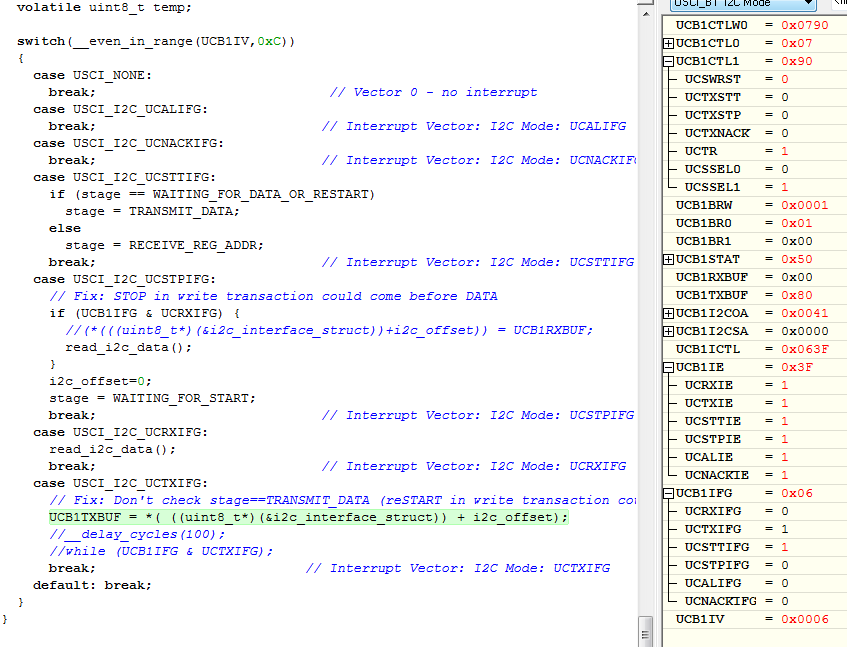
      while (UCB1IFG & UCTXIFG);
      break;                          // Interrupt Vector: I2C Mode: UCTXIFG
    default: break;
  }
}
The code hangs on line 88 ( while (UCB1IFG & UCTXIFG); ) *didn't figure out how highlight works*
Below's the code for sensor check. First the line is established via buffer, then I read sensor, then I close the bus.
if(LTC4315_bus_enable(LTC4315_I2C_ADDRESS, LTC4315_BUS2)){ // 41 - ltc
    if(LM75A_read_temperature1(&temp)){
        temp_storage.device2_temperature_storage = (uint32_t)temp;
    }
}
LTC4315_bus_disable(LTC4315_I2C_ADDRESS, LTC4315_BUS2);
The hang is caught both with and without debugger being connected. Sometimes I caught debugger stuck on __bis_SR_register(LPM0_bits + GIE); string of I2C_Master_WriteReg, unable to close the LTC line, but the debugger said that UCB1_ISR is in use (which is slave). So I wonder, wether it can be that there is a conflict between UCB0_ISR and UCB1_ISR? Or is it smth else that I just don't see?
Maybe it's important: system works in while(1) loop in main. there are also UART, SPI and RTC_A working. Also, I tried to remove LPM0 from I2C Master, but then I failed to do read operations with LTC and couldn't open the link.
I appreciate your help.