This thread has been locked.

If you have a related question, please click the "Ask a related question" button in the top right corner. The newly created question will be automatically linked to this question.

MSP430 + Triac


Hello Forum,

I am working on a dimmer project and am interfacing MSP430 with Triac (BT136-600E), i am using a non-isolated Capacitive Reactance P.S for the circuit derived from mains 230V AC. The Triac used is a gate sensitive type is fired in Q2 and Q3 with negative pulse to gate. The Line/Live is connected to Vcc of the circuit.  i have tested the circuit with ON and OFF control of the triac and works good.

i need to derive Voltage ZCD in order to phase control the load, First option is to use high value resistor/s (1 Meg + 1Meg) and connect it to I/O pin of MSP430 and rely on internal clamp diodes on i/o pin and pass it thru internal Schmitt  trigger to get a square wave. second option is to use a High value resistor + a Zener like 2.7V , with the setup given in the following diagram, i am not sure how to implement the  ZCD resistor + Zener , i mean how should i connect these parts in the circuit ?

Regards,

NIschay


  • Hi,

    I advise to use transoptors and isolate MCU and the controlled circuit. By that you will simplify control and sense circuits.
    They would have separated grounds, so it will be easier to design it. Also MCU ground would be separated when you used transoptor.
    You can build the circuit from serial resistor and Gratz bridge that could supply transoptor inputs (add zener diode in parallel).

    On the transoptor output you will have signal that can be used to determine zero crossing of the voltage. This signal can be connected to msp430 input as digital.

    Regards,
    Piotr Romaniuk, Ph.D.
    ELESOFTROM

  •  

    Hi Piotr, thanks for the reply.

    I've used optocouplers for ZCD before but in this application i want to keep parts count and cost low. many dimmer projects based on PIC and AVRs have used the above technique for ZCD, using high value resistor and internal clamp diodes, but i want to use a high value resistor and a Zener to detect the ZC.

    I hope to hear from JMG and OCY on this topic


    Regards,

    Nischay

  • Mr.Nischay Kumar V said:
    I hope to hear from JMG and OCY on this topic

    Sorry, Can't help you with this now. I'm currently too busy with my job and this problem is too complex so I cannot just look at it in a spare minute and give some good (?) advice. Especially since it is with high voltage and therefore needs double-checking. In this case I better say nothing than saying something wrong.

  •  

    @ JMC, Its Okay, you have been giving valuable advice on many occasions to the forum members,  i needed opinion of a person whose is an expert in MSP430, so i asked. 

    i dropped the idea of using Zener but am using a NPN transistor to generate 50Hz square wave on port pin.


    Regards,

    Nischay

  • Hello Nischay

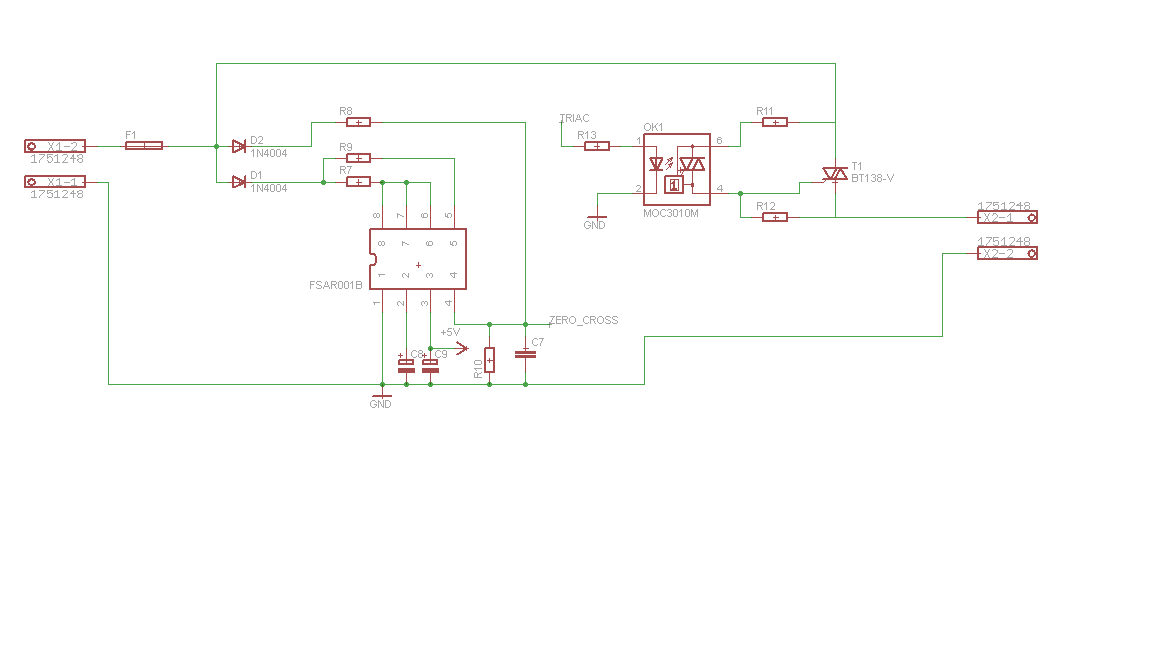
    I tried to do something like what you're doing. tried several foramas. but what gave more certain is how this scheme in below using an electric AC-DC Liner FSAR001B 80-265 with input AC output voltage of 5V. But the MSP430 requires 3.3v, two things I've seen work is to put a LED in series with the MSP430 alementação the summation of the LED over the MSP of the exact voltage for its operation (But I do not advise) and use another one resistive divider.
    To trigger the triac is nothing better than a MOC3022 without the zero cross, but because this IC is dedicated to him firing triac with a simple and logical level of the mcu you will easily control the triac, despite the isolation esa not being used in this circuit . And the output pin 4 to make reading zerocross will come out next 2v.

  • The simplest phase sensing circuit is connecting a 10kohm resistor from cathode of D3 zener (in your schematic) to your io pin. 

    You will need to do some phase compensation with a timer.

    See slaa043a.pdf for other hints. www.ti.com/lit/an/slaa043a/slaa043a.pdf

    Peter

**Attention** This is a public forum