This thread has been locked.

If you have a related question, please click the "Ask a related question" button in the top right corner. The newly created question will be automatically linked to this question.

MSP430FR5989: DAC/ AFE2 autocalibration

Part Number: MSP430FR5989

Dear Ti Team,

I wanted to know exactly what's the difference or the need of DAC autocalibration, on the FLOW ESI GUI you can set "Periodic DAC Autocalibration" (in the datasheet nothing about this appear):
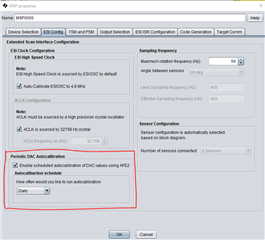
I made a test with it for each minute, here is the power consumption (160uA during 112ms): 

Apparently if MCU is in LPM3 without measuring the disk this "DAC autocalibration" isn't done. The "medium" edges are rotation disk detections and the "little" ones are the AFE2 autocalibration, that it's done with a Timer of 15 sec. The GUI generates 2 defines for this, TIME_TO_RECAL_REPEAT is linked to "DAC Autocalibration" and TIME_TO_RECAL is linked to AFE2 autocalibration.

My questions are: what's the difference? Is "DAC autocalibration" needed? What's its purpose? Why this doesn't appear on datasheet? Moreover i wanted to know a good estimation time for AFE2 autocalibration, is 15 seg needed or can I do it each minute for example?

Best regards

Samuel

  • Hi Samuel,

    Let me check with one of our experts on this device.

  • Hi Dennis,

    Thank you, I'll wait the support.

    Best regards

    Samuel

  • Hi Samuel,

    I'm still waiting for a response from one of our experts.

    In the meantime, if you haven't already, take a look at section 5.1 in the this SLAA639 application note.

  • Hi Samuel,

    I'm coming up short finding an answer for you.  Did my suggestion to review section 5.1 help at all?

  • Hi Dennis,

    No sorry, I still have those questions. Don't understand those 2 "autcalibrations" if the AFE2 include a DAC.

    Best regards

    Samuel

  • Hi Samuel,

    Ok, I'm being told the calibration is necessary in order to track, and compensate for the small changes in the AFE1,2 over time. Basically AFE2 detects small changes in its DAC output and compensates as necessary.  AFE1 is then updated with AFE2 DAC setting so they are always the same. Section5.1 above describes how this is done in more detail.

    How often re-calibration is needed depends on the environment the meter is operating in and the expected drift due to changes in temperature, so I really can't say.  You will need to test your device across temperature to help determine when the auto-calibration is needed. Also, be mindful of the power consumption.  Performing calibrations more often than needed can consume battery power.

    Regarding the TIME_TO_RECAL and TIME_TO_RECAL_REPEAT, TIME_TO_RECAL determines how often the AFE2 recalibration should be done (every minute, hour, daily, etc.).  The TIME_TO_RECAL_REPEAT sets the number of re-calibrations performed when the AFE2 is scheduled to be re-calibrated.  For example, you could set TIME_TO_RECAL = every hour, and have it perform 4 calibrations each time.

    Does this help?

  • Hi Dennis,

    Thanks for your reply. I understand the 2 first paragraphs, but I disagree the third one because of the things I mention in the beginning of the post.

    What I could see with the code and power analyzer is that with TIME_TO_RECAL I can set AFE2 autocalibration (very little deltas in the power consumption pic) and with TIME_TO_RECAL_REPEAT I can set DAC autocalibration (big 4 deltas on the pic, one is hidden by the cursor) due to the FLOW ESI GUI (see the first pic). So that's why I don't understand, because AFE2 includes a DAC, why when AFE2 is autocalibrated DAC isn't? Moreover, on your paragraph you say that "TIME_TO_RECAL_REPEAT sets the number of re-calibrations performed when the AFE2 is scheduled to be re-calibrated", so it should do each time a little delta appears. But what I see in power consumption is that one calibrates each 15 sec (set), and the other each minute.

    Best regards

    Samuel

  • Hi Samuel,

    I apologize for the delay.  I'm struggling to find anyone that knows the answer, so it I'm going to have to try to set something up and test the software to understand what is happening.  I will come back today with a response.

  • Hi Samuel,

    I spent much of the day trying to figure out how the software is supposed to work, but with no luck.  There is no documentation (public or private) that I could find.  This software was apparently written back in 2013, and there is no way to find who wrote it.  I'm running out of options and people to ask.  I will try again tomorrow.

  • Hi Samuel,

    Good news - I was able to find someone who has worked with the SW in the past.  It has been a while for him so it may take him a little time to come back to speed on how the SW works.

  • Hi Samuel,

    I believe your open questions are related to the use of TIME_TO_RECAL and TIME_TO_RECAL_REPEAT  defines in the code.

    TIME_TO_RECAL is used to configure a timer to trigger every 15 sec. The frequency at which the re calibration is triggered is determined by TIME_TO_RECAL_REPEAT. If you selected every minute it will have a value of 4, if you selected hourly it will have a value of 240 and so on.

    Like Dennis mentioned previously this DAC calibration is application specific and would be needed in case you notice your signals are drifting overtime. One thing to notice is that the DAC recalibration required the detection of four complete rotations otherwise the calibration times out. If you need to adjust the time-out period you can modify RECAL_TIME_OUT.

    Best Regards,
    Ivan

  • Hi Ivan,

    Thank you for your reply, that solved my issue. But with your last comment I have another one, so if the system doesn't complete 4 rotations the RECAL_TIME_OUT force the system to recalibrate? Or is just to start again the counter to get the recalibration trigger?

    Best regards

    Samuel

  • Hi Samuel,

    If AFE2 re-calibration fails, then previous sampling rate is restored and none of the AFE1 DAC values are updated. The re-calibration timer is reset and the application will wait until the next re-calibration trigger.

    Ivan

**Attention** This is a public forum