This thread has been locked.

If you have a related question, please click the "Ask a related question" button in the top right corner. The newly created question will be automatically linked to this question.

MSP430FR2533: About Charge Transfer Technology

Genius 5840 points
Part Number: MSP430FR2533


Hello,

I'm reading following description.

http://software-dl.ti.com/msp430/msp430_public_sw/mcu/msp430/CapTIvate_Design_Center/latest/exports/docs/users_guide/html/CapTIvate_Technology_Guide_html/markdown/ch_technology.html#mutual-mode-charge-and-transfer-phases

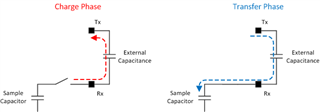
But I'm not sure why external capacitor is charged when charge phase.

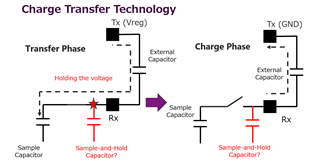
Does the RX electrode actually have a sample and hold capacitor or any regulator as shown in the figure?
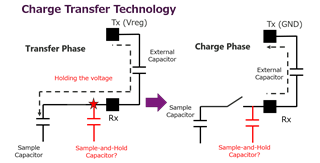
I didn't know where the "electric charge" to charge the external capacitor came from.

Regards,

U-SK

  • TI's capacitive touch sensing technology CapTIvateTm is based on charge transfer collection. The principle includes: 1) Charging the sensor input capacitor ; 2) Transferring the accumulated charge to the internal sampling capacitor . This process will continue to repeat until the voltage on both sides of  reaches the trigger voltage  of the internal comparator. The number of charge transfers required to reach the threshold directly characterizes the size of . When the capacitive sensor is touched by a human hand,  and charge transfer number will change. The MCU senses the occurrence of a touch event by comparing the numbers of different charge transfer cycles. MSP430 uses a current mirror to control the proportional relationship between the input current of  and the discharge current of , so as to equivalently amplify  and have a larger range.

    Hope it can helps you answer part of your question.

  • Hi Eason Zhou,

    Tank you for your reply.

    I understand that the charge phase and transfer phase are repeated for sensing.

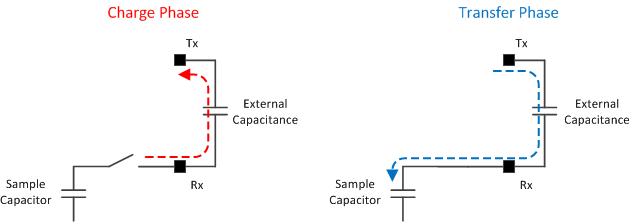
    You explained  "1) Charging the sensor input capacitor", but I can't find "sensor input capacitor" in below image.

    If the RX line is shorted in the charge phase as shown below, I don't think the external capacitor will be charged in the charge phase.

    The document also explained "sample-and-hold circuit drives the Rx node" in charge phase.

    So I think additional capacitor is actually present at RX port.

    Is my understanding correct?

    I would appreciate it if you could tell me more about the charge transfer technology of the mutual capacity method with a more detailed diagram.

    Regards,

    U-SK

  • Hi U-SK,

    For the Charging the sensor input capacitor, it refer to the parasitic capacitance, you can take it as "External Capacitor".

    For the TX part, it is just connect it to GND or to Vreg(1.5V).

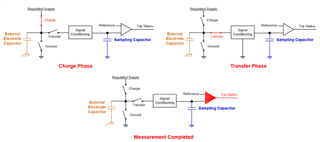
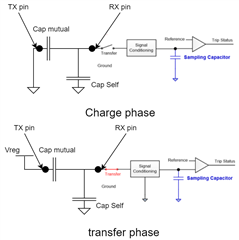
    For the RX part, you can refer to this picture:

    Actually, the method of  self mode and mutual mod, is same. The only difference is that:

    For self mode, it charge the capacitance between RX to GND, through RX pin.

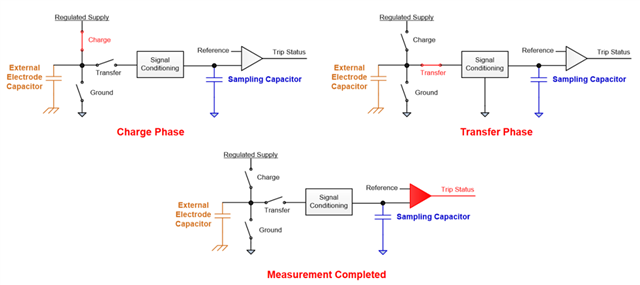
    For mutual mode, it charge the capacitance between TX to RX and RX to GND, through TX pin. And it keep the voltage on RX pin to be stable, that can helps only transfer the capacitor between TX to RX.

    Eason

  • Hi Eason,

    Thank you for your reply.

    I still can't understand the explanation.
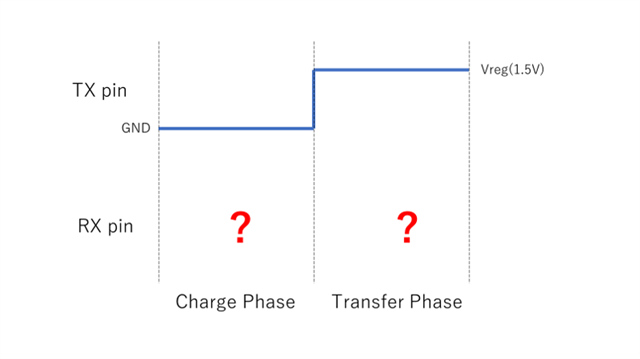
    Where in the figure below can be considered as the RX pin and where can it be considered as the TX pin?

    In the figure below, I could not understand why the External Capacitance is charged even though the TX pin is GND during the charge phase.

    I think that the voltage of the TX pin is as follows in the above figure, but could you tell me how much voltage the RX pin will be in each phase?

    Thank you for you cooperation.

    Best Regards,

    U-SK

  • Hi U-SK,

    You can see this one, you must know that for a mutual touch, It will exist mutual cap and self cap. The circuit is to keep RX pin voltage to be stable, then it will not move the current from self cap to internal sample cap.

    Eason

  • Hi Eason,

    Sorry for late reply.

    Thank you for your advice.

    I understand well.

    Regards,

    U-SK

**Attention** This is a public forum