Part Number: MSP432P401R
My end goal for this project is to sample audio from an amplified electret microphone, and store it in SRAM (short sample, I know) using DMA.
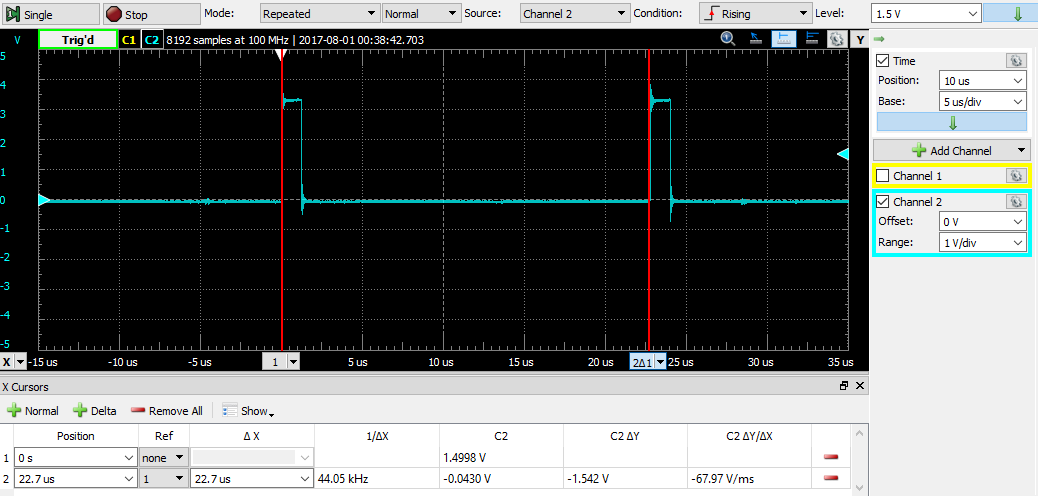
Currently, the output of my microphone circuit looks perfect through an oscilloscope. I'm running my MSP432 at 48 MHz; so I should be able to sample at 44.1 kHz without a problem, though I will probably sample slower just to save RAM.
My ideal scenario is as follows:
- Automatically trigger ADC conversions at a rate of 44.1 kHz using Timer_A0.
- When each conversion is completed, automatically transfer sample to memory.
The problem I am running into is that I can't get the ADC to trigger automatically using a timer. I can't find any example code that doesn't use the DriverLib API.
So FOR NOW, I am trying to manually trigger a conversion at 44.1 kHz using a timer interrupt. I configured Timer_A0 in UP mode, with a CCR0 value that triggers a timer overflow interrupt at a rate of 44.1 kHz. So my timer is working perfectly, but when I start a conversion inside my timer interrupt function (and manually store the data inside a conversion complete interrupt), I get wonky ADC results when I look at the data after pausing the program.
Here is my code as of now:
#include "msp.h"

#define A0 BIT5

#define num_samples 100

#define startConversion() ADC14->CTL0 |= ADC14_CTL0_ENC | ADC14_CTL0_SC

#define startSampling() TIMER_A0->CCR[0] =	271 // Corresponds to 44.1 kHz sampling rate
#define stopSampling() TIMER_A0->CCR[0] = 0;

void VCORE1();
void FLASH_init();
void CLK_init();
void ADC_init();
void TIMER_init();

volatile uint16_t audio[num_samples];
volatile uint16_t i = 0;

void main(void)
{
	WDT_A->CTL = WDT_A_CTL_PW | WDT_A_CTL_HOLD;		// stop watchdog timer

	//P2->DIR |= BIT7;

	//Enable MCLK clock output on P4.3
	//P4->DIR |= BIT3;
	//P4->SEL0 |= BIT3;

	VCORE1();				//Go to VCORE1 mode before setting clock to 48 MHz
	FLASH_init();
	CLK_init();				//Set clock to 48 MHz
	ADC_init();				//Initializes ADC, waiting for Timer to start conversions
	TIMER_init();

	NVIC_EnableIRQ(ADC14_IRQn);
	NVIC_EnableIRQ(TA0_0_IRQn);

	__enable_irq();

	startSampling();

	while(1);
}

void ADC14_IRQHandler(void)
{
	audio[i] = ADC14->MEM[0];	//Save sample, clears flag
}

void TA0_0_IRQHandler(void)
{
	TIMER_A0->CCTL[0] &= ~TIMER_A_CCTLN_CCIFG;	//Clear timer flag
	//P2->OUT |= BIT7; //For testing timer
	startConversion();
}

void VCORE1()
{
	while(PCM->CTL1 & PCM_CTL1_PMR_BUSY);
	PCM->CTL0 = PCM_CTL0_KEY_VAL | PCM_CTL0_AMR__AM_LDO_VCORE1;
	while(PCM->CTL1 & PCM_CTL1_PMR_BUSY);
}

void FLASH_init()
{
	//Configure Flash wait-state to 1 for both banks 0 & 1
	FLCTL->BANK0_RDCTL = (FLCTL->BANK0_RDCTL & ~(FLCTL_BANK0_RDCTL_WAIT_MASK)) |
			FLCTL_BANK0_RDCTL_WAIT_1;
	FLCTL->BANK1_RDCTL  = (FLCTL->BANK0_RDCTL & ~(FLCTL_BANK1_RDCTL_WAIT_MASK)) |
			FLCTL_BANK1_RDCTL_WAIT_1;
}

void CLK_init()
{
	//Set clock to 48 MHz
	CS->KEY 	= 	CS_KEY_VAL;				//Unlock CS registers
	CS->CTL0 	= 	CS_CTL0_DCOEN 	|
					CS_CTL0_DCORSEL_5;		//Choose 24MHz MHz clock speed
	CS->CTL1 	= 	CS_CTL1_SELS_3 	|
					CS_CTL1_SELM_3;			//Use DCOCLK as source for MCLK, SMCLK + HSMCLK
	CS->KEY		=	0;						//Re-lock CS registers
}

void ADC_init()
{
	P5->DIR &= ~(A0);	//Set ADC pin as input

	P5->SEL0 |= A0;		//Choose ADC as port function
	P5->SEL1 |= A0;

	ADC14->CTL0	=	//ADC14_CTL0_SHS_1	|	//Use TA0 to start conversion
					ADC14_CTL0_SHP	 	|	//??
					ADC14_CTL0_ON;		 	//Turn ADC module on
	ADC14->CTL1	=	ADC14_CTL1_RES__14BIT;	//Set 14-bit resolution
	ADC14->IER0 = 	ADC14_IER0_IE0;			//Enable interrupt when conversion on A0 is complete
}

void TIMER_init()
{
	TIMER_A0->CCTL[0] 	=	TIMER_A_CCTLN_CCIE;			//Enable CC interrupt

	TIMER_A0->CTL 		=	TIMER_A_CTL_TASSEL_2 	|	//Select SMCLK as source for timer
							TIMER_A_CTL_ID_2		|	//Divide clock by 4 (this yields 6 MHz for the timer clock)
							TIMER_A_CTL_MC_1		|	//Up mode
							TIMER_A_CTL_CLR			;	//Clear timer count

}