Part Number: BQ40Z80
Other Parts Discussed in Thread: BQ24780S
Dear E2E team,
When I validate the cell balancing, I notice that the balancing time is greater than the calculation, see the image below:

What's going wrong?
BR,
Loïc
This thread has been locked.
If you have a related question, please click the "Ask a related question" button in the top right corner. The newly created question will be automatically linked to this question.
Hello Jose
My question is not about calculating the balancing time (another post has resolved this)
The Qmax Delta is 12 mAh, with 66 s/mAh bal time/mAh paramter, the calculation of the balancing delay is 12*66 = 792 s. Why has CBTime increased to 10,410 s?
Hi Loic,
It is hard to answer without looking at data. The gauge will adjust cell balancing time depending on how much SOC difference is between the cells. This CB time will be adjusted if the gauge takes an OCV measurement and updates DOD. The present DOD might have changed. This can also happen if Qmax updates.
Please share a log file.
Regards,
Jose Couso
Hello Loic,
I had to look at the actual FW code for this. The explanation in TRM is high level. I will try to explain from the actual code what the balancing algorithm does.
Step-1:
The gauge calculates the highest Qcharge of each cell. Qcharge is the amount of charge needed to bring the cell to full.
dQ = Max_Qcharge - MinQcharge
Step-2:
Cell Balance time = dQ * dataFlash Cell balance time
To calculate QCharge for each cell is not as straight forward as taking the difference in QMax of each cell. The code does something a little bit more complicated which I cannot reveal.
I did a walkthrough the code with actual numbers and this is what I obtained. Using the highlighted row in yelow.
Following the code, I obtained for Max_Qcharge 111 mAh and for Min_Qcharge -44 mAh.
Taking the difference:
dQ = 111 - (-44) = 155 mAh
Cell Balance Time = 155 * 67 ~= 10385 seconds
My numbers might be off a little bit, but it is confirmed that the algorithm is following the code.
Regards,
Jose Couso
Hello Jose,
Thank you for your reply, but can you explain why the Cell2 with a QMAX of 1275 mAh is balanced whereas the Cell1 has a Qmax of 1287 ?
Also, can I add a coefficient about 0.076 for have a good balancing time (10410 x 0.076 = 791 s)?
Regards,
Loïc
Hello Loic,
You should be referencing at the CBDOD_n of each cell to determine the cell to be balanced. Or possibly, the cell voltage. The cell with highest cell voltage will balance down to the lowest cell. For DOD is opposite. Lowest DOD = highest voltage. DOD = Depth of Discharge.
Also, can I add a coefficient about 0.076 for have a good balancing time (10410 x 0.076 = 791 s)?
Unfortunately, this algorithm is not flexible. It is fixed and it determines the amount of balance time by comparing how much charge is in each cell in real time.
You can use external cell balancing if you wish to balance faster. The algorithm will still work since it constantly calculates the charge needed to bring the cells as close as possible to each other. See this app note for more insight in external balancing.
Regards,
Jose Couso
Hello Jose,
Thanks again for your explanations, but I've added the rest of the recording in Excel and the result seems very bad.

The record :
And last record today
Look at the fact that at the beginning, cell 2 was balanced and now it's cell 1 that's balanced. I think there's a flip-flop effect due to over-balancing.
regards
Loïc
Hello Loic,
Cell balancing is only active when CB bit is set in Operation Status B register. Check if this one is set. Otherwise, the gauge is only calculating cell balancing time.
Regards,
Jose
Hello Jose,
The answer is Yes CB bit is set in Operation Status B register.

Regards,
Loïc
Hello Loic,
When Cell Balancing is active, Cell-1 voltage was higher than Cell-2 voltage. Therefore, CB time-1 was active. Cell-1 voltage needs to balance down to cell-2 voltage.
Regards,
Jose Couso
Hello Jose,
My request is about cell2 being unbalanced by the balancing function, you can see below in the recordings that I'm talking about the phenonem :
Regards,
Loïc
Hi Loic,
I am not too sure what you are referring to.
Cell Balancing is only enabled during the first charge period according to your log.
During this time, cell-1 balanced down to cell-2.
My only concern is that cell balancing seems off during relax, do you have it disabled during relax?
The gauge will balance during charge and relax if configured to do so.
Regards,
Jose Couso
Hi Jose,
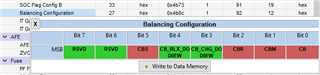
My balancing configuration, Active + Relax mode + External mode

I continued with the cycle test:

Regards Loic
Hi Loic,
Can you please enable bits 4 and 3? This will help with the DOD error. Errors in DOD measurement can disable balancing. 
Regards,
Jose Couso
Hi Jose,
Before changing, can you explain which variables are used for weighted ? Also, are you suggesting that the DOD calculation is wrong? Perhaps it would be better if I resolved the DOD calculation error first?
BR,
Loïc
Hi Loïc,
When CB_RLX_DOD0EW and CB_CHG_DOD0EW are enabled, the gauge will use a error weighted DOD (depth of discharge) instead of the Depth of discharge (DOD0). This might add more accuracy to the cell balancing as the DOD0 might not be the true depth of discharge. In any case, this should be a feature to enhance accuracy.
Also what chemistry type is your cell? If it's LFP, please reference to this thread.
Regards,
Jose Couso
Hi José
I have activated CB_RLX_DOD0EW and CB_CHG_DOD0EW . I confirm that it's LFP cell.
After moreover cycles, I have always the swithc between cell 1 and cell 2. I observe that with Advanced Charge Algorithm / Cell Balancing Config / Bal Time/mAh Cell 1 = 7 and Advanced Charge Algorithm / Cell Balancing Config / Bal Time/mAh Cell 2-6 = 7 this is less critical.
What do you think about this?

BR,
Loïc
Hi Loic,
I am a bit confused on this behavior. Why the end of charge voltage looks like this?
Regards,
Jose Couso
Hi Jose,
Its because I charge the batterie with power supply without tapper current.
Regards,
Loïc
Hi Loic,
I am not sure if this a good idea. You might not be getting every bit out of the cell without the tapering phase. The cell might be be charging to its fully potential.
It does look like there's an improvement in cell balancing time with CB_RLX_DOD0EW and CB_CHG_DOD0EW enabled.
Regards,
Jose Couso
Hi Jose,
I continued the test with the charger BQ24780S. CB_RLX_DOD0EW and CB_CHG_DOD0EW are enabled. Please find here the capture

Merry Christmas and Happy New year,
Loïc
Hello Loic,
The gauge will not perform well without a proper charge taper using LFP chemistry. The gauge relies on the taper at the end of charge to help determine the full charge state, without the taper it could lead to high errors in the DOD estimation at full charge.
Sincerely,
Wyatt Keller