This thread has been locked.

If you have a related question, please click the "Ask a related question" button in the top right corner. The newly created question will be automatically linked to this question.

TMS320C6678: C6000 boot magic address changes .text

Part Number: TMS320C6678

We are running on a c6678 DSP and using CCS8 with CGT c6000_8.3.2 and are seeing what appears to be corruption of the .text section when BOOT_MAGIC_ADDRESS is written.

extern volatile cregister unsigned int DNUM;

uint32_t getDspId() {
  return DNUM;
}

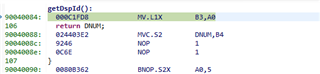
Assembly before core0 writes boot magic address
Assembly after writing boot magic address of core 1, from core 0 with all cores but 0 halted
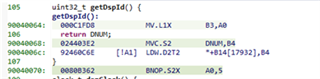
When the first core write BOOT_MAGIC_ADDRESS for core1 the asm code changes at the same time. It was my understanding writing that boot magic addr did not really do much until the IPC was written to release those core.

#define MAGIC_ADDR          0x87fffc

#define BOOT_MAGIC_ADDR(x)  (MAGIC_ADDR + (1<<28) + (x<<24))

Is there more processing going on when BOOT_MAGIC_ADDRESS is written? When BOOT_MAGIC_ADDRESS is written I am seeing the .text section of the program have its memory modified, specifically one word is being set to c_int00 value. The address being written is no where near the .text memory that changes (0x9004007C in one instance)

  • Thanks for that info. I have further debugged this issue and isolated where/when the corruption is occurring.

    We are loading many memory segments into L2SRAM and "PROGRAM". It appears there is no protection if the L2SRAM usage by an application grows to overlap 0x87FF80 to 0x87FFFF? Is this something you expect could happen, and how might we protect against it or atleast fail to compile in these instances?

    What does "PROGRAM" map to if used in app.cfg? I suspect its L2SRAMwhich is also mapped to 0x9000XXXX?

  • We have our platform.xdc setup to map program to 0x90000000 but that address is not documented in the data sheet.

                    ["PROGRAM",
                         {
                            name: "PROGRAM",
                            base: 0x90000000,                    
                            len: 0x10000000,                    
                            space: "code/data",
                            access: "RWX",
                         }
                    ],

  • Initially 90000000 seems to map to L2SRM up through 87FFFF, changes to one affects the other. I cannot tell where the remaining memory after actually resides. I am not sure what the 0x90000000 address is doing, can you please elaborate on this behavior and why RLB memory is allowed to be reused like this?

    Thank You

  • John,

    Let me look at it and get back.

    Regards

    Shankari G

  • John,

    Please have a look at this memory map of Platform_test code where the code snippet of Boot magic address is implemented.

    Meanwhile, I will have a closer look on yours.

    Compare the memory section with yours....

    /*
     *  Linker command file
     *
     */
    
    -c
    -heap  0x41000
    -stack 0xa000
    
    /* Memory Map 1 - the default */
    MEMORY
    {
        L1PSRAM (RWX)  : org = 0x0E00000, len = 0x7FFF
        L1DSRAM (RWX)  : org = 0x0F00000, len = 0x7FFF 
    
        L2SRAM (RWX)   : org = 0x0800000, len = 0x080000
        MSMCSRAM (RWX) : org = 0xc000000, len = 0x100000
        DDR3 (RWX)     : org = 0x80000000,len = 0x20000000
    }


    SECTIONS
    {
        .csl_vect   >       MSMCSRAM
        .text       >       MSMCSRAM
        GROUP (NEAR_DP)
        {
        .neardata
        .rodata
        .bss
        } load > MSMCSRAM
        .stack      >       MSMCSRAM
        .cinit      >       MSMCSRAM
        .cio        >       MSMCSRAM
        .const      >       MSMCSRAM
        .data       >       MSMCSRAM
        .switch     >       MSMCSRAM
        .sysmem     >       MSMCSRAM
        .far        >       MSMCSRAM
        .testMem    >       MSMCSRAM
        .fardata    >       MSMCSRAM
        platform_lib > 		MSMCSRAM
    }


    Regards

    Shankari G 

  • Thank you! I am mostly interested in the 0x90000000 address and what that is actually doing. Part of the data is showing up in L2SRAM but the map file has an address of 0x90000xxxx. I do not know where the remaining 0x90000000 data is in memory assuming that address is virtual and does not really exist.

    I do not know why we are using the 0x90000000 address or where the previous developer got it.

  • Somehow the 0x90000000 Address is getting mapped to L2SRAM.

    In the compiler generated map file its reported as 0x900xxxxx in the debugger if L2SRM 0x85ffff is displayed and I page up and down the addresses glitch and bounces between the 0x9000000 and 0x86xxxx perspectives.

    When this occurs the Bootloader section in L2 SRAM (Table 2-3 in c6678 datasheet) is being overloaded and corrupted. When the end of L2 SRAM is reached, the 0x9xxxxxxx address space continues on but I cannot tell what memory it is actually using.

  • John,

    By any chance, if you have the C6678 EVM, please tru out the FAQ, I pointed and check whether it jump boots using Boot-Magic.

    By this, you will have one working reference assembly code to compare it with yours.

    Regards

    Shankari G

  • More information - The 0x9000_0000 address I was looking at is actually DDR memory that seems to be getting cached. We intended to have DDR Caching disabled in our app.cfg via this command
    Cache.setMarMeta(0x80000000,0xFFFFFFF,Cache.Mar_DISABLE);

    Is there any reason using the debugger or jtag to load would affect how caching is done?

  • Is there any reason using the debugger or jtag to load would affect how caching is done?

    No. not related. 

    Have not come across such case from other customers.

    ===

    According to the datasheet, page no: 111, Fig 5-4 :-  L2 memory's Block base address starts at 0x0080 0000h and ends by 0x0087 FFFFh.

    For example, address location 0x10800000 is the global base address for C66x CorePac Core 0's L2 memory. C66x CorePac Core 0 can access this location by either using 0x10800000 or 0x00800000.

    And Infact, "For C66x CorePac Core 0, as mentioned, this is equivalent to 0x10800000, for C66x CorePac Core 1 this is equivalent to 0x11800000, and for C66x CorePac Core 2 this is equivalent to 0x12800000. "

    ===

    Cache user guide is here: https://www.ti.com/lit/ug/sprugy8/sprugy8.pdf

    ===

    Yes, possibly, the address, 0x90000000 maps to DDR3.

    It is even evident in the sample-linker command file, above, with memory map configuration for DDR3. 

    MEMORY
    {
    L1PSRAM (RWX) : org = 0x0E00000, len = 0x7FFF
    L1DSRAM (RWX) : org = 0x0F00000, len = 0x7FFF

    L2SRAM (RWX) : org = 0x0800000, len = 0x080000
    MSMCSRAM (RWX) : org = 0xc000000, len = 0x100000
    DDR3 (RWX) : org = 0x80000000,len = 0x20000000
    }

    ====

    Please note that the "Table 2-3 Bootloader section in L2 SRAM" starts at address 0x0087 2DC0 and ends at 0x0087FFFF.

    Here ----> #define MAGIC_ADDR          0x0087FFFC ( Please note that the boot magic address is the last field in the bootloader section in L2SRAM)

    ===

    But however the boot loader section of L2SRAM (start address 0x0087 2DC0 and end address 0x0087 FFFF)  should not get corrupted.....

    If this table gets corrupted, no guarantee of jump boot.

    Probably, you may have to find out the root cause of the "boot loader table corruption".

    While debugging, upto which point, the corruption doesnot occur? 

    ==

    Regards

    Shankari G

  • This issue has been isolated to be a procedural issue regarding when the L2 RAM is changed over from the bootloader mode to being used as cache memory.

    This issue only occurs when the DSPs are booted from JTAG with ccs. If the program is loaded on all 8 cores initially, Cores 1-7 switch over to using L2SRAM as Cache at that time before they are run.

    When Core0 is kicked off, it was writing the boot magic address after the other cores were switched over to a cached mode and the address in question was no longer valid to use as a boot address at all.