


Part Number: SK-AM62-LP
Other Parts Discussed in Thread: SYSCONFIG
Tool/software:
Hi,
I'm writing an application using the McASP driver.
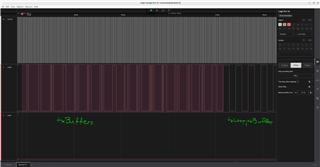
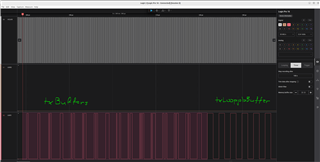
I managed to configure the MCASP0 driver instance to transmit 8-slot/16-bit TDM frames at the rate of 48 kHz via a single serializer (either AXR0 or AXR1):
- AXR0:
- AXR1:
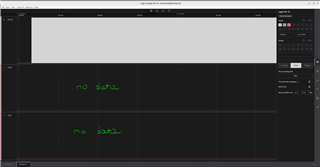
The problem is that when I enable 2 serializers (i.e., AXR0 and AXR1) and run the very same application I cannot see any data on the corresponding serial data pins - I can only see the serial bit clock signal:
I'd like to know how to enable 2 serializers so that they can can service data on both pins at the same time.
Is adding the second serializer in SysConfig enough?
Do I need to send more data?
Is there any exemplary application implementing a TDM multi-slot multi-serializer case available?
Plase find below the application code and SysConfig settings:
- application:
#include "mcasp_util.h"

#include "ti_drivers_config.h"

#include <FreeRTOS.h>
#include <drivers/mcasp.h>
#include <kernel/dpl/CacheP.h>
#include <kernel/dpl/DebugP.h>
#include <task.h>

#include <stdint.h>
#include <string.h>

#define SLOT_COUNT               (8u)
#define SLOT_SIZE_IN_B           (4u)
#define FRAME_COUNT              (2u)
#define FRAME_SIZE_IN_B          (SLOT_COUNT * SLOT_SIZE_IN_B)
#define DATA_SIZE_IN_B           (FRAME_COUNT * FRAME_SIZE_IN_B)
#define LOOPJOB_BUFFER_SIZE_IN_B (FRAME_SIZE_IN_B)

uint8_t txBuffers[FRAME_COUNT][FRAME_SIZE_IN_B] __attribute__((aligned(256)));

MCASP_Transaction txTransactions[FRAME_COUNT] = {};

uint32_t volatile txCallbackCallCount = 0u;

extern uint8_t txLoopjobBuffer[];

static void fillTxBuffers(uint8_t (* const buffer)[FRAME_COUNT][FRAME_SIZE_IN_B])
{
    for (uint32_t i = 0u; i < FRAME_COUNT; ++i)
    {
        for (uint32_t j = 0u; j < FRAME_SIZE_IN_B; ++j)
        {
            (*buffer)[i][j] = (FRAME_SIZE_IN_B * i + j) % 256u;
        }
    }
}

static void fillLoopjobBuffer(
    uint8_t (* const buffer)[LOOPJOB_BUFFER_SIZE_IN_B],
    uint32_t const value)
{
    for (uint32_t i = 0u; i < LOOPJOB_BUFFER_SIZE_IN_B; i += 4u)
    {
        *((uint32_t*)(&((*buffer)[i]))) = value;
    }
}

static void submitBuffers(
    MCASP_Handle const handle,
    MCASP_Transaction (* const transactions)[FRAME_COUNT],
    uint8_t (* const buffers)[FRAME_COUNT][FRAME_SIZE_IN_B],
    int32_t (* const callback)(MCASP_Handle, MCASP_Transaction*))
{
    for (uint32_t i = 0u; i < FRAME_COUNT; ++i)
    {
        (*transactions)[i].buf = &(*buffers)[i];
        (*transactions)[i].count = FRAME_SIZE_IN_B / SLOT_SIZE_IN_B;
        (*transactions)[i].timeout = 0xFFFFFFFFu;

        callback(handle, &(*transactions)[i]);
    }
}

static void awaitTransferCompletion(void)
{
    vTaskDelay(pdMS_TO_TICKS(100u));
}

static void withdrawBuffers(
    MCASP_Handle const handle,
    MCASP_Transaction* (* const callback)(MCASP_Handle))
{
    while (callback(handle) != NULL)
    {
    }
}

void mcaspMain(void* args)
{
    MCASP_Handle handle;

    fillTxBuffers(&txBuffers);
    CacheP_wb(&txBuffers, DATA_SIZE_IN_B, CacheP_TYPE_ALL);

    fillLoopjobBuffer(&txLoopjobBuffer, 0xFFFFFFFFu);
    CacheP_wb(&txLoopjobBuffer, LOOPJOB_BUFFER_SIZE_IN_B, CacheP_TYPE_ALL);

    handle = MCASP_getHandle(CONFIG_MCASP0);
    DebugP_assert(handle != NULL);

    submitBuffers(
        handle,
        &txTransactions,
        &txBuffers,
        &MCASP_submitTx
    );

    DebugP_assert(MCASP_startTransferTx(handle) == SystemP_SUCCESS);

    awaitTransferCompletion();

    MCASP_stopTransferTx(handle);

    withdrawBuffers(handle, &MCASP_withdrawTx);
}

void runOnTransmittingData(
    MCASP_Handle handle,
    MCASP_Transaction* const transaction)
{
    ++txCallbackCallCount;
}
- SysConfig settings:
/**
 * These arguments were used when this file was generated. They will be automatically applied on subsequent loads
 * via the GUI or CLI. Run CLI with '--help' for additional information on how to override these arguments.
 * @cliArgs --device "AM62x" --package "AMC" --part "Default" --context "a53ss0-0" --product "MCU_PLUS_SDK_AM62x@09.02.01"
 * @versions {"tool":"1.20.0+3587"}
 */

/**
 * Import the modules used in this configuration.
 */
const mcasp      = scripting.addModule("/drivers/mcasp/mcasp", {}, false);
const mcasp1     = mcasp.addInstance();
const debug_log  = scripting.addModule("/kernel/dpl/debug_log");
const mmu_armv8  = scripting.addModule("/kernel/dpl/mmu_armv8", {}, false);
const mmu_armv81 = mmu_armv8.addInstance();
const mmu_armv82 = mmu_armv8.addInstance();

/**
 * Write custom configuration values to the imported modules.
 */
mcasp1.$name                                   = "CONFIG_MCASP0";
mcasp1.txHclkSourceMux                         = 2;
mcasp1.rxHclkSourceMux                         = 2;
mcasp1.txCallbackFxn                           = "runOnTransmittingData";
mcasp1.rxCallbackFxn                           = "runOnReceivingData";
mcasp1.txLoopjobBuf                            = "txLoopjobBuffer";
mcasp1.rxLoopjobBuf                            = "rxLoopjobBuffer";
mcasp1.rxActiveSlotMask                        = 0x3;
mcasp1.rxDataMask                              = 0xFFFFFFFF;
mcasp1.enableLoopback                          = false;
mcasp1.clkSyncMode                             = "ASYNC";
mcasp1.enableMcaspRx                           = false;
mcasp1.TxMode                                  = "TDM";
mcasp1.NumTxSlots                              = 8;
mcasp1.txAfifoEnable                           = false;
mcasp1.txActiveSlotMask                        = 0xFF;
mcasp1.txFsPolarity                            = 0;
mcasp1.txBitClkPolarity                        = 0;
mcasp1.txDataDelay                             = 0;
mcasp1.TxSlotSize                              = 16;
mcasp1.txDataMask                              = 0xFF000000;
mcasp1.txLoopjobBufLength                      = 16;
mcasp1.MCASP.$assignAllowConflicts             = "MCASP0";
mcasp1.mcaspSer.create(2);
mcasp1.mcaspSer[0].$name                       = "CONFIG_MCASP_SER0";
mcasp1.mcaspSer[0].MCASP.$assignAllowConflicts = "MCASP0";
mcasp1.mcaspSer[1].$name                       = "CONFIG_MCASP_SER1";
mcasp1.mcaspSer[1].serNum                      = 1;
mcasp1.mcaspSer[1].MCASP.$assignAllowConflicts = "MCASP0";
scripting.suppress("Resource conflict,MCASP0 is also in use by @@@.+?@@@, @@@.+?@@@", mcasp1.MCASP, "$assign");
scripting.suppress("Resource conflict,MCASP0 is also in use by @@@.+?@@@, @@@.+?@@@", mcasp1.mcaspSer[0].MCASP, "$assign");
scripting.suppress("Resource conflict,MCASP0 is also in use by @@@.+?@@@, @@@.+?@@@", mcasp1.mcaspSer[1].MCASP, "$assign");

const udma         = scripting.addModule("/drivers/udma/udma", {}, false);
const udma1        = udma.addInstance({}, false);
udma1.$name        = "CONFIG_UDMA0";
mcasp1.bcDmaDriver = udma1;

const udma2         = udma.addInstance({}, false);
udma2.$name         = "CONFIG_UDMA1";
mcasp1.pktDmaDriver = udma2;

debug_log.enableUartLog        = true;
debug_log.uartLog.$name        = "CONFIG_UART_CONSOLE";
debug_log.uartLog.UART.$assign = "USART0";

mmu_armv81.size  = 0x80000000;
mmu_armv81.$name = "SOC_MEM_REGION";

mmu_armv82.vAddr     = 0x80000000;
mmu_armv82.pAddr     = 0x80000000;
mmu_armv82.size      = 0x80000000;
mmu_armv82.attribute = "MAIR7";
mmu_armv82.$name     = "DDR_REGION";

/**
 * Pinmux solution for unlocked pins/peripherals. This ensures that minor changes to the automatic solver in a future
 * version of the tool will not impact the pinmux you originally saw.  These lines can be completely deleted in order to
 * re-solve from scratch.
 */
mcasp1.MCASP.AFSX.$suggestSolution             = "MCASP0_AFSX";
mcasp1.MCASP.ACLKX.$suggestSolution            = "MCASP0_ACLKX";
mcasp1.SYSTEM.$suggestSolution                 = "SYSTEM0";
mcasp1.mcaspSer[0].MCASP.AXR0.$suggestSolution = "MCASP0_AXR0";
mcasp1.mcaspSer[1].MCASP.AXR1.$suggestSolution = "MCASP0_AXR1";
debug_log.uartLog.UART.RXD.$suggestSolution    = "UART0_RXD";
debug_log.uartLog.UART.TXD.$suggestSolution    = "UART0_TXD";
BR,
Maciek

