A related question is a question created from another question. When the related question is created, it will be automatically linked to the original question.
If you have a related question, please click the "Ask a related question" button in the top right corner. The newly created question will be automatically linked to this question.
I know for sure that the CAN interface can be used in interrupt or polling mode (in fact, on AM62x Linux can only interact with the MCU domain CAN with polling mode). For that particular driver & set of devicetree nodes, you simply remove the interrupts & interrupt-names entries from the devicetree file:
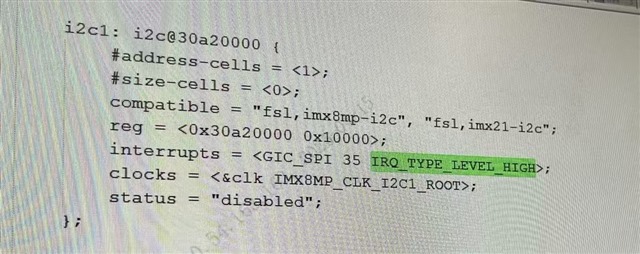
On the other hand, the I2C bindings documentation claims that interrupts are a required property of the devicetree node: Documentation/devicetree/bindings/i2c/ti,omap4-i2c.yaml
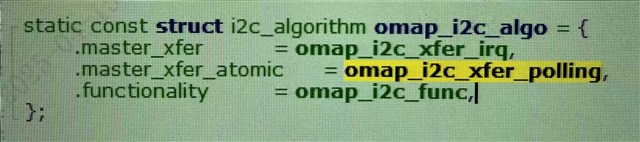
The i2c-omap.c driver itself definitely has a call for doing polling, as you identified.
The i2c-omap driver is a low-level driver to interact with the I2C peripheral, and the customer will need to use a higher-level driver to actually interact with their I2C peripheral. My expectation is that the calls in the higher-level driver will dictate whether polling or interrupts are used - even if interrupts are enabled for I2C, if the higher level driver makes a call that translates into master_xfer_atomic, then I would expect the polling method to be used.