This thread has been locked.

If you have a related question, please click the "Ask a related question" button in the top right corner. The newly created question will be automatically linked to this question.

AM3354: Junction Temperature (Tj) Calculation and Verification for ZCZ Package

Part Number: AM3354

Hi TI Team,

We have a customer who is evaluating the thermal performance of the AM3354BZCZ100 and would like to verify their Junction Temperature ($T_j$) calculation.

Below are the measurement data and the calculation formula they used based on the AM335x datasheet (Table 7-1. Thermal Resistance Characteristics):

  • Measured Power Dissipation ($P$): 1.07 W

  • Measured Case Top Temperature ($T_c$ / $T_t$): 89°C (measured using a Type J thermocouple attached to the center top of the package)

  • Customer's Calculation Formula:

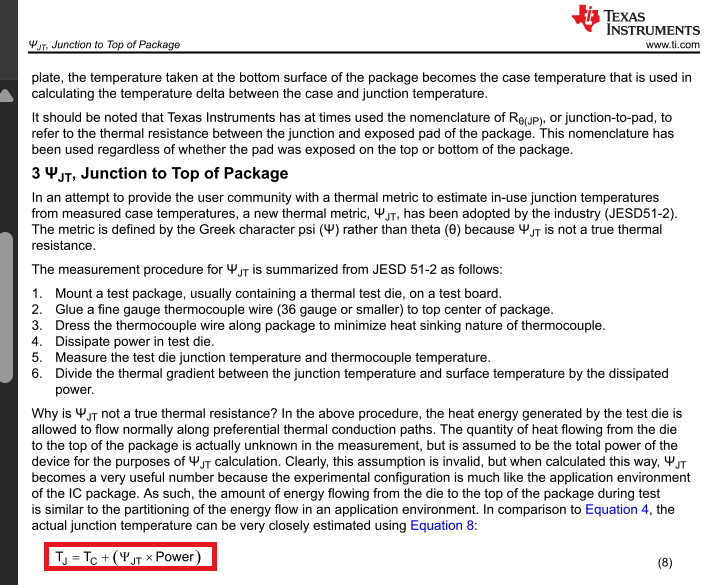
    $$T_j = 89 + (1.07 \times 0.3) = 89.321^\circ\text{C}$$

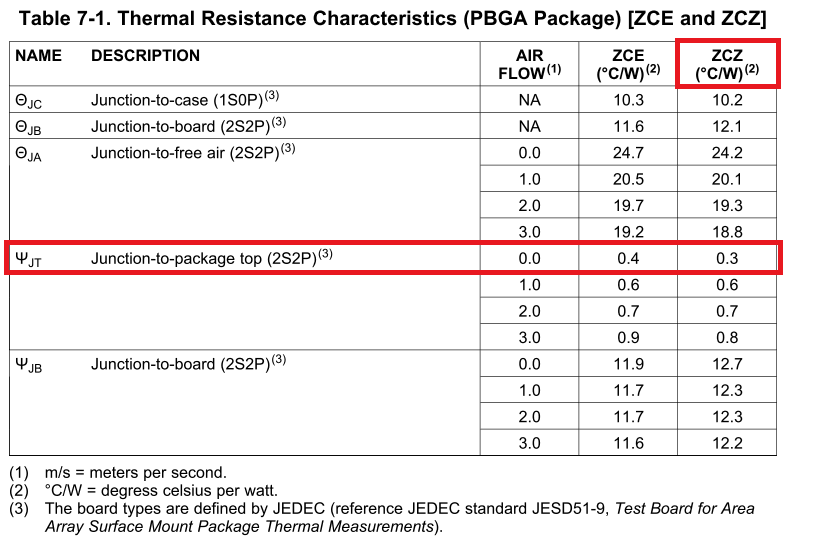
    (Note: It appears they are using a junction-to-top characterization parameter, $\Psi_{JT}$, of 0.3°C/W from Table 7-1).

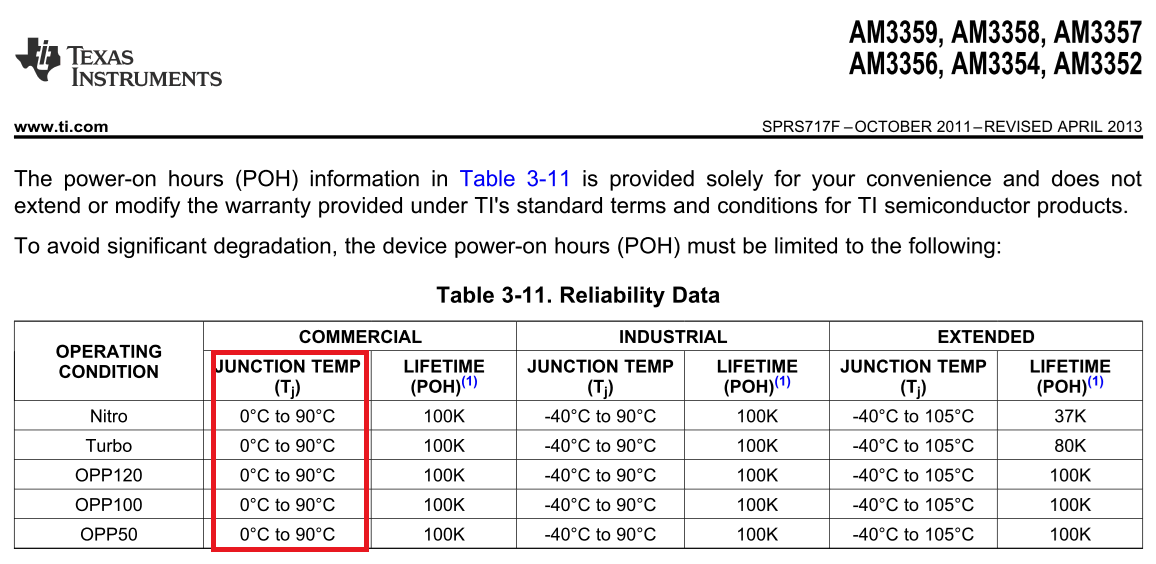
The calculated $T_j$ is 89.321°C, which they believe falls within the operating specification of the AM3354BZCZ100.

Could you please help us confirm the following?

  1. Is this calculation methodology and the resulting $T_j$ of 89.321°C correct?

  2. Is the parameter used (0.3°C/W) indeed the correct $\Psi_{JT}$ (Junction-to-Top Characterization Parameter) for the ZCZ package of the AM3354?

 

aten1.gif


aten2.gif


aten3.gif

aten4.gif

Thank you for your support.

Best regards,


Daniel

  • Hello Daniel,

    Thank you for the query.

    Let me review the inputs.

    Regards,

    Sreenivasa

  • Hello Daniel,

    Please refer below inputs from the customer:

    The values provided in the datasheet are based on 2S2P PCB as described the JESD51-9 JEDEC standard, referenced in the table note below the Thermal Resistance Characteristic table.  The thermal resistance of their specific implementation may vary from the values defined in the datasheet.  It appears they are going to be close to the limit based on their calculated value.  Therefore, they should consider performing a thermal analysis of their specific implementation taking into account the entire operating range of their system.  For example, a slight increase in supply voltage can result in a significant increase in power dissipation.

    Regards,

    Sreenivasa