This thread has been locked.

If you have a related question, please click the "Ask a related question" button in the top right corner. The newly created question will be automatically linked to this question.

OMAP L138 GPIO interrupts in the same bank

Other Parts Discussed in Thread: OMAPL138

Hi,

OMAP L138 DSP is receiving GPIO interrupts in the same bank (GPIO Bank 4) on different GPIO pins, at the same instant.On receiving GPIO bank 4 interrupt, I read INTSTAT45 register and found that only one of the GPIO pins has raised the interrupt.Is it that other interrupts have been missed?

I have searched for similar posts in forum but didnt find a solution.

Thanks

Sreejaya

  • Hi,

    I read INTSTAT45 register and found that only one of the GPIO pins has raised the interrupt.

    How did you read INTSTAT45 reg ?

    Are you reading the INTSTAT45 reg. value through emulator or prints the INTSTAT45 value through DSP code?

    Have you are considering the BINTEN reg if you wish to access the GPIO interrupt events,

    Refer the OMAPL138 TRM chapter 21.2.10.2 & 21.3.2

    Also Refer the chapter 3.2.2.1 of OMAPL138 TRM for DSP interrupt map for GPIO banks,

    Say e.g,

    54(event)       --->        GPIO_B4INT (interrupt name)   ---> GPIO Bank 4 Interrupt (interrupt Source)


  • Hi

    I have configured GP4[2],GP4[3],GP4[4] and GP4[7] as interrupts triggered on rising edge. Signals on these pins were probed and found that rising edge occurs at the same instant.

    DSP receives the GPIO bank 4 interrupt and enters interrupt service routine.Inside ISR, INTSTAT45 is checked for pending interrupts.It is found that only GP4[4] bit is set in INTSTAT45 register.Is it that other interrupts are missed?

    BINTEN register value is 0x000001FF. ISR is as given below.


    if(GPIO_BANK45->uint32_INTSTAT & GPIO_INTSTAT_GP4_4)// GP4[4])
    {
    SETBIT(GPIO_BANK45->uint32_INTSTAT , GPIO_INTSTAT_GP4_4);
    /* handling function*/
    }


    if(GPIO_BANK45->uint32_INTSTAT & GPIO_INTSTAT_GP4_7)// GP4[7])
    {
    SETBIT(GPIO_BANK45->uint32_INTSTAT , GPIO_INTSTAT_GP4_7);
    /* handling function*/
    }


    if(GPIO_BANK45->uint32_INTSTAT & GPIO_INTSTAT_GP4_3)// GP4[3])
    {
    SETBIT(GPIO_BANK45->uint32_INTSTAT , GPIO_INTSTAT_GP4_3);
    /* handling function*/
    }


    if(GPIO_BANK45->uint32_INTSTAT & GPIO_INTSTAT_GP4_2)// GP4[2])
    {
    SETBIT(GPIO_BANK45->uint32_INTSTAT , GPIO_INTSTAT_GP4_2);
    /* handling function*/
    }


    //clearing DSP interrupt pending status
    ICR = (1 << guchar_GPIOBank4IntrIndx);
    }

    Regards

    Sreejaya

  • Hi,

    What kind of code are you using?

    Starterware or CSL code or own etc.,?

    BINTEN register value is 0x000001FF. ISR is as given below.

    Good configuration.

    DSP receives the GPIO bank 4 interrupt and enters interrupt service routine.Inside ISR, INTSTAT45 is checked for pending interrupts.It is found that only GP4[4] bit is set in INTSTAT45 register.Is it that other interrupts are missed?

    1) Try to handle only one GPIO4[2] or GPIO4[3] or GPIO4[4] or GPIO4[7]

    2) Try to change the GPIO interrupt handler order in ISR;

    GP4[4] -> GP4[7] -> GP[3] -> GP[2]

    TO

    GP4[2] -> GP4[3] -> GP[4] -> GP[7]


    if(GPIO_BANK45->uint32_INTSTAT & GPIO_INTSTAT_GP4_2)// GP4[2])
    {
    SETBIT(GPIO_BANK45->uint32_INTSTAT , GPIO_INTSTAT_GP4_2);
    /* handling function*/
    }


    if(GPIO_BANK45->uint32_INTSTAT & GPIO_INTSTAT_GP4_3)// GP4[3])
    {
    SETBIT(GPIO_BANK45->uint32_INTSTAT , GPIO_INTSTAT_GP4_3);
    /* handling function*/
    }


    if(GPIO_BANK45->uint32_INTSTAT & GPIO_INTSTAT_GP4_4)// GP4[4])
    {
    SETBIT(GPIO_BANK45->uint32_INTSTAT , GPIO_INTSTAT_GP4_4);
    /* handling function*/
    }


    if(GPIO_BANK45->uint32_INTSTAT & GPIO_INTSTAT_GP4_7)// GP4[7])
    {
    SETBIT(GPIO_BANK45->uint32_INTSTAT , GPIO_INTSTAT_GP4_7);
    /* handling function*/
    }


    //clearing DSP interrupt pending status
    ICR = (1 << guchar_GPIOBank4IntrIndx);
    }

    After changing this order, Whether the GPIO interrupt is occurring only for GP4[2] ?

  • Hi Sreejaya,

    Sreejaya says said:
    OMAP L138 DSP is receiving GPIO interrupts in the same bank (GPIO Bank 4) on different GPIO pins, at the same instant.

    1. I would like to understand about your GPIO configuration on the GPIO pins to generate interrupts.

    2. After realizing interrupt on just one pin of bank 4,  Check whether by mistake you are resetting/clearing the register before checking other interrupts on pins.

    GPIO Configuration for Bank[0] and GPIO0_7_PIN to generate interrupt follows. This code snippet is given in MCSDK GPIO example project. If needed I can provide you the link to download the package.

    gpioPowerOn();  

    /* Configure GPIO0_7 (GPIO0_7_PIN) as an output                           */

     CSL_FINS(gpioRegs->BANK[0].DIR,GPIO_DIR_DIR7,0);   

    /* set the GIPO0_7 value to 0                                             */

        CSL_FINS(gpioRegs->BANK[0].OUT_DATA,GPIO_OUT_DATA_OUT7,0);   

    /* Enable GPIO Bank interrupt for bank 0                                  */

        CSL_FINST(gpioRegs->BINTEN,GPIO_BINTEN_EN0,ENABLE);   

    /* Configure GPIO(GPIO0_7_PIN) to generate interrupt on rising edge       */

        CSL_FINS(gpioRegs->BANK[0].SET_RIS_TRIG, GPIO_SET_RIS_TRIG_SETRIS7,            CSL_GPIO_SET_RIS_TRIG_SETRIS_ENABLE);   

    /* map GPIO0 event to cpu int4                                            */

        CSL_FINS(intcRegs->INTMUX1, DSPINTC_INTMUX1_INTSEL4,            CSL_INTC_EVENTID_GPIO_BNK0_INT);   

    /* set ISTP to point to the vector table address                          */

        ISTP = (unsigned int)_intcVectorTable;  

    /* clear all interrupts, bits 4 thru 15                                   */

        ICR = 0xFFF0;   

    /* enable the bits for non maskable interrupt and CPUINT4                 */

        IER = 0x12;   

    /* enable interrupts, set GIE bit                                         */

        _enable_interrupts();


    Regards,

    Shankari

    -------------------------------------------------------------------------------------------------------

    Please click the Verify Answer button on this post if it answers your question.
    -------------------------------------------------------------------------------------------------------- 

  • HI Sreejaya,

    Sreejaya says said:
    I have configured GP4[2],GP4[3],GP4[4] and GP4[7] as interrupts triggered on rising edge. Signals on these pins were probed and found that rising edge occurs at the same instant.DSP receives the GPIO bank 4 interrupt and enters interrupt service routine.Inside ISR, INTSTAT45 is checked for pending interrupts.It is found that only GP4[4] bit is set in INTSTAT45 register.Is it that other interrupts are missed?

    If configurations are correct, then the interrupts will not get missed.

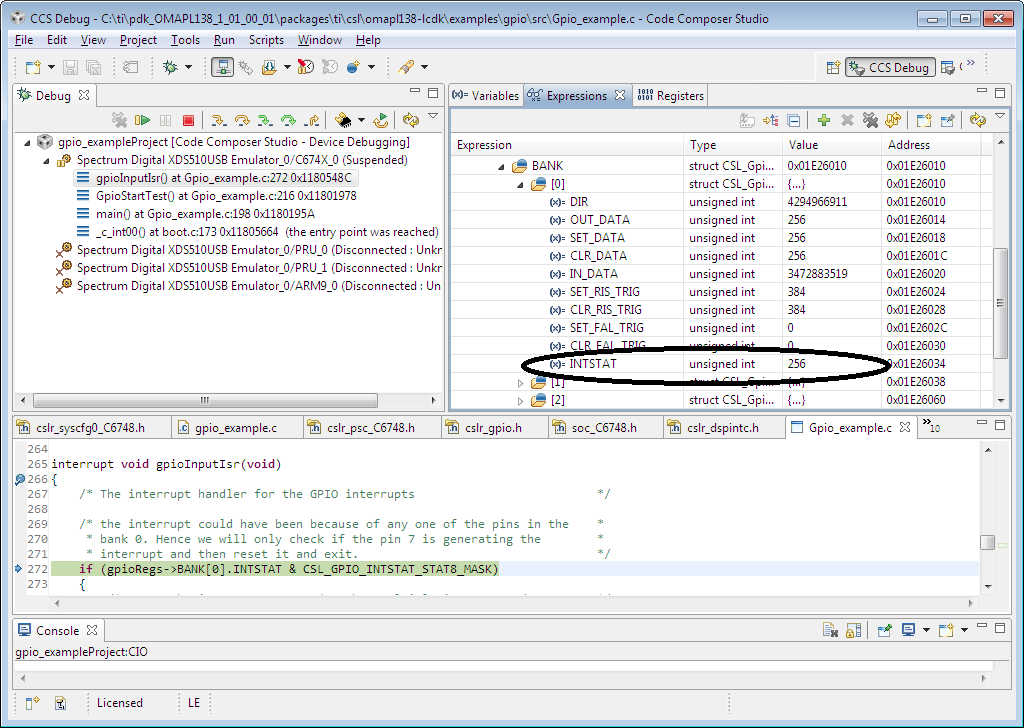
    I have configured GPIO0_7 and GPIO0_8 pins of GPIO Bank [0] to generate interrupts simultaneously on both the pins and able to read the correct values at "INTSTAT01" register, Have a look at the attached screenshot below.


    The modified sample code is attached. You can refer to it and change the configurations for other GPIO Banks and pins.

    /*
     * Gpio_example.c
     *
     * This file contains the test / demo code to demonstrate basic GPIO operations 
     * using the Regsiter CSL macros.
     *
     * Copyright (C) 2009 Texas Instruments Incorporated - http://www.ti.com/
     *
     *
     *  Redistribution and use in source and binary forms, with or without
     *  modification, are permitted provided that the following conditions
     *  are met:
     *
     *    Redistributions of source code must retain the above copyright
     *    notice, this list of conditions and the following disclaimer.
     *
     *    Redistributions in binary form must reproduce the above copyright
     *    notice, this list of conditions and the following disclaimer in the
     *    documentation and/or other materials provided with the
     *    distribution.
     *
     *    Neither the name of Texas Instruments Incorporated nor the names of
     *    its contributors may be used to endorse or promote products derived
     *    from this software without specific prior written permission.
     *
     *  THIS SOFTWARE IS PROVIDED BY THE COPYRIGHT HOLDERS AND CONTRIBUTORS
     *  "AS IS" AND ANY EXPRESS OR IMPLIED WARRANTIES, INCLUDING, BUT NOT
     *  LIMITED TO, THE IMPLIED WARRANTIES OF MERCHANTABILITY AND FITNESS FOR
     *  A PARTICULAR PURPOSE ARE DISCLAIMED. IN NO EVENT SHALL THE COPYRIGHT
     *  OWNER OR CONTRIBUTORS BE LIABLE FOR ANY DIRECT, INDIRECT, INCIDENTAL,
     *  SPECIAL, EXEMPLARY, OR CONSEQUENTIAL DAMAGES (INCLUDING, BUT NOT
     *  LIMITED TO, PROCUREMENT OF SUBSTITUTE GOODS OR SERVICES; LOSS OF USE,
     *  DATA, OR PROFITS; OR BUSINESS INTERRUPTION) HOWEVER CAUSED AND ON ANY
     *  THEORY OF LIABILITY, WHETHER IN CONTRACT, STRICT LIABILITY, OR TORT
     *  (INCLUDING NEGLIGENCE OR OTHERWISE) ARISING IN ANY WAY OUT OF THE USE
     *  OF THIS SOFTWARE, EVEN IF ADVISED OF THE POSSIBILITY OF SUCH DAMAGE.
     *
    */
    
    /** ============================================================================
     *   @brief A simple example to demonstrate CSL GPIO register layer usage
         and interrupts in a BIOS application.
     *
     *   @file  Gpio_example.c
     *
     *   <b> Example Description </b>
     *   @verbatim
     *   This example demonstrates the use of GPIO module. The sample does
     *   this by configuring the GPIO pin GPIO0_7(configured as output pin) as
     *   an interrupt pin. Then it sets the status of the pin to high to
     *   trigger an interrupt which is then serviced by an ISR function.
     *   @endverbatim
     *
     *
     *   <b> Procedure to run the example </b>
     *   @verbatim
     *   1. Open Gpio_example.pjt in CCS
     *   2. Build the project
     *   3. Connect to target and load the gpio_example.out
     *   4. Run the program
     *   5. The messages will be printed on to the console as the interrupts are
     *      generated and ISR function is called.
     *   6. on successful completion "GPIO sample application completed" is
     *      logged to the console.
     *   @endverbatim
     *
     * ============================================================================
     **/
    
    /*============================================================================*/
    /*                              INLCUDE FILES                                 */
    /*============================================================================*/
    
    #include <stdio.h>
    #include <c6x.h>
    #include <ti/csl/cslr_dspintc.h>
    #include <ti/csl/soc_C6748.h>
    #include <ti/csl/cslr_gpio.h>
    #include <ti/csl/cslr_syscfg0_C6748.h>
    #include <ti/csl/cslr_psc_C6748.h>
    
    /*============================================================================*/
    /*                        EXTERNAL FUNCTION PROTOTYPES                        */
    /*============================================================================*/
    
    extern void _intcVectorTable(void);
    
    /*============================================================================*/
    /*                         LOCAL FUNCTION PROTOTYPES                          */
    /*============================================================================*/
    
    static void gpioPowerOn(void);
    static void GpioStartTest(void);
    static void delay(Uint32 count);
    
    volatile Bool intStatus = 0;
    static Uint8 count    = 0;
    
    
    /*============================================================================*/
    /*                             GLOBAL VARIABLES                               */
    /*============================================================================*/
    
    /* sys config registers overlay                                               */
    CSL_SyscfgRegsOvly   sysRegs  = (CSL_SyscfgRegsOvly)(CSL_SYSCFG_0_REGS);
    /* Psc register overlay                                                       */
    CSL_PscRegsOvly      psc1Regs = (CSL_PscRegsOvly)(CSL_PSC_1_REGS);
    /* Gpio register overlay                                                      */
    CSL_GpioRegsOvly     gpioRegs = (CSL_GpioRegsOvly)(CSL_GPIO_0_REGS);
    /* Interrupt Controller Register Overlay                                      */
    CSL_DspintcRegsOvly intcRegs = (CSL_DspintcRegsOvly)CSL_INTC_0_REGS;
    /*============================================================================*/
    /*                             MACRO DEFINITIONS                              */
    /*============================================================================*/
    
    
    #define INT_GENERATED_FALSE 0x00
    #define INT_GENERATED_TRUE  0x01
    
    /*============================================================================*/
    /*                          FUNCTION DEFINITIONS                              */
    /*============================================================================*/
    
    void main (void)
    {
    
    	/* This function will configure an GPIO pin as an interrupt pin           */
    
        /* Key to be written to enable the pin mux registers for write            */
        sysRegs->KICK0R = 0x83e70b13;
        sysRegs->KICK1R = 0x95A4F1E0;
    
        /* enable the pinmux for the GPIO bank 0 pin 7                            */
        sysRegs->PINMUX1 = ((CSL_SYSCFG_PINMUX1_PINMUX1_3_0_GPIO0_7)
                            << (CSL_SYSCFG_PINMUX1_PINMUX1_3_0_SHIFT));
        //s
        /* enable the pinmux for the GPIO bank 0 pin 8                            */
            sysRegs->PINMUX0 = ((CSL_SYSCFG_PINMUX0_PINMUX0_31_28_GPIO0_8)
                                << (CSL_SYSCFG_PINMUX0_PINMUX0_31_28_SHIFT));
    
        /* lock the pinmux registers                                              */
        sysRegs->KICK0R = 0x00000000;
        sysRegs->KICK1R = 0x00000000;
    
        /* first enable the GPIO in the PSC                                       */
        gpioPowerOn();
    
        /* Configure GPIO0_7 (GPIO0_7_PIN) as an output                           */
        CSL_FINS(gpioRegs->BANK[0].DIR,GPIO_DIR_DIR7,0);
    
        //s
        /* Configure GPIO0_8 (GPIO0_8_PIN) as an output                           */
        CSL_FINS(gpioRegs->BANK[0].DIR,GPIO_DIR_DIR8,0);
    
        /* set the GIPO0_7 value to 0                                             */
        CSL_FINS(gpioRegs->BANK[0].OUT_DATA,GPIO_OUT_DATA_OUT7,0);
    
        //s
        /* set the GIPO0_8 value to 0                                             */
        CSL_FINS(gpioRegs->BANK[0].OUT_DATA,GPIO_OUT_DATA_OUT8,0);
    
        /* Enable GPIO Bank interrupt for bank 0                                  */
        CSL_FINST(gpioRegs->BINTEN,GPIO_BINTEN_EN0,ENABLE);
    
        /* Configure GPIO(GPIO0_7_PIN) to generate interrupt on rising edge       */
        CSL_FINS(gpioRegs->BANK[0].SET_RIS_TRIG,
                 GPIO_SET_RIS_TRIG_SETRIS7,
                 CSL_GPIO_SET_RIS_TRIG_SETRIS_ENABLE);
        //s
        /* Configure GPIO(GPIO0_8_PIN) to generate interrupt on rising edge       */
            CSL_FINS(gpioRegs->BANK[0].SET_RIS_TRIG,
                     GPIO_SET_RIS_TRIG_SETRIS8,
                     CSL_GPIO_SET_RIS_TRIG_SETRIS_ENABLE);
    
        /* map GPIO0 event to cpu int4                                            */
        CSL_FINS(intcRegs->INTMUX1,
                 DSPINTC_INTMUX1_INTSEL4,
                 CSL_INTC_EVENTID_GPIO_BNK0_INT);
    
        /* set ISTP to point to the vector table address                          */
        ISTP = (unsigned int)_intcVectorTable;
    
        /* clear all interrupts, bits 4 thru 15                                   */
        ICR = 0xFFF0;
    
        /* enable the bits for non maskable interrupt and CPUINT4                 */
        IER = 0x12;
    
        /* enable interrupts, set GIE bit                                         */
        _enable_interrupts();
    
        /* set interrupt generated status to false                                */
        intStatus = INT_GENERATED_FALSE;
    
        GpioStartTest();
    
        
    }
    
    /*
     * \brief    Function to test the GPIO functionality.
     *
     *           Will generate a GPIO interrupt by writing to the GPIO outdata
     *           register
     *
     * \param    None
     * \return   None
     *
     */
    
    static void GpioStartTest(void)
    {
        printf("Starting the GPIO testing\n");
        /* This function will set a GPIO pin to 1 (which is configured earlier) so*
         * an interrupt handler registered previously for that event is invoked   */
        while (count <= 5)
        {
            /* set the Bank 0 pin 7 to 1 to generate an interrupt                 */
            //CSL_FINS(gpioRegs->BANK[0].OUT_DATA,GPIO_OUT_DATA_OUT7,1);//e
        	CSL_FINS(gpioRegs->BANK[0].OUT_DATA,GPIO_OUT_DATA_OUT8,1);
    
            while (INT_GENERATED_TRUE != intStatus)
            {
                delay(1000);
            }
    
            printf("Interrupt generated by Gpio module, Int count %d \n",count);
            intStatus = INT_GENERATED_FALSE;
            count++;
        }
        printf("GPIO sample application completed\n");
    }
    
    /*
     * \brief    interrupt Handler routine for the GPIO interrupt
     *
     * \param    None
     * \return   None
     *
     */
    #if 0
    interrupt void gpioInputIsr(void)
    {
        /* The interrupt handler for the GPIO interrupts                          */
    
        /* the interrupt could have been because of any one of the pins in the    *
         * bank 0. Hence we will only check if the pin 7 is generating the        *
         * interrupt and then reset it and exit.                                  */
        if (gpioRegs->BANK[0].INTSTAT & CSL_GPIO_INTSTAT_STAT7_MASK)
        {
            /* reset the interrupt source (so that multiple interrupts dont ccur  */
            CSL_FINS(gpioRegs->BANK[0].OUT_DATA,GPIO_OUT_DATA_OUT7,0);
    
            /* reset the interrupt status register                                */
            CSL_FINS(gpioRegs->BANK[0].INTSTAT,GPIO_INTSTAT_STAT7,0);
    
            /* cannot print here hence set the status variable so that that task  *
             * can print the message                                              */
            intStatus = INT_GENERATED_TRUE;
        }
    }
    #endif
    
    
    interrupt void gpioInputIsr(void)
    {
        /* The interrupt handler for the GPIO interrupts                          */
    
        /* the interrupt could have been because of any one of the pins in the    *
         * bank 0. Hence we will only check if the pin 7 is generating the        *
         * interrupt and then reset it and exit.                                  */
        if (gpioRegs->BANK[0].INTSTAT & CSL_GPIO_INTSTAT_STAT8_MASK)
        {
            /* reset the interrupt source (so that multiple interrupts dont ccur  */
            CSL_FINS(gpioRegs->BANK[0].OUT_DATA,GPIO_OUT_DATA_OUT8,0);
    
            /* reset the interrupt status register                                */
            CSL_FINS(gpioRegs->BANK[0].INTSTAT,GPIO_INTSTAT_STAT8,0);
    
            /* cannot print here hence set the status variable so that that task  *
             * can print the message                                              */
            intStatus = INT_GENERATED_TRUE;
        }
        if (gpioRegs->BANK[0].INTSTAT & CSL_GPIO_INTSTAT_STAT7_MASK)
        {
            /* reset the interrupt source (so that multiple interrupts dont ccur  */
            CSL_FINS(gpioRegs->BANK[0].OUT_DATA,GPIO_OUT_DATA_OUT7,0);
    
            /* reset the interrupt status register                                */
            CSL_FINS(gpioRegs->BANK[0].INTSTAT,GPIO_INTSTAT_STAT7,0);
    
            /* cannot print here hence set the status variable so that that task  *
             * can print the message                                              */
            intStatus = INT_GENERATED_TRUE;
        }
    }
    
    
    /*
     * \brief    Function to power on the GPIO module in the power sleep controller.
     *
     * \param    None
     * \return   None
     *
     *  Note: This function causes the program to abort in case it is unable to   *
     *        enable the GPIO module.
     */
    static void gpioPowerOn(void)
    {
        volatile Uint32 pscTimeoutCount = 10240u;
        Uint32          temp            = 0;
    
        /* we will now power on the GPIO module in the PSC.                       *
         * Configure the GPIO Module to Enable state                              */
        psc1Regs->MDCTL[CSL_PSC_GPIO] = ((psc1Regs->MDCTL[CSL_PSC_GPIO]
                                            & 0xFFFFFFE0)
                                         | CSL_PSC_MDSTAT_STATE_ENABLE);
    
        /* Kick start the Enable Command                                          */
        temp = psc1Regs->PTCMD;
        temp = ((temp & CSL_PSC_PTCMD_GO0_MASK)
                | (CSL_PSC_PTCMD_GO0_SET << CSL_PSC_PTCMD_GO0_SHIFT));
    
        psc1Regs->PTCMD |= temp;
    
        /* Wait for the power state transition to occur                           */
        while (((psc1Regs->PTSTAT & (CSL_PSC_PTSTAT_GOSTAT0_IN_TRANSITION)) != 0)
            && (pscTimeoutCount>0))
        {
            pscTimeoutCount--;
        }
    
        /* Check if PSC state transition timed out                                */
        if (0 == pscTimeoutCount)
        {
            printf("GPIO PSC transition to ON state timed out\n");
        }
        else
        {
            printf("Gpio enabled in PSC\n");
        }
    }
    
    
    /*
     * \brief    Function to introduce a delay in to the program.
     *
     * \param    count [IN]  delay count to wait
     * \return   None
     *
     */
    
    static void delay(Uint32 count)
    {
        volatile Uint32 tempCount = 0;
    
        for (tempCount = 0; tempCount < count; tempCount++)
        {
            /* dummy loop to wait for some time  */
        }
    }
    
    /*============================================================================*/
    /*                               END OF FILE                                  */
    /*============================================================================*/
    

    Regards,

    Shankari

    -------------------------------------------------------------------------------------------------------

    Please click the Verify Answer button on this post if it answers your question.
    --------------------------------------------------------------------------------------------------------

  • Thank you for all the inputs.

    I rearranged the order of clearing interrupts inside ISR and found that only first GPIO is set (what ever is the order).So I changed the ISR in the following manner.


    if(GPIO_BANK45->uint32_INTSTAT & GPIO_INTSTAT_GP4_4)// GP4[4])
    {
    GPIO_BANK45->uint32_INTSTAT  =  GPIO_INTSTAT_GP4_4;
    /* handling function*/
    }


    if(GPIO_BANK45->uint32_INTSTAT & GPIO_INTSTAT_GP4_7)// GP4[7])
    {
    GPIO_BANK45->uint32_INTSTAT  =  GPIO_INTSTAT_GP4_7;
    /* handling function*/
    }


    if(GPIO_BANK45->uint32_INTSTAT & GPIO_INTSTAT_GP4_3)// GP4[3])
    {
    GPIO_BANK45->uint32_INTSTAT  =  GPIO_INTSTAT_GP4_3;
    /* handling function*/
    }


    if(GPIO_BANK45->uint32_INTSTAT & GPIO_INTSTAT_GP4_2)// GP4[2])
    {
    GPIO_BANK45->uint32_INTSTAT  =  GPIO_INTSTAT_GP4_2;
    /* handling function*/
    }


    //clearing DSP interrupt pending status
    ICR = (1 << guchar_GPIOBank4IntrIndx);
    }

    On using SETBIT in the previous ISR,other interrupts were also cleared.Now I am receiving all interrupts.

    Thanks

    Sreejaya