This thread has been locked.

If you have a related question, please click the "Ask a related question" button in the top right corner. The newly created question will be automatically linked to this question.

How to load and run the code ?

Other Parts Discussed in Thread: OMAPL138, SYSBIOS

after excluding the C6748.cmd file the MCSDK McASP example loaded.

Now to work out how to upload it to the LCDK board and run it from CSS?

[ EDIT ]

ok so I am following this guide,

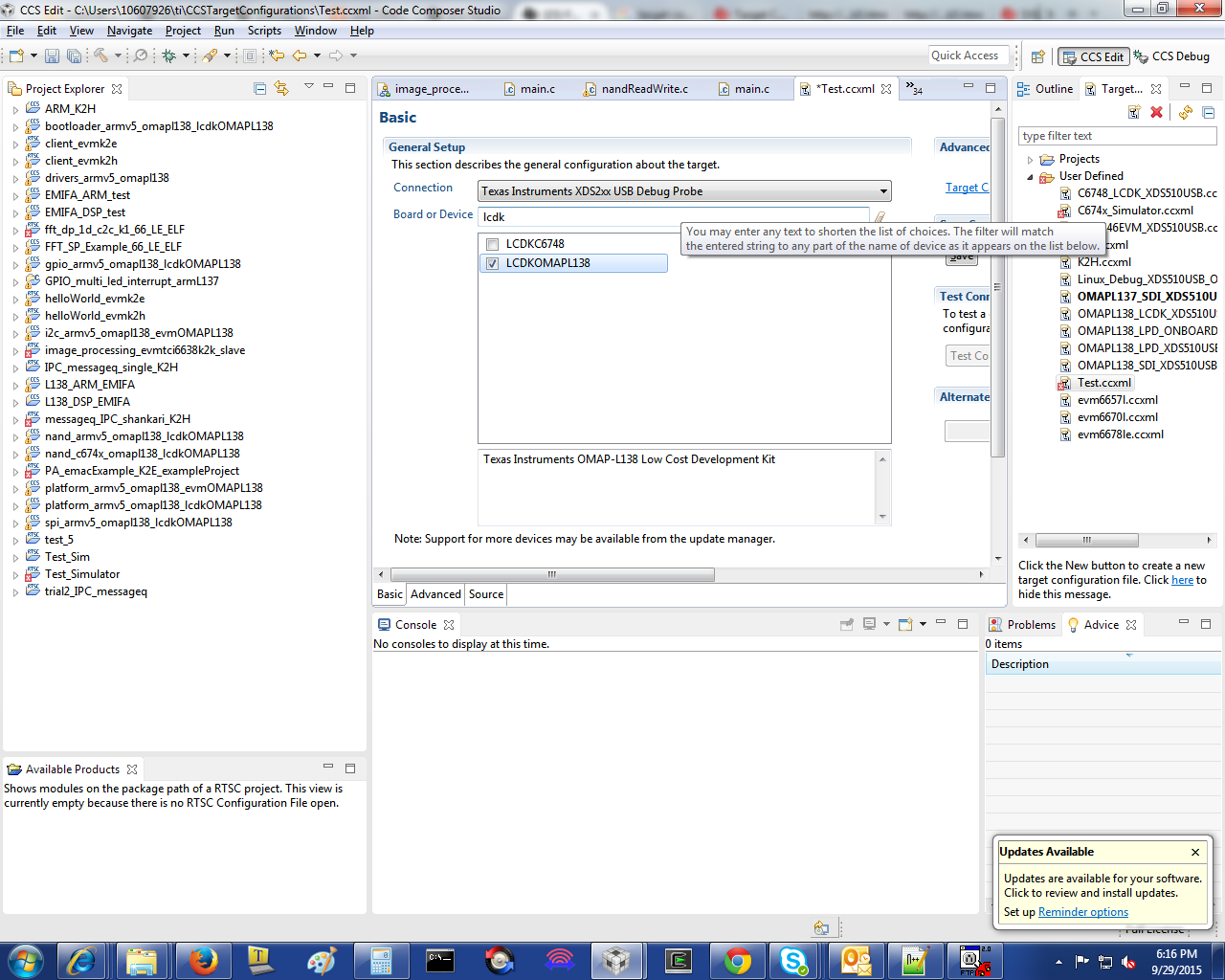
I am now trying to add the XDS200 option and select the LCDK OMAPL138 device to mcsdk.ccxml file but its NOT in the list of devices.

the dialog box hints that I can download extra devices ? but how ? download what exactly ??

I don't get a connection with the XD200 jtag , only this error;

[Start]

Execute the command:

%ccs_base%/common/uscif/dbgjtag -f %boarddatafile% -rv -o -S integrity

[Result]


-----[Print the board config pathname(s)]------------------------------------

C:\Users\benbiles\AppData\Local\.TI\693494126\
    0\0\BrdDat\testBoard.dat

-----[Print the reset-command software log-file]-----------------------------

This utility has selected a 560/2xx-class product.
This utility will load the program 'xds2xxu.out'.
E_RPCENV_IO_ERROR(-6) No connection: DTC_IO_Open::dtc_io
Failed to open i/o connection (xds2xxu:0)

An error occurred while soft opening the controller.

-----[An error has occurred and this utility has aborted]--------------------

This error is generated by TI's USCIF driver or utilities.

The value is '-250' (0xffffff06).
The title is 'SC_ERR_ECOM_EMUNAME'.

The explanation is:
An attempt to access the debug probe via USCIF ECOM has failed.

[End]

Screen grab of no LCDK-L138 in list.


sorry for all these questions. It seams the non MCSDK startware boots from flash without an OS but I am not clear how the MCSDK is working.

thanks,

BEN

  • Hi Ben,

    Now to work out how to upload it to the LCDK board and run it from CSS?

    For this, you have to create target configuration for your board and emulator.

    Which CCS version are you using ?

    I'm able to create target configuration for XDS2xx emulator with OMAPL138 LCDK board on CCSv5.5 and CCSv6.1 (latest CCS IDEs).

    Did you install the all emulation drivers and Single core supported devices when you install CCS ?

    sorry for all these questions. It seams the non MCSDK startware boots from flash without an OS but I am not clear how the MCSDK is working.

    Starterware is bare metal code (non-OS) and it has examples for ARM and as well as for DSP, need to use starterware bootloader to run the ARM and DSP application.

    Please refer to the following TI wiki.

    If  you are using MCSDK PDK examples then you could see the examples only for DSP which uses SYSBIOS (RTOS).

    C:\ti\pdk_OMAPL138_1_01_00_02\packages\ti\csl\exampleProjects

    C:\ti\pdk_OMAPL138_1_01_00_02\packages\ti\drv\exampleProjects

    You can choose either PDK example or starterware depends on your project requirement.

    Please revert to me if any clarifications required.

  • Hi,

    I downloaded CCS 5.5 again and installed everything !! this time it worked. I must have installed the wrong CPU support in the first place. I'm now able to select the lcdkomapL138 and create the mcsdk.ccxml file with the correct profile. I'm not convinced the XDS200 is connecting correctly since i still have error on test connection. I will post again under a new post 'XDS200' if that's the case.

    I'm not sure if I should be using the MCSDK or coding bare metal. I understand you can use IPC with MCSDK so I'm assuming you can use this to send jobs to the DSP from linux running on the ARM? well I'm really not clear as to how I use Linux and MCSDK or if you can at all ? in other words if I choose to use MCSDK what do you do with the ARM CPU ? can I run Linux and offload IO McASP audio mixing work to DSP and use Linux to say control a touch screen and pass GUI controls to the DSP with MCSDK ICP ?

    I'll read through these documents again and try and get a better picture of what is possible.

    essentially I am looking to achieve I2C control of multichannel ADC's & DAC's and IO over McASP TDM multichannel audio for mixing / processing . ( it would be a bonus to get Linux to control a GUI on the arm )

    I looked at the GUI composer in CCS though so maybe that could work instead !

    thanks for your help, any ideas of which way i should turn would be great. I did read that the starterware is unsupported and everything is going in the direction of MCSDK so it would make more sense to take this route if i need to upgrade to a more powerful DSP in the future?

    ben
  • Hi Ben,

    I'm not convinced the XDS200 is connecting correctly since i still have error on test connection. I will post again under a new post 'XDS200' if that's the case.

    Please make sure that you have installed the emulation drivers, check the device manager.


    I'm not sure if I should be using the MCSDK or coding bare metal. I understand you can use IPC with MCSDK so I'm assuming you can use this to send jobs to the DSP from linux running on the ARM? well I'm really not clear as to how I use Linux and MCSDK or if you can at all ? in other words if I choose to use MCSDK what do you do with the ARM CPU ? can I run Linux and offload IO McASP audio mixing work to DSP and use Linux to say control a touch screen and pass GUI controls to the DSP with MCSDK ICP ?

    Yes, you can use Linux with running DSP applications through SYSLINK.

    processors.wiki.ti.com/.../MCSDK_OMAPL138_User_Guide_Chapter_Exploring
    processors.wiki.ti.com/.../SysLink_Overview
    processors.wiki.ti.com/.../Creating_CCS_Project_for_SysLink_samples
    processors.wiki.ti.com/.../SysLink_UserGuide
    processors.wiki.ti.com/.../SysLink_FAQs

    Also you have to be careful about resource conflict.

    processors.wiki.ti.com/.../OMAP-L137_Audio_Drivers_in_the_DSP_+_Linux
  • thanks, especially for the info regarding hardware conflicts !! I should be able to customize ther kernel or 'no load' insmod drivers I suppose..
  • Thanks Ben for your update.