This thread has been locked.

If you have a related question, please click the "Ask a related question" button in the top right corner. The newly created question will be automatically linked to this question.

AM335x vs TM4C129

hi all!....

we are calling Sitara AM335x" as processor, but TM4C129 as microcontroller,

both having CPU, memory, GPIO and peripherals!.......

what is reason behind it?...........

pls clarify!.....

  • Hello Dineshkumar,

    You can call the microcontrollers also microcomputers. They contains all the needed components (CPU, SRAM, FLASH) embedded in one packaging, thus they can operate solely, in general they are with low performance. The Sitara AM335x is a processor which needs additional components (FLASH, MEMORY at least) to function and could be a part of bigger computer system with higher performance.

    Best regards,
    Kemal

  • The integration of flash is the primary distinguishing feature of an MCU (microcontroller). MPUs (microprocessors) need a non-volatile memory to sit along side for booting.

    I'll also point out that the devices you mention are worlds apart with respect to performance. The Tiva device is 120 MHz (150 DMIPS) while the AM335x is 1 GHz (2000 DMIPS).

    Related to the fact that MCUs integrate flash, they often (though not always) lack an external memory interface. This particular Tiva device you mentioned is one of the few devices to include the external memory interface. However, there's still quite a massive difference between the memory interface of the Tiva compared to the AM335x. AM335x supports DDR3 up to 400 MHz (i.e. 800 MHz throughput) while the Tiva is 60 MHz SDRAM (60 MHz throughput). Also, the Cortex A8 has a two-level cache architecture so it can efficiently utilize the external memory. For the Tiva device I would generally recommend using DMA to access the SDRAM.
  • Correct me if I am wrong but to follow on with the previous, wonderful responses, in short:

    • Sitara: OS,  1 GHz, ARM Cortex-A8/A9/A15 Device
      • operating system level computer tasks
    • Tiva: OTM, 120 MHz, ARM Cortex-M4 Device 
      • low-level, on-the-metal tasks

    The overlap in their feature sets and available functions is strong as they are both ARM Cortex, but their provided example code and sdk's are strongly distinct, Sitara does OS (Operating System) and Tiva does OTM (On-The-Metal). They are both approximately the same pricing, in volume (~$5.50 / 1k).

    I gather this after doing my own research, please correct me if I'm wrong! :)

  • I partially agree with your comments. If you want to run "real Linux" then you need to use a Sitara class device (i.e. a CPU core with MMU).

    Tiva and other MCUs aren't necessarily programmed "bare metal". In fact, now days it is most common for customers to use an RTOS. For most MCUs, the available memory tends to be the first big limitation, i.e. you can't keep adding code and drivers indefinitely because there isn't enough memory. Then there are MCUs with an external memory interface. That helps alleviate the memory bottleneck, but next you crash into performance bottlenecks. The Sitara devices have CPUs that are 10x faster as well as memory interfaces that are 10x faster.
  • Well I have just gotten a Tiva Launchpad, and already have a Beaglebone, I'll do some research and be in touch! :)

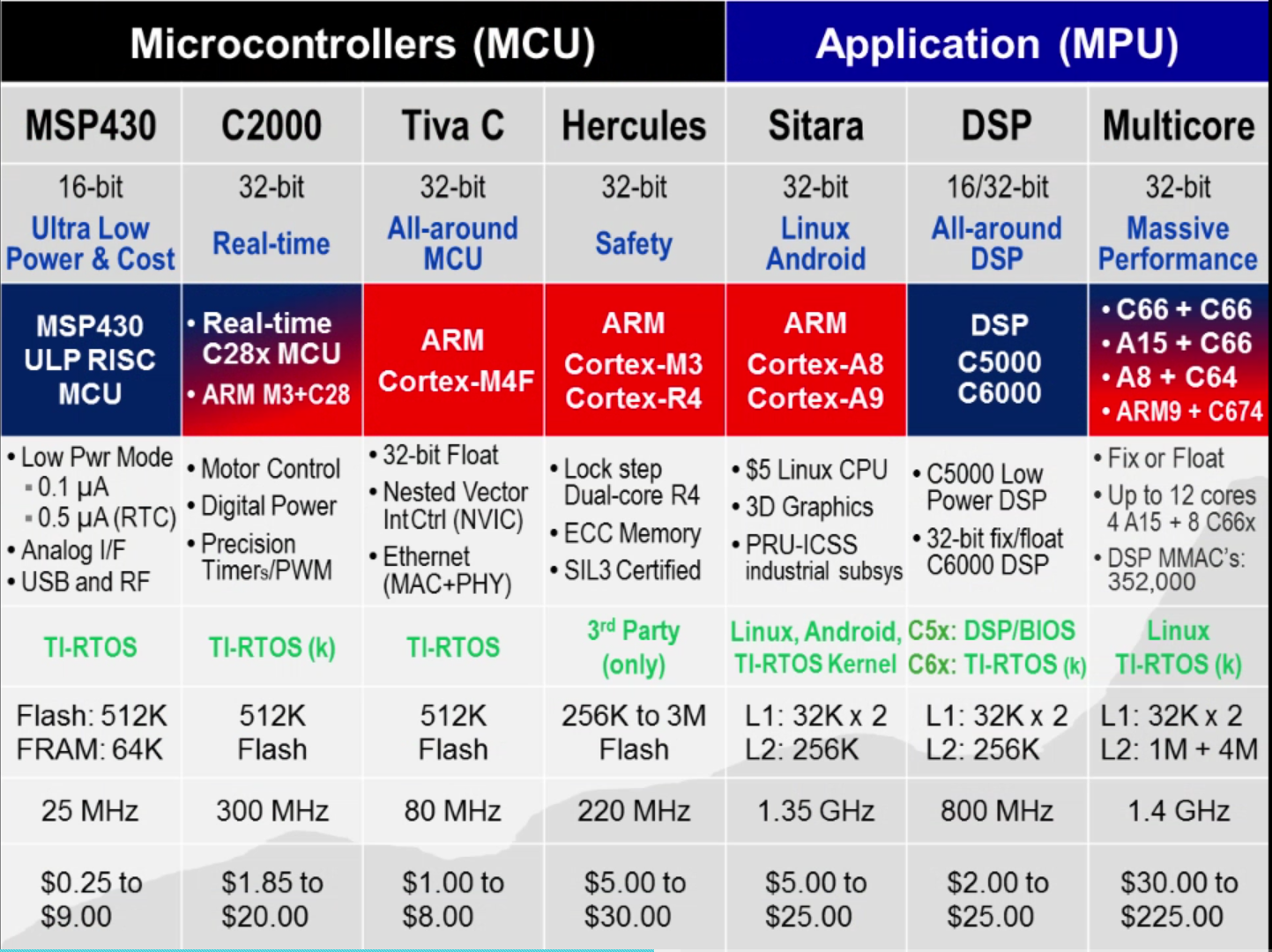
  • This image appears in the Welcome lecture of TI's RTOS workshop series https://training.ti.com/ti-rtos-workshop-series

  • Please note that table above is not updated.....there are Sitara Processors A15 running at 1.5GHz. For updated information please check TI.com