Other Parts Discussed in Thread: 66AK2H12
I will described below for more detail.
This thread has been locked.
If you have a related question, please click the "Ask a related question" button in the top right corner. The newly created question will be automatically linked to this question.
Other Parts Discussed in Thread: 66AK2H12
I will described below for more detail.
H.U.,
All of these IP blocks can be affected by changes in temperature. They are also affected by silicon process variation. Additionally, process, voltage and temperature changes affect the drive impedance of the transmitters and the termination impedance of the receivers. However, this does not indicate that temperature or silicon variation is the root cause of the problem. The 66AK2H12 is designed and verified to operate their interfaces robustly across the rated temperature and voltage ranges. The described problem appears to indicate a marginal PCB layout where changes in silicon or temperature improve or inhibit operation. Please verify that the SERDES layout rules have been met as defined in the KeyStone II Architecture Serializer/Deserializer (SerDes) User's Guide (SPRUHO3B).
Tom
Hi, Tom
Thank you for your reply.
>All of these IP blocks can be affected by changes in temperature.
Which IP block is particularly susceptible to a change in temperature?
We want to try to change this IP block parameter in order to confirm whether the phenomenon changes.
>Please verify that the SERDES layout rules have been met as defined in the KeyStone II Architecture Serializer/Deserializer (SerDes) User's Guide (SPRUHO3B).
Let me confirm with customer and get back to you.
Best regards,
H.U
H.U.,
In the other E2E thread, it is reported that there are 12 failures out of 1500 machines. Do these 12 always fail or only occasionally? That is the pass/fail ratio? If they are powered on and report a failure, do they then succeed if the unit is simply rebooted? Is warm-boot an option? Of the other 1488 not reported to fail, do they always pass? Have you tested any of these 'passing' units many times to make sure they always pass?
You stated that heating the failing devices cause the problem to clear. Can you provide more details about this test? Does this work on all failing boards? How much heat is needed? What is the chip temp when it fails and when it passes?
Tom
H.U.,
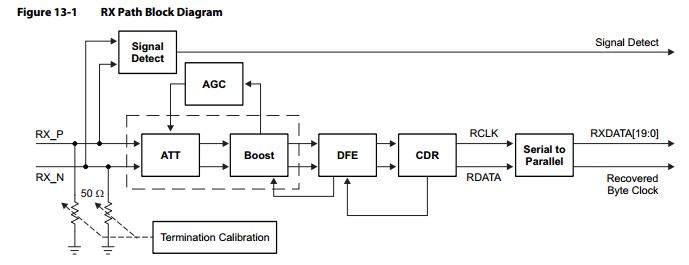
We need help from the software team. If all of the layout rules are met, then the next probable issue is SERDES tuning to optimize the SERDES transmitter and receiver settings as appropriate for the customer's board design. There is a new Application Report "SERDES Link Commissioning on KeyStone I and II Devices" (SPRAC37) available that provides an overview of the tools and techniques available. Please review with the customer and then provide the TX parameters chosen along with an explanation of how they were chosen. I have added a SERDES software expert to this thread for assistance.
Tom
H.U.,
Keystone II SGMII is 4-lane PHY-A, we saw similar link stablility issue on another custom boards. Please check the Lane_02C registers for each of the four lane, make sure bit 21:20 PMA_LN_DFE_BW_SCALE is 0x3, not 0x1.
Regards, Eric
mcsdk_bios_3_01_00_03 (pdk_keystone2_3_01_00_03):
\pdk_keystone2_3_01_00_03\packages\ti\drv\nwal\test\common\c66\bios\pdkv3\fw_pdk.c
H. U.,
Please check if they update this bit-field from 0x1 to 0x3 can resolve the problem or not? Also, please answer me whether they used other periphals like SRIO, XGE, etc? For all the perhiprals they used, for the lane register 02c, that bit field needs to be programed to 0x3.
Older CSL release missed this setting, or even the CSL is correct, but the code customer referred to doesn't has this updated can still cause the issue.
Regards, Eric
H.U.
I informed the FAE that we did not expect any problem to be found. We are not surprised by the results.
There has been no evidence of SERDES lane tuning in this discussion. This is a customer responsibility.
We have informed you of an Applications Note that highlights the tools available for tuning the SERDES configuration. We have also informed you of new software releases that better control the SERDES. We will help you walk through these integration tests but we cannot do it for you.
Tom
I was a slightly confused for a description of the Serdes register, however our customers were convinced by well explained.
So, this problem has been resolved all.