This thread has been locked.

If you have a related question, please click the "Ask a related question" button in the top right corner. The newly created question will be automatically linked to this question.

AM3356: Firmware crash

Part Number: AM3356
Other Parts Discussed in Thread: SYSBIOS, TPS51200

Hi,

we are working with AM3356 processors on in-house developed boards based on AM335x ICE v2 design. These boards have already been in use for a few weeks in a pilot plant. They are placed in line topology and every Board hast its own static IP-address. We use the ICSS-Switch functionality and the boards receive data over Ethernet from a PC. So far everything went well. Last week we had to replace two of the seven boards in our pilot plant. The replaced boards are crashing while the initialization phase. In fact that these boards worked correctly for a few weeks, we assume a hardware problem. With the XDS100v2 debug probe we tried to localize the errors. The “Scan for Errors-Tab” in the ROV-Tool shows the following errors:
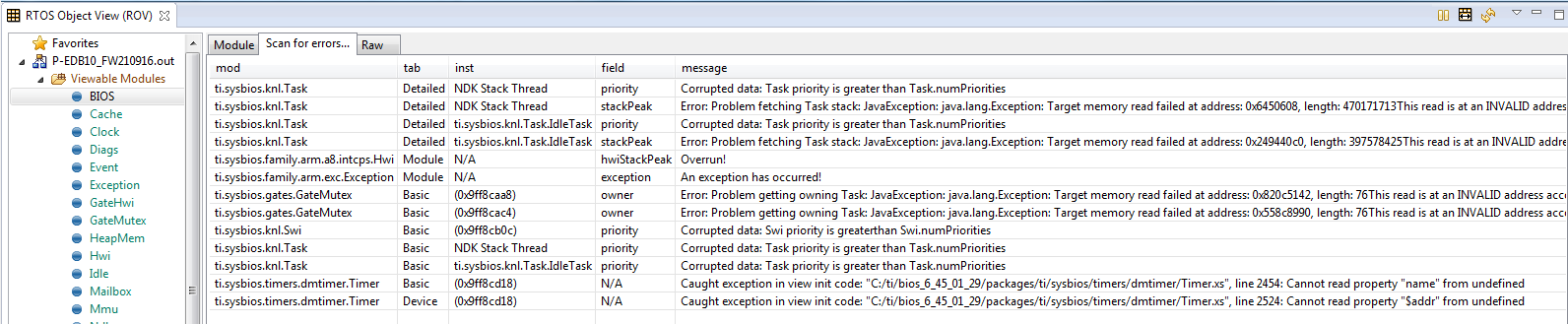
Do you have any assumptions why our boards do not work correctly anymore or with which actions we can localize the problems?
 Any help would be appreciated very much!

Best regards,
Luca

  • Hi,

    The RTOS team have been notified. They will respond here.
  • By the way, have you run a memory test on the failed boards? Can you post more information about the memory you use, and whether it has been configured as described here:
    processors.wiki.ti.com/.../AM335x_EMIF_Configuration_tips
    processors.wiki.ti.com/.../AM335x_DDR_PHY_register_configuration_for_DDR3_using_Software_Leveling
  • Hi Biser,

    thanks for your reply!
    We use an external DDR3 with 2GB. The bootloader and the .bin-file of the firmware are stored in SPI-flash.
    The DDR-tests (EDMA and data transfer) passed with no errors. The RAM seems to work correctly.

    Best regards,
    Luca
  • Hi Luca

    It looks like we need some additional information to pin this down. However it is encouraging that the RAM test runs without errors.

    I apologize in advance for asking many questions.

    To help us get on the same page - what SDK version is being used?

    Are you able to verify the stored program from flash? 

    Do you have board diagnostics or test programs  that can be run from the  XDS100v2 debug probe JTAG interface?

    David

  • Hi David,

    we use am335x_sysbios_ind_sdk_01.01.01.01 together with SYSBIOS 6.45.1.29 and NDK 2.25.0.09. I am able to flash binaries into the SPI flash with the XDS100v2 debug probe and the CCS based isdk_spi_flasher without any errors. Connecting the debug probe to one of the defective boards, the program counter stops always at the same address (0x80028A60). So, I assume that the firmware is executed until a certain point.
    I hope this information has been helpful.

    Best regards,
    Luca
  • Hi Luca

    Thank you.
    I think you have said this but let me let me confirm that the board error does not change after reflashing the program.
    Does the 2nd board also have a similar programmer counter stopping point?
    As a simple check are you able to read and write memory locations using CCS and the memory browser window around the program counter address following the stop.

    Our task will be to find out what operations are being executed and what board or device function are being access at the time the program counter stops. There are a couple of ways to do this.

    A good first step is to take advantage of the any status reporting information that has been included in the application.
    Are there any diagnostic messages that are printed out to the CCS console or a UART terminal that will tell us the program progress from the boot loader through program initialization? The UART terminal may be implemented as a USB connected terminal using a serial console terminal application (like Teraterm, minicom, HyperTerminal). In this case the serial port is often configured as 115200 baud, no parity, 1 stop bit and no flow control.

    David

  • Hi Luca, are you running your own application or it is any of the examples from our ISDK?

    Also, a couple of ideas, you can check your memory map and see if you can find out which function/module is running at address 0x80028A60. Additionally, you can open Disassembly view and see, when program hang, if there is any recognizable function. These could give you and idea on where things fail.. 

    Few more question, do yours boards have boot jumpers? if so, maybe good to check they are in the correct settings, I sometimes mess with that in my ICEv2 boards =). Maybe, it would be also good to clean the flash of the new boards and re-flashing them.

    Thank you and have a nice weekend,

    Paula

  • Hi Paula, hi David,

    thank you very much for your replies!
    I am currently out of office until the end of next week. If I remember correctly, I was able to read and write memory locations in the memory browser.
    Paula, I am running my own application based on several examples from the TI sdk examples.
    I will comment here after I did some tests with the 2nd board.

    Best regards,
    Luca
  • Part Number: AM3356

    Hi,

    we are working with AM3356 processors on in-house developed boards based on AM335x ICE v2 design. These boards have already been in use for a few weeks in a pilot plant. Some of these boards do not work any more. My colleague Luca have posted this problem in this forum.

    Now I discover a little design difference to the TI reference design. In our design we miss the connection "DDR_VREF" from the TPS51200 to the DDR3 SDRAM MT41J128M16 pins VREF_CA and VREF_DQ.
    In the datasheet is written:

    "VREFCA & VREFDQ must be maintained at all times (including self refresh) for proper device operation." 

    Do you think it is possible the SDRAM got  a damage while missing this reference voltage ?  Later I connected these pins at one board but the failure is still present.

    Please note: Not all boards have this failure and all boards run well at the beginning!

    Any help would be appreciated

    Regards Andreas

  • Hi Andreas

    We would not expect that memory operation is possible without these pins connected.
    The best way to determine the effect of not having these reference pins connected will be to ask Micron.

    David