


Part Number: PROCESSOR-SDK-AM335X
Tool/software: Linux
I am trying to send constant and large amount of bytes with SPI from a Linux embedded system -- am335x (Beaglebone: pocketbeagle version). Thing is, I am trying to increase its transfer rate. I am having trouble when sending several blocks of SPI data using spidev (which uses the MCSPI driver). I am sending blocks of 153kb everytime, but I notice a huge delay in between transfers. Here is a picture of a transfer at 15MHz:

Currently, I am accessing SPI through user-space with the following configuration on spidev (ioctl calls):
// SPI init -- (const char *device, int mode, int bits, int speed)
retv = spi_bus.spi_init(LCD_SPI_DEVICE,0,8,100000000);
And this is my write function:
// write data to SPIdev
int SPI::spi_write(const char *tx_buf, int len)
{
  int retv;

  this->xfer.tx_buf = (uint64_t) tx_buf; // output buffer
  this->xfer.rx_buf = (uint64_t) 0;      // input buffer
  this->xfer.len    = (uint32_t) len;    // length of data to write

  retv = ioctl(this->fd, SPI_IOC_MESSAGE(1), &this->xfer);
  if (retv < 0)
  {
    printf("error in spi_write(): ioctl(SPI_IOC_MESSAGE(1)) return %d", retv);
    return SPI_ERR_WRITE;
  }

  return retv;
}
I did see a slightly improvement when increasing the word length (from 8 bits to 16 bits). In this document I read that the following could help:
1) Modify INITDLY
2) Keep SPIEN Active Mode (FORCE bi)
The way I see it (judging from what the oscilloscope is showing), the most crutial part is INITDLY. Thing is, I have no idea how to modify these registers! I know I need to modify this in the spi-omap2-mcspi.c but I don't exactly know where.
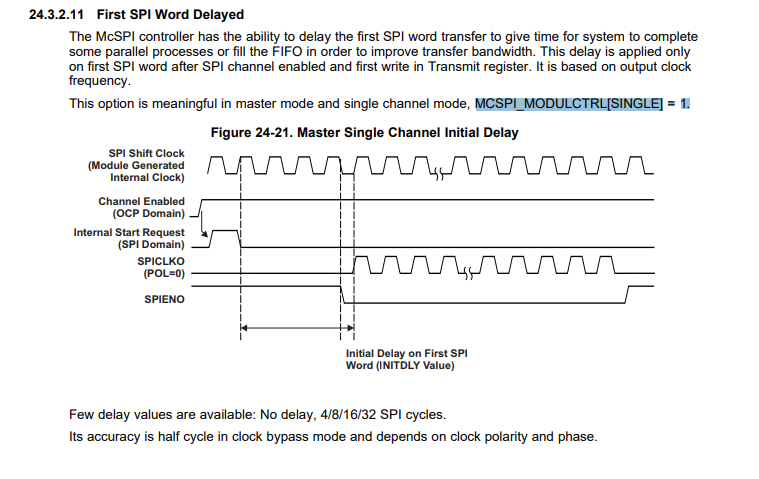
As I understand in the document, I need to modify MCSPI_MODULCTRL in the mcSPI driver. But again, I don't know where in the code I should modify it (and what to modify!). I'd appreciate any guidance!
My attempt so far:
I modified the driver with the following:
static void omap2_mcspi_set_master_mode(struct spi_master *master)
{
	struct omap2_mcspi	*mcspi = spi_master_get_devdata(master);
	struct omap2_mcspi_regs	*ctx = &mcspi->ctx;
	u32 l;
	u32 intdly_msk = 0xFFFFFF8F;

	/*
	 * Setup when switching from (reset default) slave mode
	 * to single-channel master mode
	 */
	l = mcspi_read_reg(master, OMAP2_MCSPI_MODULCTRL);
	l &= ~(OMAP2_MCSPI_MODULCTRL_STEST | OMAP2_MCSPI_MODULCTRL_MS);
	l |= OMAP2_MCSPI_MODULCTRL_SINGLE;
	l &= intdly_msk; // INITDLY (Remove pause of SPI)
	mcspi_write_reg(master, OMAP2_MCSPI_MODULCTRL, l);

	ctx->modulctrl = l;
}
That way I am setting INITDLY, but whenever I re-compile the kernel nothing happens. The SPI driver keeps working as if nothing happened!
