This thread has been locked.

If you have a related question, please click the "Ask a related question" button in the top right corner. The newly created question will be automatically linked to this question.

TMS320C5517: Power Estimation

Part Number: TMS320C5517

hi TI support,

I am evaluating TMS320C5517 for one of our low power application which includes FFT processing. I am interested in the active power consumption at 75MHz when the FFT hardware accelerator is executing a 1024 point FFT.

Surprisingly, i dont see the FFT accelerator included in the power computation spreadsheet nor is it mentioned in the document: www.ti.com/.../sprabn1.pdf
How can i find out the typical power consumption at 75MHz when the FFT accelerator is running?

Regards,
Dileepan.

  • Hi Dileepan,

    I am surprised the FFT power consumption was not captured in the Power Spreadsheet.

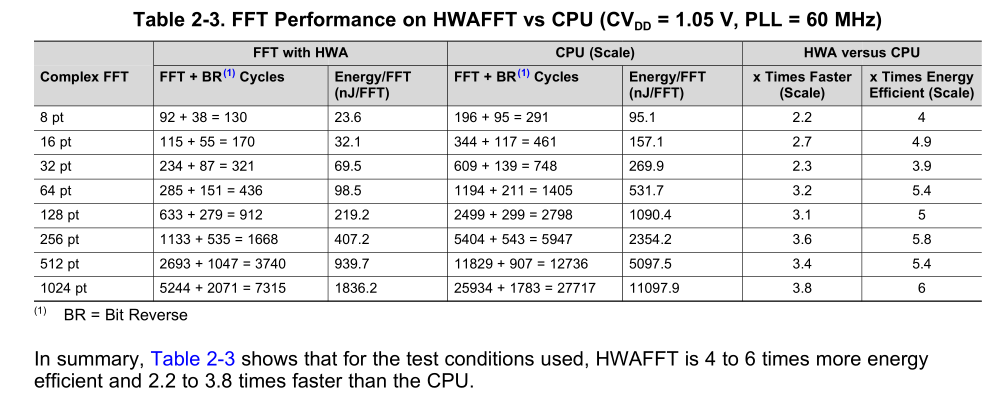
    It appears the only HWAFFT power data is documented in the TRM. Refer to SPRUH16 Section 2.7 FFT Benchmarks (shown below). This table compares execution of FFT on the CPU against execution with the HWAFFT accelerator. Both number of cycles and energy required are shown. The energy numbers are presented in nanoJoules per FFT.   P  = E / t .

    This does not answer your question, but it does show that using the HWAFFT instead of the CPU to perform a FFT executes up to 3.8x faster, and 6x more power efficient (for 1024-pt FFTs). perhaps you can get an idea of the power by reducing the CPU Utilization in the power spreadsheet.

    The most accurate method will be to measure power with the EVM while executing a HWAFFT.

    Let me know if you have any other HWAFFT questions.

    Regards,
    Mark

  • Hi Mark,

    Thanks a lot for your response. Yes, it answers my queries regarding HWAFFT power consumption. May be TI should include these data in the power spreadsheet.


    Few related queries:

    1) In spruh16, section 2.7 it mentions that PLL=75MHz or 100MHz. But on top of table 2-3,it mentions 60MHz. Which is correct? Same confusion on table 2-4 as well.

    2) As per table 2-3, if i am doing 1024pt FFT 1000 times in a second, power consumption = 1836.2*1000nJ per second = 1.8362mW. correct?

    3) In the slack time when the HWAFFT is not performing FFT, how much is the power dissipation?

    Regards,
    Dileepan.

  • Hi Mark,

    Thanks a lot for your response. Yes, it answers my queries regarding HWAFFT power consumption. May be TI should include these data in the power spreadsheet.


    Few related queries:

    1) In spruh16, section 2.7 it mentions that PLL=75MHz or 100MHz. But on top of table 2-3,it mentions 60MHz. Which is correct? Same confusion on table 2-4 as well.

    2) As per table 2-3, if i am doing 1024pt FFT 1000 times in a second, power consumption = 1836.2*1000nJ per second = 1.8362mW. correct?

    3) In the slack time when the HWAFFT is not performing FFT, how much is the power dissipation?

    Regards,
    Dileepan.

  • Hi Dileepan,


    I tracked down the original table where Tables 2-3 and 2-4 came from. These HWAFFT execution time (in cycles) and energy/FFT (in Joules) were aquired for the C5505/15 devices.

    Table 2-4. was taken with CVDD=1.05v, PLL =60MHz
    Table 2-3 was taken with CVDD=1.3v, PLL =100MHz.

    The number of cycles required to execute the HWAFFT (and CPU) routines remains the same from C5505/15 to C5517 because both have an identical HWAFFT accelerator and identical CPU.

    In theory, the Energy consumed per FFT can be scaled to the clock frequency used.
    E / FFT = (P*t) / FFT, where time is equal to the cycle count * system clock period at 60MHz (16.67ns)

    Power can be calculated by multiplying the Energy per FFT by the time required to compute the FFT (cycle count times system clock period). I think you left off the clock period in your calculation.

    These power numbers will be for the CVDD supply rail only. The other power rail consumption can be estimated with the power estimation spreadsheet.

    In the slack time, you can estimate power with the spreadsheet by reducing CPU utilization to something small (depending on any ongoing processing).

    Or if you have enough time to enter an IDLE mode, the power can be further reduced. IDLE modes are also estimated with the power estimation spreadsheet.

    Hope this helps,
    Mark

  • hi Mark,

    Thanks for the clarifications.

    My understanding was that Energy/FFT meant energy / number of FFT, and hence, to compute power, multiplying this with the number of FFTs/sec is sufficient.

    Anyway, i have got all the info required.

    Thanks,

    Regards,

    Dileepan.