This thread has been locked.

If you have a related question, please click the "Ask a related question" button in the top right corner. The newly created question will be automatically linked to this question.

RTOS/PROCESSOR-SDK-AM335X: UART interrupt

Part Number: PROCESSOR-SDK-AM335X
Other Parts Discussed in Thread: SYSCONFIG,

Tool/software: TI-RTOS

hi.,

i am trying to generate UART receive  interrupt like below

main function

main()

{
MMUConfigAndEnable();

/* Enable cache */
CacheEnable(CACHE_ALL);

// PeripheralsSetUp();
BoardInfoInit();

/* Configuring the system clocks for UART0 instance. */
UART0ModuleClkConfig();

/* Performing the Pin Multiplexing for UART0 instance. */
UARTPinMuxSetup(0);

/* Performing a module reset. */
UARTModuleReset(SOC_UART_0_REGS);


/* Performing FIFO configurations. */
UartFIFOConfigure();

UartConfigure(BAUD_RATE_115200, (UART_FRAME_WORD_LENGTH_8 |
UART_FRAME_NUM_STB_1 |
UART_PARITY_NONE));

/* Select the console type based on compile time check */
ConsoleUtilsSetType(CONSOLE_UART);

/* Enabling IRQ in CPSR of ARM processor. */
IntMasterIRQEnable();

/* Configuring AINTC to receive UART0 interrupts. */
UARTINTCConfigure();

/*Enabling required UART Interrupts. */
// UARTIntEnable(SOC_UART_0_REGS,(UART_INT_LINE_STAT | UART_INT_THR | UART_INT_RHR_CTI));
UARTIntEnable(SOC_UART_0_REGS,UART_INT_RHR_CTI);

while(1)
{

}

// interrupt function

static void UARTINTCConfigure(void)
{
/* Initializing the ARM Interrupt Controller. */
  IntAINTCInit();

/* Registering the Interrupt Service Routine(ISR). */
IntRegister(UART_INSTANCE_INT_NUM, UARTIsr);

/* Setting the priority for the system interrupt in AINTC. */
IntPrioritySet(UART_INSTANCE_INT_NUM, 0, AINTC_HOSTINT_ROUTE_IRQ);

/* Enabling the system interrupt in AINTC. */
IntSystemEnable(UART_INSTANCE_INT_NUM);
}

 Initializing the ARM Interrupt Controller.

void IntAINTCInit(void)
{
unsigned int intrNum;

HWREG(SOC_AINTC_REGS + INTC_SYSCONFIG) = INTC_SYSCONFIG_AUTOIDLE;
/* Reset the ARM interrupt controller */
HWREG(SOC_AINTC_REGS + INTC_SYSCONFIG) = INTC_SYSCONFIG_SOFTRESET;

/* Wait for the reset to complete */
while((HWREG(SOC_AINTC_REGS + INTC_SYSSTATUS)
& INTC_SYSSTATUS_RESETDONE) != INTC_SYSSTATUS_RESETDONE);

/* Enable any interrupt generation by setting priority threshold */
HWREG(SOC_AINTC_REGS + INTC_THRESHOLD) =
INTC_THRESHOLD_PRIORITYTHRESHOLD;

/* Register the default handler for all interrupts */
for(intrNum = 0; intrNum < NUM_INTERRUPTS; intrNum++)
{
fnRAMVectors[intrNum] = IntDefaultHandler;
}
}

static void UARTIsr(void)
{
volatile unsigned char rxByte;
; Perform nothing
rxByte = UARTCharGetNonBlocking(SOC_UART_0_REGS);
UARTCharPutNonBlocking(SOC_UART_0_REGS, rxByte);

}

i did like this.. , but interrupt is not generating..

please any one help me

Regards 

chandana

  • Chandana,

    Other than the code, we have no understanding of your code here. Can you please indicate if this is bare-metal or RTOS example. Is this a custom board or a TI evaluation platform. What data are you passing to UART from the host side to trigger the receive interrupt?

    Based on my understanding of your code, you are using legacy starterware.  Can you indicate why you are not using the UART driver that we provide here:

    pdk_am335x_1_0_13\packages\ti\drv\uart

    If you are looking for bare-metal UART Examples for AM335x, you can refer to diagnostic package under board folder. Please migrate to using UART LLD driver as the legacy starterware package is provided for existing industrial customer to migrate their code base to Processor SDK. We are only supporting the bootloader and the board and flash package from starterware in Processor SDK.

    Regards,

    Rahul

  • Hi Rahul 

    I took this code flow  from "AM335X_StarterWare_02_00_01_01" i am passing some data through keyboard to trigger the receive interrupt.

    /**
     * \file   uartEcho.c
     *
     * \brief  This example application demonstrates the working of UART for serial
     *         communication with another device/host by echoing back the data
     *         entered from serial console.
     *   
     *         Application Configuration:
     *   
     *             Modules Used:
     *                 UART0
     *                 Interrupt Controller
     *   
     *             Configurable Parameters:
     *                 1)Baud Rate - 115200 bps to 926100 bps
     *                 2)Word Length - 5,6,7,8 bits
     *                 3)Parity - None, Odd, Even, Mark, Space
     *                 4)Stop Bits - 1, 1.5, 2 stop bits
     *                 
     *             Hard-coded configuration of other parameters:
     *                 1) FIFO Threshold Levels:
     *                    a) TX Trigger Space value - 56
     *                    b) TX Threshold Level - 8 (TX FIFO Size - TX Trigger Space)
     *                    c) RX Threshold Level - 1
     *   
     *         Application Use case:
     *             1) Application demonstrates the Receive/Transmit features
     *                of UART using a FIFO.
     *             2) Interrupt features related to FIFO trigger levels are
     *                demonstrated for reading/writing to the FIFO.
     *             3) Functionality of UART with different Line characterics
     *                and Baud rates are demonstrated.
     *   
     *         Running the Example:
     *             On executing the example:
     *             1) The user will be requested to enter 8 bytes of data from the
     *                serial console. The keyed in data will be echoed back
     *                immediately.
     *             2) Then the user will be given options to either re-run the
     *                application using default or non-default Baud Rate and Line
     *                characteristics or quit the application.
     *   
     */
    
    /*
    * Copyright (C) 2010 Texas Instruments Incorporated - http://www.ti.com/ 
    */
    /* 
    *  Redistribution and use in source and binary forms, with or without 
    *  modification, are permitted provided that the following conditions 
    *  are met:
    *
    *    Redistributions of source code must retain the above copyright 
    *    notice, this list of conditions and the following disclaimer.
    *
    *    Redistributions in binary form must reproduce the above copyright
    *    notice, this list of conditions and the following disclaimer in the 
    *    documentation and/or other materials provided with the   
    *    distribution.
    *
    *    Neither the name of Texas Instruments Incorporated nor the names of
    *    its contributors may be used to endorse or promote products derived
    *    from this software without specific prior written permission.
    *
    *  THIS SOFTWARE IS PROVIDED BY THE COPYRIGHT HOLDERS AND CONTRIBUTORS 
    *  "AS IS" AND ANY EXPRESS OR IMPLIED WARRANTIES, INCLUDING, BUT NOT 
    *  LIMITED TO, THE IMPLIED WARRANTIES OF MERCHANTABILITY AND FITNESS FOR
    *  A PARTICULAR PURPOSE ARE DISCLAIMED. IN NO EVENT SHALL THE COPYRIGHT 
    *  OWNER OR CONTRIBUTORS BE LIABLE FOR ANY DIRECT, INDIRECT, INCIDENTAL, 
    *  SPECIAL, EXEMPLARY, OR CONSEQUENTIAL DAMAGES (INCLUDING, BUT NOT 
    *  LIMITED TO, PROCUREMENT OF SUBSTITUTE GOODS OR SERVICES; LOSS OF USE,
    *  DATA, OR PROFITS; OR BUSINESS INTERRUPTION) HOWEVER CAUSED AND ON ANY
    *  THEORY OF LIABILITY, WHETHER IN CONTRACT, STRICT LIABILITY, OR TORT 
    *  (INCLUDING NEGLIGENCE OR OTHERWISE) ARISING IN ANY WAY OUT OF THE USE 
    *  OF THIS SOFTWARE, EVEN IF ADVISED OF THE POSSIBILITY OF SUCH DAMAGE.
    *
    */
    
    #include "uart_irda_cir.h"
    #include "evmskAM335x.h"
    #include "soc_AM335x.h"
    #include "interrupt.h"
    #include "consoleUtils.h"
    #include "hw_types.h"
    #include <string.h>
    #include "cache.h"
    #include "mmu.h"
    #include "error.h"
    
    /******************************************************************************
    **              INTERNAL MACRO DEFINITIONS
    ******************************************************************************/
    #define BAUD_RATE_115200           (115200u)
    #define UART_MODULE_INPUT_CLK      (48000000u)
    
    #define START_ADDR_DDR             (0x80000000u)
    #define START_ADDR_DEV             (0x44000000u)
    #define START_ADDR_OCMC            (0x40300000u)
    #define NUM_SECTIONS_DDR           (512u)
    #define NUM_SECTIONS_DEV           (960u)
    #define NUM_SECTIONS_OCMC          (1u)
    
    #define UART_INSTANCE_BASE_ADD     (SOC_UART_0_REGS)
    #define UART_INSTANCE_INT_NUM      (SYS_INT_UART0INT)
    
    /* Baud Rates of UART for communication. */
    #define BAUD_RATE_115200          (115200u)
    #define BAUD_RATE_128000          (128000u)
    #define BAUD_RATE_230400          (230400u)
    #define BAUD_RATE_460800          (460800u)
    #define BAUD_RATE_921600          (921600u)
    
    #define APP_EXIT                  (FALSE)
    #define APP_CONTINUE              (TRUE)
    #define NUM_TX_STRINGS            (2)
    
    /*
    ** The number of data bytes to be transmitted to Transmit FIFO of UART
    ** per generation of the Transmit Empty interrupt. This can take a maximum
    ** value of TX Trigger Space which is 'TX FIFO size - TX Threshold Level'.
    */
    #define NUM_TX_BYTES_PER_TRANS    (56)
    
    /******************************************************************************
    **              INTERNAL FUNCTION PROTOTYPES
    ******************************************************************************/
    static unsigned int UartUserInputGet(unsigned int *baudRate,
                                         unsigned int *lineCharConfig);
    static void UartCustomizeSettings(unsigned int *baudRate,
                                      unsigned int *lineCharConfig);
    static void UartConfigure(unsigned int baudRate, unsigned int lineCharConfig);
    static void UartLineCharacSet(unsigned int lineCharConfig);
    static void UartBaudRateSet(unsigned int baudRate);
    static void MMUConfigAndEnable(void);
    static void UARTINTCConfigure(void);
    static void UartFIFOConfigure(void);
    static void UARTIsr(void);
    
    /******************************************************************************
    **              GLOBAL VARIABLE DEFINITIONS
    ******************************************************************************/
    unsigned char welcome[] = "\r\n\r\nStarterWare AM335X UART Interrupt application.\r\n";
    unsigned char enter[] = "Please enter 8 bytes. They will echoed back individually.\r\n";
    volatile unsigned int numRdBytesISR = 0;
    
    /* A flag used to signify the application to transmit data to UART TX FIFO. */
    volatile unsigned int txFIFOEmptyFlag = FALSE;
    
    /* This keeps a count of the number of strings transferred to TX FIFO. */
    volatile unsigned int txStrCount = 0;
    
    /*
    ** Flag which indicates whether the total Transmit transaction which involves
    ** transfer of all the strings in context is complete.
    */
    volatile unsigned int txComplFlag = FALSE;
    
    /* Page tables start must be aligned in 16K boundary */
    #ifdef __TMS470__
    #pragma DATA_ALIGN(pageTable, MMU_PAGETABLE_ALIGN_SIZE);
    static volatile unsigned int pageTable[MMU_PAGETABLE_NUM_ENTRY];
    
    #elif defined(__IAR_SYSTEMS_ICC__)
    #pragma data_alignment=MMU_PAGETABLE_ALIGN_SIZE
    static volatile unsigned int pageTable[MMU_PAGETABLE_NUM_ENTRY];
    
    #elif defined(gcc)
    static volatile unsigned int pageTable[MMU_PAGETABLE_NUM_ENTRY]
     __attribute__((aligned(MMU_PAGETABLE_ALIGN_SIZE)));
    
    #else
    #error "Unsupported Compiler. \r\n"
    
    #endif
    
    /******************************************************************************
    **              FUNCTION DEFINITIONS
    ******************************************************************************/
    
    /*
    ** This function will setup the MMU. The function maps three regions -
    ** 1. DDR
    ** 2. OCMC RAM
    ** 3. Device memory
    ** The function also enables the MMU.
    */
    void MMUConfigAndEnable(void)
    {
        /*
        ** Define DDR memory region of AM335x. DDR can be configured as Normal
        ** memory with R/W access in user/privileged modes. The cache attributes
        ** specified here are,
        ** Inner - Write through, No Write Allocate
        ** Outer - Write Back, Write Allocate
        */
        REGION regionDdr = {
                            MMU_PGTYPE_SECTION, START_ADDR_DDR, NUM_SECTIONS_DDR,
                            MMU_MEMTYPE_NORMAL_NON_SHAREABLE(MMU_CACHE_WT_NOWA,
                                                             MMU_CACHE_WB_WA),
                            MMU_REGION_NON_SECURE, MMU_AP_PRV_RW_USR_RW,
                            (unsigned int*)pageTable
                           };
        /*
        ** Define OCMC RAM region of AM335x. Same Attributes of DDR region given.
        */
        REGION regionOcmc = {
                             MMU_PGTYPE_SECTION, START_ADDR_OCMC, NUM_SECTIONS_OCMC,
                             MMU_MEMTYPE_NORMAL_NON_SHAREABLE(MMU_CACHE_WT_NOWA,
                                                              MMU_CACHE_WB_WA),
                             MMU_REGION_NON_SECURE, MMU_AP_PRV_RW_USR_RW,
                             (unsigned int*)pageTable
                            };
    
        /*
        ** Define Device Memory Region. The region between OCMC and DDR is
        ** configured as device memory, with R/W access in user/privileged modes.
        ** Also, the region is marked 'Execute Never'.
        */
        REGION regionDev = {
                            MMU_PGTYPE_SECTION, START_ADDR_DEV, NUM_SECTIONS_DEV,
                            MMU_MEMTYPE_DEVICE_SHAREABLE,
                            MMU_REGION_NON_SECURE,
                            MMU_AP_PRV_RW_USR_RW  | MMU_SECTION_EXEC_NEVER,
                            (unsigned int*)pageTable
                           };
    
        /* Initialize the page table and MMU */
        MMUInit((unsigned int*)pageTable);
    
        /* Map the defined regions */
        MMUMemRegionMap(&regionDdr);
        MMUMemRegionMap(&regionOcmc);
        MMUMemRegionMap(&regionDev);
    
        /* Now Safe to enable MMU */
        MMUEnable((unsigned int*)pageTable);
    }
    
    
    int main(void)
    {
        unsigned char *pTxStr[NUM_TX_STRINGS] = {welcome, enter};
        unsigned int numByteChunks[NUM_TX_STRINGS] = {0};
        unsigned int remainBytes[NUM_TX_STRINGS] = {0};
        static unsigned char *qTxStr = NULL;
        unsigned int lineCharConfig = 0;
        unsigned int numBytesTx = 0;
        unsigned int baudRate = 0;
        unsigned int cntIndex = 0;
        int retVal = -1;
    
        /* Setup the MMU and do necessary MMU configurations. */
        MMUConfigAndEnable();
    
        /* Enable all levels of CACHE. */
        CacheEnable(CACHE_ALL);
    
        /* Configuring the system clocks for UART0 instance. */
        UART0ModuleClkConfig();
    
        /* Performing the Pin Multiplexing for UART0 instance. */
        UARTPinMuxSetup(0);
    
        /* Performing a module reset. */
        UARTModuleReset(UART_INSTANCE_BASE_ADD);
    
        /* Performing FIFO configurations. */
        UartFIFOConfigure();
    
        UartConfigure(BAUD_RATE_115200, (UART_FRAME_WORD_LENGTH_8 |
                                         UART_FRAME_NUM_STB_1 |
                                         UART_PARITY_NONE));
    
        /* Select the console type based on compile time check */
        ConsoleUtilsSetType(CONSOLE_UART);
    
        /* Enabling IRQ in CPSR of ARM processor. */
        IntMasterIRQEnable();
    
        /* Configuring AINTC to receive UART0 interrupts. */
        UARTINTCConfigure();
    
        /* Collecting the quotient and remainder values to aid in transmission. */
        for(cntIndex = 0; cntIndex < NUM_TX_STRINGS; cntIndex++)
        {
            numByteChunks[cntIndex] = (strlen((const char *)pTxStr[cntIndex])) /
                                       NUM_TX_BYTES_PER_TRANS;
    
            remainBytes[cntIndex] = (strlen((const char *)pTxStr[cntIndex])) %
                                     NUM_TX_BYTES_PER_TRANS;
        }
    
        /* Enabling required UART Interrupts. */
        UARTIntEnable(UART_INSTANCE_BASE_ADD,
                      (UART_INT_LINE_STAT | UART_INT_THR | UART_INT_RHR_CTI));
    
        while(1)
        {
            txComplFlag = FALSE;
            qTxStr = pTxStr[txStrCount];
            cntIndex = 0;
    
            while(TRUE != txComplFlag)
            {
                /* This branch is entered if a TX transaction is not yet complete. */
                if(TRUE == txFIFOEmptyFlag)
                {
                    if(cntIndex < numByteChunks[txStrCount])
                    {
                        /* Transmitting bytes in chunks of NUM_TX_BYTES_PER_TRANS. */
                        numBytesTx = UARTFIFOWrite(SOC_UART_0_REGS,
                                                   qTxStr,
                                                   NUM_TX_BYTES_PER_TRANS);
    
                        qTxStr = qTxStr + numBytesTx;
                        cntIndex++;
                    }
    
                    else
                    {
                        /* Transmitting remaining data from the data block. */
                        numBytesTx = UARTFIFOWrite(SOC_UART_0_REGS,
                                                   qTxStr,
                                                   remainBytes[txStrCount]);
    
                        txStrCount++;
                        if(NUM_TX_STRINGS != txStrCount)
                        {
                            qTxStr = pTxStr[txStrCount];
                        }
                    }
    
                    txFIFOEmptyFlag = FALSE;
    
                    /*
                    ** Re-enables the Transmit Interrupt. This interrupt
                    ** was disabled in the Transmit section of the UART ISR.
                    */
                    UARTIntEnable(SOC_UART_0_REGS, UART_INT_THR);
                }
            }
    
            while(numRdBytesISR < 8)
            {
    
            }
            numRdBytesISR = 0;
            /* Disabling the currently enabled UART interrupts. */
            UARTIntDisable(UART_INSTANCE_BASE_ADD, (UART_INT_RHR_CTI | UART_INT_LINE_STAT));
    
            retVal = UartUserInputGet(&baudRate, &lineCharConfig);
            if(APP_EXIT == retVal)
            {
                ConsoleUtilsPrintf("\r\nApplication is exiting.\r\n");
                break;
            }
    
            ConsoleUtilsPrintf(
                   "\r\nReconfiguring the UART with the selected parameters.\r\n");
            UARTModuleReset(UART_INSTANCE_BASE_ADD);
            UartFIFOConfigure();
            UartConfigure(baudRate, lineCharConfig);
    
            txStrCount = 0;
    
            /* Enabling required UART Interrupts. */
            UARTIntEnable(UART_INSTANCE_BASE_ADD,
                          (UART_INT_LINE_STAT | UART_INT_THR | UART_INT_RHR_CTI));
        }
    
        /* Support for Automation Testing. */
        PRINT_STATUS(S_PASS);
    
        while(1);
    }
    
    
    /*
    ** A wrapper function performing FIFO configurations.
    */
    
    static void UartFIFOConfigure(void)
    {
        unsigned int fifoConfig = 0;
    
        /*
        ** - Transmit Trigger Level Granularity is 4
        ** - Receiver Trigger Level Granularity is 1
        ** - Transmit FIFO Space Setting is 56. Hence TX Trigger level
        **   is 8 (64 - 56). The TX FIFO size is 64 bytes.
        ** - The Receiver Trigger Level is 1.
        ** - Clear the Transmit FIFO.
        ** - Clear the Receiver FIFO.
        ** - DMA Mode enabling shall happen through SCR register.
        ** - DMA Mode 0 is enabled. DMA Mode 0 corresponds to No
        **   DMA Mode. Effectively DMA Mode is disabled.
        */
        fifoConfig = UART_FIFO_CONFIG(UART_TRIG_LVL_GRANULARITY_4,
                                      UART_TRIG_LVL_GRANULARITY_1,
                                      UART_FCR_TX_TRIG_LVL_56,
                                      1,
                                      1,
                                      1,
                                      UART_DMA_EN_PATH_SCR,
                                      UART_DMA_MODE_0_ENABLE);
    
        /* Configuring the FIFO settings. */
        UARTFIFOConfig(UART_INSTANCE_BASE_ADD, fifoConfig);
    }
    
    /*
    ** A wrapper function performing UART Baud Rate settings.
    */
    
    static void UartBaudRateSet(unsigned int baudRate)
    {
        unsigned int divisorValue = 0;
    
        /* Computing the Divisor Value. */
        divisorValue = UARTDivisorValCompute(UART_MODULE_INPUT_CLK,
                                             baudRate,
                                             UART16x_OPER_MODE,
                                             UART_MIR_OVERSAMPLING_RATE_42);
    
        /* Programming the Divisor Latches. */
        UARTDivisorLatchWrite(UART_INSTANCE_BASE_ADD, divisorValue);
    }
    
    /*
    ** A wrapper function performing UART Line Characteristics Configuration.
    */
    
    static void UartLineCharacSet(unsigned int lineCharConfig)
    {
        unsigned int wLenStbFlag = 0;
        unsigned int parityFlag = 0;
    
        wLenStbFlag = (lineCharConfig & (UART_LCR_NB_STOP | UART_LCR_CHAR_LENGTH));
        parityFlag = (lineCharConfig & (UART_LCR_PARITY_TYPE2 |
                                        UART_LCR_PARITY_TYPE1 |
                                        UART_LCR_PARITY_EN));
    
        UARTLineCharacConfig(UART_INSTANCE_BASE_ADD, wLenStbFlag, parityFlag);
    }
    
    /*
    ** A wrapper function performing UART Configurations.
    */
    
    static void UartConfigure(unsigned int baudRate, unsigned int lineCharConfig)
    {
        UartBaudRateSet(baudRate);
    
        /* Switching to Configuration Mode B. */
        UARTRegConfigModeEnable(UART_INSTANCE_BASE_ADD, UART_REG_CONFIG_MODE_B);
    
        UartLineCharacSet(lineCharConfig);
    
        /* Disabling write access to Divisor Latches. */
        UARTDivisorLatchDisable(UART_INSTANCE_BASE_ADD);
    
        /* Disabling Break Control. */
        UARTBreakCtl(UART_INSTANCE_BASE_ADD, UART_BREAK_COND_DISABLE);
    
        /* Switching to UART16x operating mode. */
        UARTOperatingModeSelect(UART_INSTANCE_BASE_ADD, UART16x_OPER_MODE);
    }
    
    /*
    ** Interrupt Service Routine for UART.
    */
    
    static void UARTIsr(void)
    {
        unsigned int rxErrorType = 0;
        unsigned char rxByte = 0;
        unsigned int intId = 0;
        unsigned int idx = 0;
    
        /* Checking ths source of UART interrupt. */
        intId = UARTIntIdentityGet(UART_INSTANCE_BASE_ADD);
    
        switch(intId)
        {
            case UART_INTID_TX_THRES_REACH:
    
                /* Checking if the total TX transactions are complete. */
                if(txStrCount < NUM_TX_STRINGS)
                {
                    txFIFOEmptyFlag = TRUE;
                }
                else
                {
                    txComplFlag = TRUE;
                }
    
                UARTIntDisable(SOC_UART_0_REGS, UART_INT_THR);
    
            break;
    
            case UART_INTID_RX_THRES_REACH:
                rxByte = UARTCharGetNonBlocking(UART_INSTANCE_BASE_ADD);
                UARTCharPutNonBlocking(UART_INSTANCE_BASE_ADD, rxByte);
                numRdBytesISR++;
            break;
    
            case UART_INTID_RX_LINE_STAT_ERROR:
    
                rxErrorType = UARTRxErrorGet(SOC_UART_0_REGS);
    
                /* Check if Overrun Error has occured. */
                if(rxErrorType & UART_LSR_RX_OE)
                {
                    ConsoleUtilsPrintf("\r\nUART Overrun Error occured."
                                  " Reading and Echoing all data in RX FIFO.\r\n");
    
                    /* Read the entire RX FIFO and the data in RX Shift register. */
                    for(idx = 0; idx < (RX_FIFO_SIZE + 1); idx++)
                    {
                        rxByte = UARTFIFOCharGet(SOC_UART_0_REGS);
                        UARTFIFOCharPut(SOC_UART_0_REGS, rxByte);
                    }
    
                    break;
                }
    
                /* Check if Break Condition has occured. */
                else if(rxErrorType & UART_LSR_RX_BI)
                {
                    ConsoleUtilsPrintf("\r\nUART Break Condition occured.");
                }
    
                /* Check if Framing Error has occured. */
                else if(rxErrorType & UART_LSR_RX_FE)
                {
                    ConsoleUtilsPrintf("\r\nUART Framing Error occured.");
                }
    
                /* Check if Parity Error has occured. */
                else if(rxErrorType & UART_LSR_RX_PE)
                {
                    ConsoleUtilsPrintf("\r\nUART Parity Error occured.");
                }
    
                ConsoleUtilsPrintf(" Data at the top of RX FIFO is: ");
                rxByte = UARTFIFOCharGet(SOC_UART_0_REGS);
                UARTFIFOCharPut(SOC_UART_0_REGS, rxByte);
    
            break;
    
            case UART_INTID_CHAR_TIMEOUT:
    
                ConsoleUtilsPrintf("\r\nUART Character Timeout Interrupt occured."
                                  " Reading and Echoing all data in RX FIFO.\r\n");
    
                /* Read all the data in RX FIFO. */
                while(TRUE == UARTCharsAvail(SOC_UART_0_REGS))
                {
                    rxByte = UARTFIFOCharGet(SOC_UART_0_REGS);
                    UARTFIFOCharPut(SOC_UART_0_REGS, rxByte);
                    numRdBytesISR++;
                }
    
            break;
        
            default:
            break;    
        }
    }
    
    /*
    ** This function configures the AINTC to receive UART interrupts.
    */
    
    static void UARTINTCConfigure(void)
    {
        /* Initializing the ARM Interrupt Controller. */
        IntAINTCInit();
    
        /* Registering the Interrupt Service Routine(ISR). */
        IntRegister(UART_INSTANCE_INT_NUM, UARTIsr);
    
        /* Setting the priority for the system interrupt in AINTC. */
        IntPrioritySet(UART_INSTANCE_INT_NUM, 0, AINTC_HOSTINT_ROUTE_IRQ);
    
        /* Enabling the system interrupt in AINTC. */
        IntSystemEnable(UART_INSTANCE_INT_NUM);
    }
    
    /*
    ** A wrapper function that collects inputs from the user regarding the future
    ** course of the application.
    */
    
    static unsigned int UartUserInputGet(unsigned int *baudRate, unsigned int *lineCharConfig)
    {
        unsigned int retVal = APP_CONTINUE;
        unsigned char choice = 0;
    
        ConsoleUtilsPrintf("\r\n\r\nThe application presents three options.\r\n"
                           "1> Continue using the application with the Default"
                                                    "Settings (115200, 8-N-1).\r\n"
                           "2> Customize the Baud Rate and Line"
                                                             "Characteristics.\r\n"
                           "3> Exit the application.\r\n"
                           "\r\nEnter the serial number of your choice:\r\n");
    
        ConsoleUtilsScanf("%c", &choice);
    
        switch(choice)
        {
            case '2':
                UartCustomizeSettings(baudRate, lineCharConfig);
            break;
    
            case '3':
                retVal = APP_EXIT;
            break;
    
            case '1':
            default:
                *baudRate = BAUD_RATE_115200;
                *lineCharConfig = (UART_FRAME_WORD_LENGTH_8 |
                                   UART_FRAME_NUM_STB_1 |
                                   UART_PARITY_NONE);
                ConsoleUtilsPrintf(
                                  "\r\nContinuing the application with the Default"
                              " Settings:\r\nBaud Rate = 115200 bps, 8 Data Bits, "
                                  "No Parity and 1 Stop Bit.\r\n");
            break;
        }
    
        return retVal;
    }
    
    /*
    ** A wrapper function that collects inputs from the user related to UART
    ** Configuration parameters.
    */
    
    static void UartCustomizeSettings(unsigned int *baudRate, unsigned int *lineCharConfig)
    {
        unsigned char choice = 0;
        unsigned int wordLen = 0;
        unsigned int stopBit = 0;
        unsigned int parity = 0;
    
        ConsoleUtilsPrintf("\r\n\r\nThere is a provision for the user"
                                                    "to choose from the available"
                           " Baud Rates and Line Characterstics.\r\n"
                           "\r\nChoose a Baud Rate from the following choices:\r\n"
                           "1> 115200 bps\r\n"
                           "2> 230400 bps\r\n"
                           "3> 460800 bps\r\n"
                           "4> 921600 bps\r\n"
                           "\r\nEnter the serial number of your choice:\r\n");
    
        ConsoleUtilsScanf("%c", &choice);
    
        switch(choice)
        {
            case '1':
                *baudRate = BAUD_RATE_115200;
                ConsoleUtilsPrintf("\r\nBaud Rate selected = 115200 bps.\r\n");
            break;
    
            case '2':
                *baudRate = BAUD_RATE_230400;
                ConsoleUtilsPrintf("\r\nBaud Rate selected = 230400 bps.\r\n");
            break;
    
            case '3':
                *baudRate = BAUD_RATE_460800;
                ConsoleUtilsPrintf("\r\nBaud Rate selected = 460800 bps.\r\n");
            break;
    
            case '4':
                *baudRate = BAUD_RATE_921600;
                ConsoleUtilsPrintf("\r\nBaud Rate selected = 921600 bps.\r\n");
            break;
    
            default:
                *baudRate = BAUD_RATE_115200;
                ConsoleUtilsPrintf(
                               "\r\nSelected Default Baud Rate = 115200 bps.\r\n");
            break;
        }
    
        ConsoleUtilsPrintf(
          "\r\nConfiguring the Line Characteristics  involves two steps:\r\n"
          "1> Configuring the Word Length and number of Stop Bits per frame\r\n"
          "2> Configuring the Parity of the frame\r\n"
          "\r\nFirst Step:\r\nChoose a Word Length from the following choices:\r\n"
          "1> 5 bits\r\n2> 6 bits\r\n3> 7 bits\r\n4> 8 bits\r\n"
          "\r\nEnter the serial number of your choice:\r\n");
    
        ConsoleUtilsScanf("%c", &choice);
    
        switch(choice)
        {
            case '1':
                wordLen = UART_FRAME_WORD_LENGTH_5;
                ConsoleUtilsPrintf("\r\nSelected Word Length per frame = 5.\r\n");
            break;
    
            case '2':
                wordLen = UART_FRAME_WORD_LENGTH_6;
                ConsoleUtilsPrintf("\r\nSelected Word Length per frame = 6.\r\n");
            break;
    
            case '3':
                wordLen = UART_FRAME_WORD_LENGTH_7;
                ConsoleUtilsPrintf("\r\nSelected Word Length per frame = 7.\r\n");
            break;
    
            case '4':
                wordLen = UART_FRAME_WORD_LENGTH_8;
                ConsoleUtilsPrintf("\r\nSelected Word Length per frame = 8.\r\n");
            break;
    
            default:
                wordLen = UART_FRAME_WORD_LENGTH_8;
                ConsoleUtilsPrintf("\r\nSelected Default Word Length per frame = 8.\r\n");
            break;
        }
    
        ConsoleUtilsPrintf("\r\nChoose the number of Stop Bits per frame"
                           "from the following options:\r\n"
                           "1> 1 Stop Bit (for word length = 5, 6, 7, 8)\r\n"
                           "2> 1.5 Stop Bits (for word length = 5)\r\n"
                           "3> 2 Stop Bits (for word length = 6, 7, 8)\r\n"
                           "\r\nEnter the serial number of your choice:\r\n");
    
        ConsoleUtilsScanf("%c", &choice);
    
        switch(choice)
        {
            case '1':
                stopBit = UART_FRAME_NUM_STB_1;
                ConsoleUtilsPrintf(
                            "\r\nSelected Number of Stop Bits per frame = 1.\r\n");
            break;
    
            case '2':
                stopBit = UART_FRAME_NUM_STB_1_5_2;
                ConsoleUtilsPrintf(
                          "\r\nSelected Number of Stop Bits per frame = 1.5.\r\n");
            break;
    
            case '3':
                stopBit = UART_FRAME_NUM_STB_1_5_2;
                ConsoleUtilsPrintf(
                            "\r\nSelected Number of Stop Bits per frame = 2.\r\n");
            break;
    
            default :
                stopBit = UART_FRAME_NUM_STB_1;
                ConsoleUtilsPrintf(
                    "\r\nSelected Default Number of Stop Bits per frame = 1.\r\n");
            break;
        }
    
        ConsoleUtilsPrintf(
                "\r\nLine Characteristics Config - Second Step - Parity\r\n"
                "Choose a Parity Configuration from the following options:\r\n"
                "1> No Parity\r\n"
                "2> Odd Parity is generated.\r\n"
                "3> Even Parity is generated.\r\n"
                "4> The Parity Bit is forced to 1"
                                       " in the transmitted and received data.\r\n"
                "5> The Parity Bit is forced to 0"
                                       " in the transmitted and received data.\r\n"
                "\r\nEnter the serial number of your choice:\r\n");
        ConsoleUtilsScanf("%c", &choice);
    
        switch(choice)
        {
            case '1':
                parity = UART_PARITY_NONE;
                ConsoleUtilsPrintf(
                                  "\r\nSelected Parity Configuration = None.\r\n");
            break;
    
            case '2':
                parity = UART_ODD_PARITY;
                ConsoleUtilsPrintf("\r\nSelected Parity Configuration = Odd.\r\n");
            break;
    
            case '3':
                parity = UART_EVEN_PARITY;
                ConsoleUtilsPrintf(
                                  "\r\nSelected Parity Configuration = Even.\r\n");
            break;
    
            case '4':
                parity = UART_PARITY_REPR_1;
                ConsoleUtilsPrintf(
                       "\r\nSelected Parity Configuration = Parity bit is 1.\r\n");
            break;
    
            case '5': parity = UART_PARITY_REPR_0;
                ConsoleUtilsPrintf(
                       "\r\nSelected Parity Configuration = Parity bit is 0.\r\n");
            break;
    
            default:
                parity = UART_PARITY_NONE;
                ConsoleUtilsPrintf(
                          "\r\nSelected Default Parity Configuration = None.\r\n");
            break;
        }
    
        *lineCharConfig = (parity | stopBit | wordLen);
    }
    
    /******************************* End of file *********************************/
    

    regards 

    chandana

  • hi rahul,

    I tried this example also .. i am getting error like "CortxA8: Unhandled ADP_Stopped exception 0x800248A0"  this.in this example i want change mood like callback mode right?

    can you please explain me that what and all i want to configure in interrupt mode and also  which register i want to enable 

    regards 

    chandana

    /*
     * Copyright (C) 2015-2016 Texas Instruments Incorporated - http://www.ti.com/
     *
     * Redistribution and use in source and binary forms, with or without
     * modification, are permitted provided that the following conditions
     * are met:
     *
     * Redistributions of source code must retain the above copyright
     * notice, this list of conditions and the following disclaimer.
     *
     * Redistributions in binary form must reproduce the above copyright
     * notice, this list of conditions and the following disclaimer in the
     * documentation and/or other materials provided with the
     * distribution.
     *
     * Neither the name of Texas Instruments Incorporated nor the names of
     * its contributors may be used to endorse or promote products derived
     * from this software without specific prior written permission.
     *
     * THIS SOFTWARE IS PROVIDED BY THE COPYRIGHT HOLDERS AND CONTRIBUTORS
     * "AS IS" AND ANY EXPRESS OR IMPLIED WARRANTIES, INCLUDING, BUT NOT
     * LIMITED TO, THE IMPLIED WARRANTIES OF MERCHANTABILITY AND FITNESS FOR
     * A PARTICULAR PURPOSE ARE DISCLAIMED. IN NO EVENT SHALL THE COPYRIGHT
     * OWNER OR CONTRIBUTORS BE LIABLE FOR ANY DIRECT, INDIRECT, INCIDENTAL,
     * SPECIAL, EXEMPLARY, OR CONSEQUENTIAL DAMAGES (INCLUDING, BUT NOT
     * LIMITED TO, PROCUREMENT OF SUBSTITUTE GOODS OR SERVICES; LOSS OF USE,
     * DATA, OR PROFITS; OR BUSINESS INTERRUPTION) HOWEVER CAUSED AND ON ANY
     * THEORY OF LIABILITY, WHETHER IN CONTRACT, STRICT LIABILITY, OR TORT
     * (INCLUDING NEGLIGENCE OR OTHERWISE) ARISING IN ANY WAY OUT OF THE USE
     * OF THIS SOFTWARE, EVEN IF ADVISED OF THE POSSIBILITY OF SUCH DAMAGE.
     *
     */
    
    /**
     *  \file  uart_test.c
     *
     *  \brief  Example application main file. This application will demonstrate
     *          UART RTOS driver for interrupt mode.
     *   This file performs as mentioned below:
     *
     *      1. Configure UART using structure UART_Params where user can configure
     *         readmode writemode etc. different parameters.
     *      2. First call UART_init()
     *      3. Call UART_open with UART_Params structure to get UART instance handle.
     *      4. Then user is expected to input some data(can be upto max 1000 chars)
     *         and it is printed back on console using UART RTOS API's
     *         UART_read() and UART_write() respectively.
     *   Note
     *      1. The sample application is written for TDAXX EVM, DRA75X EVM and AM57XX.
     *      2. The UART instance used is UART1 for TDA2XX,AM57XX,DRA75X and
     *         UART3 for TDA3XX,DRA78X
     *
    **/
    
    /* ========================================================================== */
    /*                             Include Files                                  */
    /* ========================================================================== */
    /* XDCtools Header files */
    #include <xdc/std.h>
    #include <xdc/cfg/global.h>
    #include <xdc/runtime/Error.h>
    #include <xdc/runtime/System.h>
    
    /* BIOS Header files */
    #include <ti/sysbios/BIOS.h>
    #include <ti/sysbios/knl/Task.h>
    
    #include "stdio.h"
    #include "stdint.h"
    #include "stdlib.h"
    #include "string.h"
    
    /* UART Header files */
    #include <ti/drv/uart/UART.h>
    #include <ti/drv/uart/src/UART_osal.h>
    #include <ti/csl/hw_types.h>
    #include <ti/csl/soc.h>
    
    /* ========================================================================== */
    /*                           Macros & Typedefs                                */
    /* ========================================================================== */
    #if defined (SOC_TDA2XX) || defined (SOC_TDA2PX) || defined (SOC_DRA75x) || defined (SOC_AM572x) || defined (SOC_TDA2EX) || defined (SOC_AM571x)
    #define UART_INSTANCE 0
    #define XBAR_INST CSL_XBAR_INST_IPU1_IRQ_44
    #define XBAR_IRQ CSL_XBAR_UART1_IRQ
    #endif
    #if defined (SOC_TDA3XX) || defined (SOC_DRA78x)
    #define UART_INSTANCE 2
    #endif
    
    /* ========================================================================== */
    /*                          Internal Function Declarations                    */
    /* ========================================================================== */
    /* None */
    
    /* ========================================================================== */
    /*                            Global Variables                                */
    /* ========================================================================== */
    UART_Handle uart_handle;
    
    /* UART parameters structure polled mode*/
    const UART_Params user_params = {
        UART_MODE_BLOCKING,     /* readMode */
        UART_MODE_BLOCKING,     /* writeMode */
        SemaphoreP_WAIT_FOREVER,/* readTimeout */
        SemaphoreP_WAIT_FOREVER,/* writeTimeout */
        NULL,                  /* readCallback */
        NULL,                 /* writeCallback */
        UART_RETURN_NEWLINE,  /* readReturnMode */
        UART_DATA_TEXT,       /* readDataMode */
        UART_DATA_TEXT,       /* writeDataMode */
        UART_ECHO_ON,         /* readEcho */
        115200,               /* baudRate */
        UART_LEN_8,           /* dataLength */
        UART_STOP_ONE,        /* stopBits */
        UART_PAR_NONE         /* parityType */
    };
    
    /* ========================================================================== */
    /*                          Function Definitions                              */
    /* ========================================================================== */
    void padConfig_prcmEnable()
    {
    #if defined (SOC_AM572x) || defined (SOC_AM571x)
        /*Pad configurations */
        HW_WR_REG32(CSL_MPU_CORE_PAD_IO_REGISTERS_REGS+CSL_CONTROL_CORE_PAD_IO_PAD_UART1_RXD,0x00040000);
        HW_WR_REG32(CSL_MPU_CORE_PAD_IO_REGISTERS_REGS+CSL_CONTROL_CORE_PAD_IO_PAD_UART1_TXD,0x00000000);
    #endif
    #if defined (SOC_TDA2XX) || defined (SOC_TDA2PX) || defined (SOC_TDA2EX) || defined (SOC_DRA75x)
        /*Pad configurations */
        HW_WR_REG32(SOC_CORE_PAD_IO_REGISTERS_BASE+CTRL_CORE_PAD_UART1_RXD,0x00040000);
        HW_WR_REG32(SOC_CORE_PAD_IO_REGISTERS_BASE+CTRL_CORE_PAD_UART1_TXD,0x00000000);
    #endif
    #if defined (SOC_TDA3XX) || defined (SOC_DRA78x)
        /*Pad configurations */
        HW_WR_REG32(SOC_CORE_PAD_IO_REGISTERS_BASE+CTRL_CORE_PAD_IO_SPI1_SCLK,0x00040001);
        HW_WR_REG32(SOC_CORE_PAD_IO_REGISTERS_BASE+CTRL_CORE_PAD_IO_SPI1_CS0,0x00000001);
    #endif
    }
    
    void uart_test(UArg arg0, UArg arg1)
    {
        UART_Params      params;
        int32_t count;
        char input = '\n';
        char buffPointer[1000];
        char echoPrompt[] = "\nuart driver example test:\nEnter some data or press the esc \n";
        char echoPrompt1[] = "Data received is\n";
    
        padConfig_prcmEnable();
    #if defined (SOC_TDA2XX) || defined (SOC_TDA2PX) || defined (SOC_DRA75x) || defined (SOC_AM572x) || defined (SOC_TDA2EX) || defined (SOC_AM571x)
        CSL_xbarIrqConfigure(CSL_XBAR_IRQ_CPU_ID_IPU1,XBAR_INST,XBAR_IRQ);
    #endif
    
        UART_init();
        params = user_params;
        uart_handle = UART_open(UART_INSTANCE, &params);
    
        UART_write(uart_handle,echoPrompt,sizeof(echoPrompt));
    
        while(1)
           {
            count=UART_read(uart_handle,buffPointer,1000);
            UART_write(uart_handle,&input,1U);
            UART_write(uart_handle,echoPrompt1,sizeof(echoPrompt1));
            UART_write(uart_handle,buffPointer,count);
            UART_write(uart_handle,echoPrompt,sizeof(echoPrompt));
           }
    }
    
    int main(void)
    {
        Task_Handle task;
        Error_Block eb;
    
        Error_init(&eb);
    
        task = Task_create(uart_test, NULL, &eb);
        if (task == NULL) {
            System_printf("Task_create() failed!\n");
            BIOS_exit(0);
        }
    
        /* Start BIOS */
        BIOS_start();
        return (0);
    }
    /********************************* End of file ******************************/
    

  • Hi rahul

    i am waiting for your reply.

    what i want to do for resolving this issue 

    regards

    chandna 

  • Part Number: PROCESSOR-SDK-AM335X

    Tool/software: TI-RTOS

    Hi.,

    i have a interrupt issue. i took example code in AM335X_StarterWare_02_00_01_01 this sdk code.

    /**
     * \file   uartEcho.c
     *
     * \brief  This example application demonstrates the working of UART for serial
     *         communication with another device/host by echoing back the data
     *         entered from serial console.
     *   
     *         Application Configuration:
     *   
     *             Modules Used:
     *                 UART0
     *                 Interrupt Controller
     *   
     *             Configurable Parameters:
     *                 1)Baud Rate - 115200 bps to 926100 bps
     *                 2)Word Length - 5,6,7,8 bits
     *                 3)Parity - None, Odd, Even, Mark, Space
     *                 4)Stop Bits - 1, 1.5, 2 stop bits
     *                 
     *             Hard-coded configuration of other parameters:
     *                 1) FIFO Threshold Levels:
     *                    a) TX Trigger Space value - 56
     *                    b) TX Threshold Level - 8 (TX FIFO Size - TX Trigger Space)
     *                    c) RX Threshold Level - 1
     *   
     *         Application Use case:
     *             1) Application demonstrates the Receive/Transmit features
     *                of UART using a FIFO.
     *             2) Interrupt features related to FIFO trigger levels are
     *                demonstrated for reading/writing to the FIFO.
     *             3) Functionality of UART with different Line characterics
     *                and Baud rates are demonstrated.
     *   
     *         Running the Example:
     *             On executing the example:
     *             1) The user will be requested to enter 8 bytes of data from the
     *                serial console. The keyed in data will be echoed back
     *                immediately.
     *             2) Then the user will be given options to either re-run the
     *                application using default or non-default Baud Rate and Line
     *                characteristics or quit the application.
     *   
     */
    
    /*
    * Copyright (C) 2010 Texas Instruments Incorporated - http://www.ti.com/ 
    */
    /* 
    *  Redistribution and use in source and binary forms, with or without 
    *  modification, are permitted provided that the following conditions 
    *  are met:
    *
    *    Redistributions of source code must retain the above copyright 
    *    notice, this list of conditions and the following disclaimer.
    *
    *    Redistributions in binary form must reproduce the above copyright
    *    notice, this list of conditions and the following disclaimer in the 
    *    documentation and/or other materials provided with the   
    *    distribution.
    *
    *    Neither the name of Texas Instruments Incorporated nor the names of
    *    its contributors may be used to endorse or promote products derived
    *    from this software without specific prior written permission.
    *
    *  THIS SOFTWARE IS PROVIDED BY THE COPYRIGHT HOLDERS AND CONTRIBUTORS 
    *  "AS IS" AND ANY EXPRESS OR IMPLIED WARRANTIES, INCLUDING, BUT NOT 
    *  LIMITED TO, THE IMPLIED WARRANTIES OF MERCHANTABILITY AND FITNESS FOR
    *  A PARTICULAR PURPOSE ARE DISCLAIMED. IN NO EVENT SHALL THE COPYRIGHT 
    *  OWNER OR CONTRIBUTORS BE LIABLE FOR ANY DIRECT, INDIRECT, INCIDENTAL, 
    *  SPECIAL, EXEMPLARY, OR CONSEQUENTIAL DAMAGES (INCLUDING, BUT NOT 
    *  LIMITED TO, PROCUREMENT OF SUBSTITUTE GOODS OR SERVICES; LOSS OF USE,
    *  DATA, OR PROFITS; OR BUSINESS INTERRUPTION) HOWEVER CAUSED AND ON ANY
    *  THEORY OF LIABILITY, WHETHER IN CONTRACT, STRICT LIABILITY, OR TORT 
    *  (INCLUDING NEGLIGENCE OR OTHERWISE) ARISING IN ANY WAY OUT OF THE USE 
    *  OF THIS SOFTWARE, EVEN IF ADVISED OF THE POSSIBILITY OF SUCH DAMAGE.
    *
    */
    
    #include "uart_irda_cir.h"
    #include "evmskAM335x.h"
    #include "soc_AM335x.h"
    #include "interrupt.h"
    #include "consoleUtils.h"
    #include "hw_types.h"
    #include <string.h>
    #include "cache.h"
    #include "mmu.h"
    #include "error.h"
    
    /******************************************************************************
    **              INTERNAL MACRO DEFINITIONS
    ******************************************************************************/
    #define BAUD_RATE_115200           (115200u)
    #define UART_MODULE_INPUT_CLK      (48000000u)
    
    #define START_ADDR_DDR             (0x80000000u)
    #define START_ADDR_DEV             (0x44000000u)
    #define START_ADDR_OCMC            (0x40300000u)
    #define NUM_SECTIONS_DDR           (512u)
    #define NUM_SECTIONS_DEV           (960u)
    #define NUM_SECTIONS_OCMC          (1u)
    
    #define UART_INSTANCE_BASE_ADD     (SOC_UART_0_REGS)
    #define UART_INSTANCE_INT_NUM      (SYS_INT_UART0INT)
    
    /* Baud Rates of UART for communication. */
    #define BAUD_RATE_115200          (115200u)
    #define BAUD_RATE_128000          (128000u)
    #define BAUD_RATE_230400          (230400u)
    #define BAUD_RATE_460800          (460800u)
    #define BAUD_RATE_921600          (921600u)
    
    #define APP_EXIT                  (FALSE)
    #define APP_CONTINUE              (TRUE)
    #define NUM_TX_STRINGS            (2)
    
    /*
    ** The number of data bytes to be transmitted to Transmit FIFO of UART
    ** per generation of the Transmit Empty interrupt. This can take a maximum
    ** value of TX Trigger Space which is 'TX FIFO size - TX Threshold Level'.
    */
    #define NUM_TX_BYTES_PER_TRANS    (56)
    
    /******************************************************************************
    **              INTERNAL FUNCTION PROTOTYPES
    ******************************************************************************/
    static unsigned int UartUserInputGet(unsigned int *baudRate,
                                         unsigned int *lineCharConfig);
    static void UartCustomizeSettings(unsigned int *baudRate,
                                      unsigned int *lineCharConfig);
    static void UartConfigure(unsigned int baudRate, unsigned int lineCharConfig);
    static void UartLineCharacSet(unsigned int lineCharConfig);
    static void UartBaudRateSet(unsigned int baudRate);
    static void MMUConfigAndEnable(void);
    static void UARTINTCConfigure(void);
    static void UartFIFOConfigure(void);
    static void UARTIsr(void);
    
    /******************************************************************************
    **              GLOBAL VARIABLE DEFINITIONS
    ******************************************************************************/
    unsigned char welcome[] = "\r\n\r\nStarterWare AM335X UART Interrupt application.\r\n";
    unsigned char enter[] = "Please enter 8 bytes. They will echoed back individually.\r\n";
    volatile unsigned int numRdBytesISR = 0;
    
    /* A flag used to signify the application to transmit data to UART TX FIFO. */
    volatile unsigned int txFIFOEmptyFlag = FALSE;
    
    /* This keeps a count of the number of strings transferred to TX FIFO. */
    volatile unsigned int txStrCount = 0;
    
    /*
    ** Flag which indicates whether the total Transmit transaction which involves
    ** transfer of all the strings in context is complete.
    */
    volatile unsigned int txComplFlag = FALSE;
    
    /* Page tables start must be aligned in 16K boundary */
    #ifdef __TMS470__
    #pragma DATA_ALIGN(pageTable, MMU_PAGETABLE_ALIGN_SIZE);
    static volatile unsigned int pageTable[MMU_PAGETABLE_NUM_ENTRY];
    
    #elif defined(__IAR_SYSTEMS_ICC__)
    #pragma data_alignment=MMU_PAGETABLE_ALIGN_SIZE
    static volatile unsigned int pageTable[MMU_PAGETABLE_NUM_ENTRY];
    
    #elif defined(gcc)
    static volatile unsigned int pageTable[MMU_PAGETABLE_NUM_ENTRY]
     __attribute__((aligned(MMU_PAGETABLE_ALIGN_SIZE)));
    
    #else
    #error "Unsupported Compiler. \r\n"
    
    #endif
    
    /******************************************************************************
    **              FUNCTION DEFINITIONS
    ******************************************************************************/
    
    /*
    ** This function will setup the MMU. The function maps three regions -
    ** 1. DDR
    ** 2. OCMC RAM
    ** 3. Device memory
    ** The function also enables the MMU.
    */
    void MMUConfigAndEnable(void)
    {
        /*
        ** Define DDR memory region of AM335x. DDR can be configured as Normal
        ** memory with R/W access in user/privileged modes. The cache attributes
        ** specified here are,
        ** Inner - Write through, No Write Allocate
        ** Outer - Write Back, Write Allocate
        */
        REGION regionDdr = {
                            MMU_PGTYPE_SECTION, START_ADDR_DDR, NUM_SECTIONS_DDR,
                            MMU_MEMTYPE_NORMAL_NON_SHAREABLE(MMU_CACHE_WT_NOWA,
                                                             MMU_CACHE_WB_WA),
                            MMU_REGION_NON_SECURE, MMU_AP_PRV_RW_USR_RW,
                            (unsigned int*)pageTable
                           };
        /*
        ** Define OCMC RAM region of AM335x. Same Attributes of DDR region given.
        */
        REGION regionOcmc = {
                             MMU_PGTYPE_SECTION, START_ADDR_OCMC, NUM_SECTIONS_OCMC,
                             MMU_MEMTYPE_NORMAL_NON_SHAREABLE(MMU_CACHE_WT_NOWA,
                                                              MMU_CACHE_WB_WA),
                             MMU_REGION_NON_SECURE, MMU_AP_PRV_RW_USR_RW,
                             (unsigned int*)pageTable
                            };
    
        /*
        ** Define Device Memory Region. The region between OCMC and DDR is
        ** configured as device memory, with R/W access in user/privileged modes.
        ** Also, the region is marked 'Execute Never'.
        */
        REGION regionDev = {
                            MMU_PGTYPE_SECTION, START_ADDR_DEV, NUM_SECTIONS_DEV,
                            MMU_MEMTYPE_DEVICE_SHAREABLE,
                            MMU_REGION_NON_SECURE,
                            MMU_AP_PRV_RW_USR_RW  | MMU_SECTION_EXEC_NEVER,
                            (unsigned int*)pageTable
                           };
    
        /* Initialize the page table and MMU */
        MMUInit((unsigned int*)pageTable);
    
        /* Map the defined regions */
        MMUMemRegionMap(&regionDdr);
        MMUMemRegionMap(&regionOcmc);
        MMUMemRegionMap(&regionDev);
    
        /* Now Safe to enable MMU */
        MMUEnable((unsigned int*)pageTable);
    }
    
    
    int main(void)
    {
        unsigned char *pTxStr[NUM_TX_STRINGS] = {welcome, enter};
        unsigned int numByteChunks[NUM_TX_STRINGS] = {0};
        unsigned int remainBytes[NUM_TX_STRINGS] = {0};
        static unsigned char *qTxStr = NULL;
        unsigned int lineCharConfig = 0;
        unsigned int numBytesTx = 0;
        unsigned int baudRate = 0;
        unsigned int cntIndex = 0;
        int retVal = -1;
    
        /* Setup the MMU and do necessary MMU configurations. */
        MMUConfigAndEnable();
    
        /* Enable all levels of CACHE. */
        CacheEnable(CACHE_ALL);
    
        /* Configuring the system clocks for UART0 instance. */
        UART0ModuleClkConfig();
    
        /* Performing the Pin Multiplexing for UART0 instance. */
        UARTPinMuxSetup(0);
    
        /* Performing a module reset. */
        UARTModuleReset(UART_INSTANCE_BASE_ADD);
    
        /* Performing FIFO configurations. */
        UartFIFOConfigure();
    
        UartConfigure(BAUD_RATE_115200, (UART_FRAME_WORD_LENGTH_8 |
                                         UART_FRAME_NUM_STB_1 |
                                         UART_PARITY_NONE));
    
        /* Select the console type based on compile time check */
        ConsoleUtilsSetType(CONSOLE_UART);
    
        /* Enabling IRQ in CPSR of ARM processor. */
        IntMasterIRQEnable();
    
        /* Configuring AINTC to receive UART0 interrupts. */
        UARTINTCConfigure();
    
        /* Collecting the quotient and remainder values to aid in transmission. */
        for(cntIndex = 0; cntIndex < NUM_TX_STRINGS; cntIndex++)
        {
            numByteChunks[cntIndex] = (strlen((const char *)pTxStr[cntIndex])) /
                                       NUM_TX_BYTES_PER_TRANS;
    
            remainBytes[cntIndex] = (strlen((const char *)pTxStr[cntIndex])) %
                                     NUM_TX_BYTES_PER_TRANS;
        }
    
        /* Enabling required UART Interrupts. */
        UARTIntEnable(UART_INSTANCE_BASE_ADD,
                      (UART_INT_LINE_STAT | UART_INT_THR | UART_INT_RHR_CTI));
    
        while(1)
        {
            txComplFlag = FALSE;
            qTxStr = pTxStr[txStrCount];
            cntIndex = 0;
    
            while(TRUE != txComplFlag)
            {
                /* This branch is entered if a TX transaction is not yet complete. */
                if(TRUE == txFIFOEmptyFlag)
                {
                    if(cntIndex < numByteChunks[txStrCount])
                    {
                        /* Transmitting bytes in chunks of NUM_TX_BYTES_PER_TRANS. */
                        numBytesTx = UARTFIFOWrite(SOC_UART_0_REGS,
                                                   qTxStr,
                                                   NUM_TX_BYTES_PER_TRANS);
    
                        qTxStr = qTxStr + numBytesTx;
                        cntIndex++;
                    }
    
                    else
                    {
                        /* Transmitting remaining data from the data block. */
                        numBytesTx = UARTFIFOWrite(SOC_UART_0_REGS,
                                                   qTxStr,
                                                   remainBytes[txStrCount]);
    
                        txStrCount++;
                        if(NUM_TX_STRINGS != txStrCount)
                        {
                            qTxStr = pTxStr[txStrCount];
                        }
                    }
    
                    txFIFOEmptyFlag = FALSE;
    
                    /*
                    ** Re-enables the Transmit Interrupt. This interrupt
                    ** was disabled in the Transmit section of the UART ISR.
                    */
                    UARTIntEnable(SOC_UART_0_REGS, UART_INT_THR);
                }
            }
    
            while(numRdBytesISR < 8)
            {
    
            }
            numRdBytesISR = 0;
            /* Disabling the currently enabled UART interrupts. */
            UARTIntDisable(UART_INSTANCE_BASE_ADD, (UART_INT_RHR_CTI | UART_INT_LINE_STAT));
    
            retVal = UartUserInputGet(&baudRate, &lineCharConfig);
            if(APP_EXIT == retVal)
            {
                ConsoleUtilsPrintf("\r\nApplication is exiting.\r\n");
                break;
            }
    
            ConsoleUtilsPrintf(
                   "\r\nReconfiguring the UART with the selected parameters.\r\n");
            UARTModuleReset(UART_INSTANCE_BASE_ADD);
            UartFIFOConfigure();
            UartConfigure(baudRate, lineCharConfig);
    
            txStrCount = 0;
    
            /* Enabling required UART Interrupts. */
            UARTIntEnable(UART_INSTANCE_BASE_ADD,
                          (UART_INT_LINE_STAT | UART_INT_THR | UART_INT_RHR_CTI));
        }
    
        /* Support for Automation Testing. */
        PRINT_STATUS(S_PASS);
    
        while(1);
    }
    
    
    /*
    ** A wrapper function performing FIFO configurations.
    */
    
    static void UartFIFOConfigure(void)
    {
        unsigned int fifoConfig = 0;
    
        /*
        ** - Transmit Trigger Level Granularity is 4
        ** - Receiver Trigger Level Granularity is 1
        ** - Transmit FIFO Space Setting is 56. Hence TX Trigger level
        **   is 8 (64 - 56). The TX FIFO size is 64 bytes.
        ** - The Receiver Trigger Level is 1.
        ** - Clear the Transmit FIFO.
        ** - Clear the Receiver FIFO.
        ** - DMA Mode enabling shall happen through SCR register.
        ** - DMA Mode 0 is enabled. DMA Mode 0 corresponds to No
        **   DMA Mode. Effectively DMA Mode is disabled.
        */
        fifoConfig = UART_FIFO_CONFIG(UART_TRIG_LVL_GRANULARITY_4,
                                      UART_TRIG_LVL_GRANULARITY_1,
                                      UART_FCR_TX_TRIG_LVL_56,
                                      1,
                                      1,
                                      1,
                                      UART_DMA_EN_PATH_SCR,
                                      UART_DMA_MODE_0_ENABLE);
    
        /* Configuring the FIFO settings. */
        UARTFIFOConfig(UART_INSTANCE_BASE_ADD, fifoConfig);
    }
    
    /*
    ** A wrapper function performing UART Baud Rate settings.
    */
    
    static void UartBaudRateSet(unsigned int baudRate)
    {
        unsigned int divisorValue = 0;
    
        /* Computing the Divisor Value. */
        divisorValue = UARTDivisorValCompute(UART_MODULE_INPUT_CLK,
                                             baudRate,
                                             UART16x_OPER_MODE,
                                             UART_MIR_OVERSAMPLING_RATE_42);
    
        /* Programming the Divisor Latches. */
        UARTDivisorLatchWrite(UART_INSTANCE_BASE_ADD, divisorValue);
    }
    
    /*
    ** A wrapper function performing UART Line Characteristics Configuration.
    */
    
    static void UartLineCharacSet(unsigned int lineCharConfig)
    {
        unsigned int wLenStbFlag = 0;
        unsigned int parityFlag = 0;
    
        wLenStbFlag = (lineCharConfig & (UART_LCR_NB_STOP | UART_LCR_CHAR_LENGTH));
        parityFlag = (lineCharConfig & (UART_LCR_PARITY_TYPE2 |
                                        UART_LCR_PARITY_TYPE1 |
                                        UART_LCR_PARITY_EN));
    
        UARTLineCharacConfig(UART_INSTANCE_BASE_ADD, wLenStbFlag, parityFlag);
    }
    
    /*
    ** A wrapper function performing UART Configurations.
    */
    
    static void UartConfigure(unsigned int baudRate, unsigned int lineCharConfig)
    {
        UartBaudRateSet(baudRate);
    
        /* Switching to Configuration Mode B. */
        UARTRegConfigModeEnable(UART_INSTANCE_BASE_ADD, UART_REG_CONFIG_MODE_B);
    
        UartLineCharacSet(lineCharConfig);
    
        /* Disabling write access to Divisor Latches. */
        UARTDivisorLatchDisable(UART_INSTANCE_BASE_ADD);
    
        /* Disabling Break Control. */
        UARTBreakCtl(UART_INSTANCE_BASE_ADD, UART_BREAK_COND_DISABLE);
    
        /* Switching to UART16x operating mode. */
        UARTOperatingModeSelect(UART_INSTANCE_BASE_ADD, UART16x_OPER_MODE);
    }
    
    /*
    ** Interrupt Service Routine for UART.
    */
    
    static void UARTIsr(void)
    {
        unsigned int rxErrorType = 0;
        unsigned char rxByte = 0;
        unsigned int intId = 0;
        unsigned int idx = 0;
    
        /* Checking ths source of UART interrupt. */
        intId = UARTIntIdentityGet(UART_INSTANCE_BASE_ADD);
    
        switch(intId)
        {
            case UART_INTID_TX_THRES_REACH:
    
                /* Checking if the total TX transactions are complete. */
                if(txStrCount < NUM_TX_STRINGS)
                {
                    txFIFOEmptyFlag = TRUE;
                }
                else
                {
                    txComplFlag = TRUE;
                }
    
                UARTIntDisable(SOC_UART_0_REGS, UART_INT_THR);
    
            break;
    
            case UART_INTID_RX_THRES_REACH:
                rxByte = UARTCharGetNonBlocking(UART_INSTANCE_BASE_ADD);
                UARTCharPutNonBlocking(UART_INSTANCE_BASE_ADD, rxByte);
                numRdBytesISR++;
            break;
    
            case UART_INTID_RX_LINE_STAT_ERROR:
    
                rxErrorType = UARTRxErrorGet(SOC_UART_0_REGS);
    
                /* Check if Overrun Error has occured. */
                if(rxErrorType & UART_LSR_RX_OE)
                {
                    ConsoleUtilsPrintf("\r\nUART Overrun Error occured."
                                  " Reading and Echoing all data in RX FIFO.\r\n");
    
                    /* Read the entire RX FIFO and the data in RX Shift register. */
                    for(idx = 0; idx < (RX_FIFO_SIZE + 1); idx++)
                    {
                        rxByte = UARTFIFOCharGet(SOC_UART_0_REGS);
                        UARTFIFOCharPut(SOC_UART_0_REGS, rxByte);
                    }
    
                    break;
                }
    
                /* Check if Break Condition has occured. */
                else if(rxErrorType & UART_LSR_RX_BI)
                {
                    ConsoleUtilsPrintf("\r\nUART Break Condition occured.");
                }
    
                /* Check if Framing Error has occured. */
                else if(rxErrorType & UART_LSR_RX_FE)
                {
                    ConsoleUtilsPrintf("\r\nUART Framing Error occured.");
                }
    
                /* Check if Parity Error has occured. */
                else if(rxErrorType & UART_LSR_RX_PE)
                {
                    ConsoleUtilsPrintf("\r\nUART Parity Error occured.");
                }
    
                ConsoleUtilsPrintf(" Data at the top of RX FIFO is: ");
                rxByte = UARTFIFOCharGet(SOC_UART_0_REGS);
                UARTFIFOCharPut(SOC_UART_0_REGS, rxByte);
    
            break;
    
            case UART_INTID_CHAR_TIMEOUT:
    
                ConsoleUtilsPrintf("\r\nUART Character Timeout Interrupt occured."
                                  " Reading and Echoing all data in RX FIFO.\r\n");
    
                /* Read all the data in RX FIFO. */
                while(TRUE == UARTCharsAvail(SOC_UART_0_REGS))
                {
                    rxByte = UARTFIFOCharGet(SOC_UART_0_REGS);
                    UARTFIFOCharPut(SOC_UART_0_REGS, rxByte);
                    numRdBytesISR++;
                }
    
            break;
        
            default:
            break;    
        }
    }
    
    /*
    ** This function configures the AINTC to receive UART interrupts.
    */
    
    static void UARTINTCConfigure(void)
    {
        /* Initializing the ARM Interrupt Controller. */
        IntAINTCInit();
    
        /* Registering the Interrupt Service Routine(ISR). */
        IntRegister(UART_INSTANCE_INT_NUM, UARTIsr);
    
        /* Setting the priority for the system interrupt in AINTC. */
        IntPrioritySet(UART_INSTANCE_INT_NUM, 0, AINTC_HOSTINT_ROUTE_IRQ);
    
        /* Enabling the system interrupt in AINTC. */
        IntSystemEnable(UART_INSTANCE_INT_NUM);
    }
    
    /*
    ** A wrapper function that collects inputs from the user regarding the future
    ** course of the application.
    */
    
    static unsigned int UartUserInputGet(unsigned int *baudRate, unsigned int *lineCharConfig)
    {
        unsigned int retVal = APP_CONTINUE;
        unsigned char choice = 0;
    
        ConsoleUtilsPrintf("\r\n\r\nThe application presents three options.\r\n"
                           "1> Continue using the application with the Default"
                                                    "Settings (115200, 8-N-1).\r\n"
                           "2> Customize the Baud Rate and Line"
                                                             "Characteristics.\r\n"
                           "3> Exit the application.\r\n"
                           "\r\nEnter the serial number of your choice:\r\n");
    
        ConsoleUtilsScanf("%c", &choice);
    
        switch(choice)
        {
            case '2':
                UartCustomizeSettings(baudRate, lineCharConfig);
            break;
    
            case '3':
                retVal = APP_EXIT;
            break;
    
            case '1':
            default:
                *baudRate = BAUD_RATE_115200;
                *lineCharConfig = (UART_FRAME_WORD_LENGTH_8 |
                                   UART_FRAME_NUM_STB_1 |
                                   UART_PARITY_NONE);
                ConsoleUtilsPrintf(
                                  "\r\nContinuing the application with the Default"
                              " Settings:\r\nBaud Rate = 115200 bps, 8 Data Bits, "
                                  "No Parity and 1 Stop Bit.\r\n");
            break;
        }
    
        return retVal;
    }
    
    /*
    ** A wrapper function that collects inputs from the user related to UART
    ** Configuration parameters.
    */
    
    static void UartCustomizeSettings(unsigned int *baudRate, unsigned int *lineCharConfig)
    {
        unsigned char choice = 0;
        unsigned int wordLen = 0;
        unsigned int stopBit = 0;
        unsigned int parity = 0;
    
        ConsoleUtilsPrintf("\r\n\r\nThere is a provision for the user"
                                                    "to choose from the available"
                           " Baud Rates and Line Characterstics.\r\n"
                           "\r\nChoose a Baud Rate from the following choices:\r\n"
                           "1> 115200 bps\r\n"
                           "2> 230400 bps\r\n"
                           "3> 460800 bps\r\n"
                           "4> 921600 bps\r\n"
                           "\r\nEnter the serial number of your choice:\r\n");
    
        ConsoleUtilsScanf("%c", &choice);
    
        switch(choice)
        {
            case '1':
                *baudRate = BAUD_RATE_115200;
                ConsoleUtilsPrintf("\r\nBaud Rate selected = 115200 bps.\r\n");
            break;
    
            case '2':
                *baudRate = BAUD_RATE_230400;
                ConsoleUtilsPrintf("\r\nBaud Rate selected = 230400 bps.\r\n");
            break;
    
            case '3':
                *baudRate = BAUD_RATE_460800;
                ConsoleUtilsPrintf("\r\nBaud Rate selected = 460800 bps.\r\n");
            break;
    
            case '4':
                *baudRate = BAUD_RATE_921600;
                ConsoleUtilsPrintf("\r\nBaud Rate selected = 921600 bps.\r\n");
            break;
    
            default:
                *baudRate = BAUD_RATE_115200;
                ConsoleUtilsPrintf(
                               "\r\nSelected Default Baud Rate = 115200 bps.\r\n");
            break;
        }
    
        ConsoleUtilsPrintf(
          "\r\nConfiguring the Line Characteristics  involves two steps:\r\n"
          "1> Configuring the Word Length and number of Stop Bits per frame\r\n"
          "2> Configuring the Parity of the frame\r\n"
          "\r\nFirst Step:\r\nChoose a Word Length from the following choices:\r\n"
          "1> 5 bits\r\n2> 6 bits\r\n3> 7 bits\r\n4> 8 bits\r\n"
          "\r\nEnter the serial number of your choice:\r\n");
    
        ConsoleUtilsScanf("%c", &choice);
    
        switch(choice)
        {
            case '1':
                wordLen = UART_FRAME_WORD_LENGTH_5;
                ConsoleUtilsPrintf("\r\nSelected Word Length per frame = 5.\r\n");
            break;
    
            case '2':
                wordLen = UART_FRAME_WORD_LENGTH_6;
                ConsoleUtilsPrintf("\r\nSelected Word Length per frame = 6.\r\n");
            break;
    
            case '3':
                wordLen = UART_FRAME_WORD_LENGTH_7;
                ConsoleUtilsPrintf("\r\nSelected Word Length per frame = 7.\r\n");
            break;
    
            case '4':
                wordLen = UART_FRAME_WORD_LENGTH_8;
                ConsoleUtilsPrintf("\r\nSelected Word Length per frame = 8.\r\n");
            break;
    
            default:
                wordLen = UART_FRAME_WORD_LENGTH_8;
                ConsoleUtilsPrintf("\r\nSelected Default Word Length per frame = 8.\r\n");
            break;
        }
    
        ConsoleUtilsPrintf("\r\nChoose the number of Stop Bits per frame"
                           "from the following options:\r\n"
                           "1> 1 Stop Bit (for word length = 5, 6, 7, 8)\r\n"
                           "2> 1.5 Stop Bits (for word length = 5)\r\n"
                           "3> 2 Stop Bits (for word length = 6, 7, 8)\r\n"
                           "\r\nEnter the serial number of your choice:\r\n");
    
        ConsoleUtilsScanf("%c", &choice);
    
        switch(choice)
        {
            case '1':
                stopBit = UART_FRAME_NUM_STB_1;
                ConsoleUtilsPrintf(
                            "\r\nSelected Number of Stop Bits per frame = 1.\r\n");
            break;
    
            case '2':
                stopBit = UART_FRAME_NUM_STB_1_5_2;
                ConsoleUtilsPrintf(
                          "\r\nSelected Number of Stop Bits per frame = 1.5.\r\n");
            break;
    
            case '3':
                stopBit = UART_FRAME_NUM_STB_1_5_2;
                ConsoleUtilsPrintf(
                            "\r\nSelected Number of Stop Bits per frame = 2.\r\n");
            break;
    
            default :
                stopBit = UART_FRAME_NUM_STB_1;
                ConsoleUtilsPrintf(
                    "\r\nSelected Default Number of Stop Bits per frame = 1.\r\n");
            break;
        }
    
        ConsoleUtilsPrintf(
                "\r\nLine Characteristics Config - Second Step - Parity\r\n"
                "Choose a Parity Configuration from the following options:\r\n"
                "1> No Parity\r\n"
                "2> Odd Parity is generated.\r\n"
                "3> Even Parity is generated.\r\n"
                "4> The Parity Bit is forced to 1"
                                       " in the transmitted and received data.\r\n"
                "5> The Parity Bit is forced to 0"
                                       " in the transmitted and received data.\r\n"
                "\r\nEnter the serial number of your choice:\r\n");
        ConsoleUtilsScanf("%c", &choice);
    
        switch(choice)
        {
            case '1':
                parity = UART_PARITY_NONE;
                ConsoleUtilsPrintf(
                                  "\r\nSelected Parity Configuration = None.\r\n");
            break;
    
            case '2':
                parity = UART_ODD_PARITY;
                ConsoleUtilsPrintf("\r\nSelected Parity Configuration = Odd.\r\n");
            break;
    
            case '3':
                parity = UART_EVEN_PARITY;
                ConsoleUtilsPrintf(
                                  "\r\nSelected Parity Configuration = Even.\r\n");
            break;
    
            case '4':
                parity = UART_PARITY_REPR_1;
                ConsoleUtilsPrintf(
                       "\r\nSelected Parity Configuration = Parity bit is 1.\r\n");
            break;
    
            case '5': parity = UART_PARITY_REPR_0;
                ConsoleUtilsPrintf(
                       "\r\nSelected Parity Configuration = Parity bit is 0.\r\n");
            break;
    
            default:
                parity = UART_PARITY_NONE;
                ConsoleUtilsPrintf(
                          "\r\nSelected Default Parity Configuration = None.\r\n");
            break;
        }
    
        *lineCharConfig = (parity | stopBit | wordLen);
    }
    
    /******************************* End of file *********************************/
    
    , it is not entering to the isr function..i am not getting what is issue please any one help me.

    i uploaded example program please check.

    Regards 

    chandana 

  • Chandana,

    We have indicated in several earlier posts that Starterware software is obsolete and is no longer supported for new development.  The cut down version of starterware package in Processor SDK RTOS is only for legacy industrial customer to migrate their code base and to support the secondary bootloader functionality.

    You can clearly check this indicated in the Processor SDK RTOS FAQ as indicated in the screenshot below:

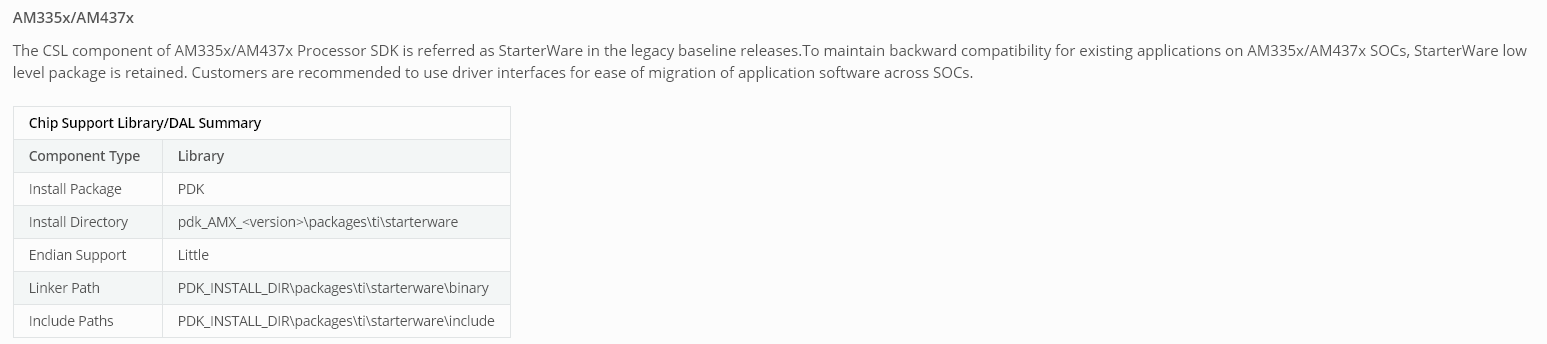
    This is also indicated in the Processor SDK RTOS CSL documentation:

    Please migrate to using UART driver in the PDK package for support from E2E forums as the code base in question here is not supported since we started supporting AM335x platform with Processor SDK RTOS releases.

    Regards,

    Rahul