This thread has been locked.

If you have a related question, please click the "Ask a related question" button in the top right corner. The newly created question will be automatically linked to this question.

AM3352: USB speed too low

Part Number: AM3352

Hi :

We use SDK 05.03.00.07 to test USB speed. Use the following instructions:

hdparm -t /dev/sda1

The test results are as follows:
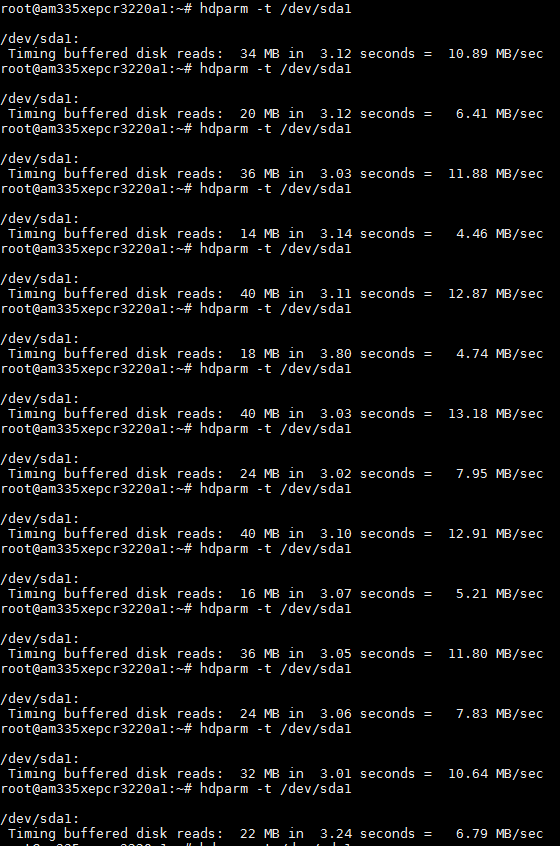
When we fixed the CPU frequency to 800M,the speed is stable at 12MB/sec :

# hdparm -t /dev/sda1

/dev/sda1:
Timing buffered disk reads: 38 MB in 3.02 seconds = 12.59 MB/sec
# hdparm -t /dev/sda1

/dev/sda1:
Timing buffered disk reads: 38 MB in 3.02 seconds = 12.59 MB/sec
# hdparm -t /dev/sda1

/dev/sda1:
Timing buffered disk reads: 38 MB in 3.06 seconds = 12.42 MB/sec

 But when we use SDK 03.01.00.06 and CPU frequency is not fixed, the speed is stable at 16MB/sec. 

# hdparm -t /dev/sda1

/dev/sda1:
Timing buffered disk reads: 50 MB in 3.00 seconds = 16.65 MB/sec
# hdparm -t /dev/sda1

/dev/sda1:
Timing buffered disk reads: 50 MB in 3.09 seconds = 16.19 MB/sec
# hdparm -t /dev/sda1

/dev/sda1:
Timing buffered disk reads: 50 MB in 3.01 seconds = 16.61 MB/sec
# hdparm -t /dev/sda1

/dev/sda1:
Timing buffered disk reads: 50 MB in 3.09 seconds = 16.20 MB/sec

  • Hi,

    With PLSDK 5.3.0.7, if CPU frequency is not fixed to 800MHz, what is the cpufreq governor which you use in your test above?

  • Hi Bin

    We haven't made any changes to cpufreq governor, which is consistent with EVMSK.

  • Hi,

    The Processor SDK by default uses cpufreq governor ondenand which would dynamically change the CPU clock based on the system runtime load. So the throughput performance would not be consistent depending on the governor policy. Please change the governor to performance or userspace if you want a consistent throughput.

    You might ask why SDK3.1 behaviors differently - SDK v5.3 uses kernel v4.14 while SDK v3.1 uses kernel v4.4 which is two years older. It is common that the kernel cpufreq policies have great difference across the two-years development.