This thread has been locked.

If you have a related question, please click the "Ask a related question" button in the top right corner. The newly created question will be automatically linked to this question.

TDA2PXEVM: Radar algorithm handles time

Part Number: TDA2PXEVM

Hi

I want to ask about the processing time of radar algorithms on EVE and DSP.

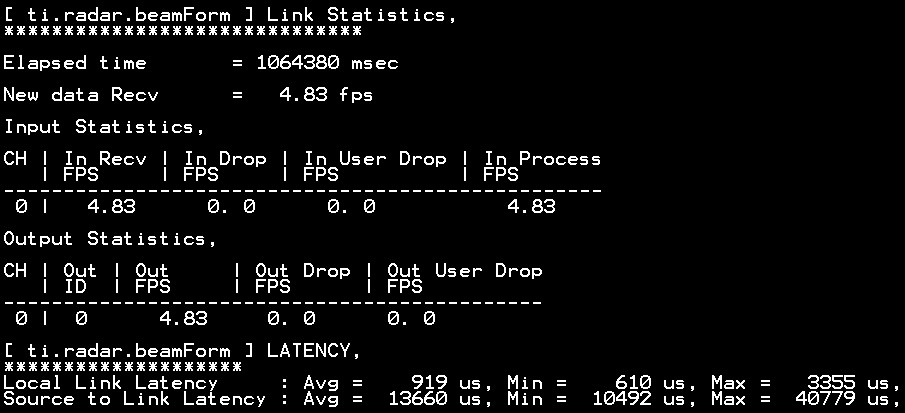
When I use radar_read_objectdetect_write usecase and process the sample data Input_512x128_4Rx_1Tx_1TS_10Frm.bin, the radar algorithm processing time is as shown below:

Average total time = 5516 + 6902 + 919 = 13337us

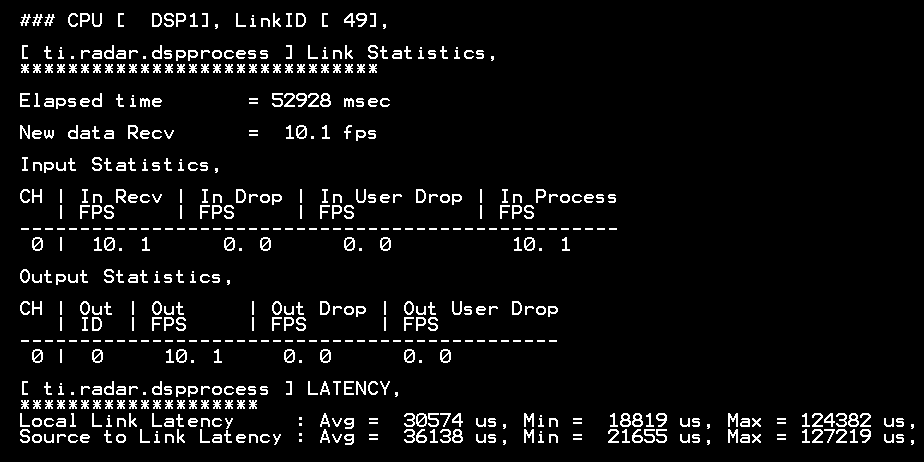
When I use usecase:NetworkRx(IPU1_1) -> Alg_RadarProcess_fft (DSP1) -> Alg_RadarProcess_objectDetect (DSP1) -> NetworkTx (IPU1_1)

1D FFT on EVE and 2D FFT CFAR AOA on DSP:
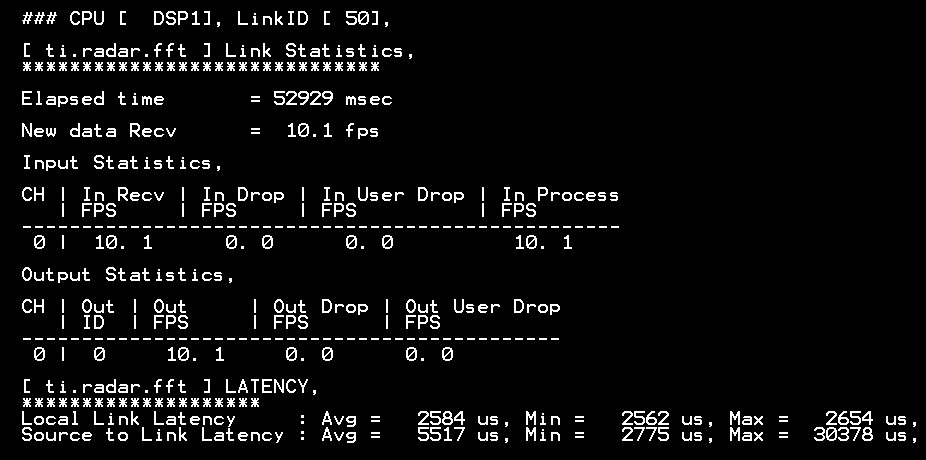
Average total time = 2584 + 30574 = 33158us

(1)Why do all the algorithms run on EVE so much less time than 1D FFT on EVE, 2D FFT, CFAR, AOA on DSP?Is it because AOA processing takes time?

(2)Is the 16-bit 2D FFT processed on the DSP?

Looking forward to your reply.

  • Hi 

    The EVE implementation is more memory efficient and compute efficient with respect to the DSP when it comes ot the 2D FFT stage. Also note the 2D FFT on the DSP is 32 bit and the EVE is 16 bit by deault. The AoA algorithm of DSP is different from the EVE. EVE uses beam forming (essentiallly matrix multiplication. The DSP uses 3rd dim FFT.

    In the 2D FFT case the first dimension is always on the EVE. The EVE can perform the 2nd dim FFT (16 bit or 32 bit output configuration is present). In your case it looks like the 2nd dim FFT is done by the DSP. This is a 32 bit floating point FFT operation.

    Thanks and Regards

    Piyali