This thread has been locked.

If you have a related question, please click the "Ask a related question" button in the top right corner. The newly created question will be automatically linked to this question.

AM5746: QSPI clock

Guru 10295 points

Part Number: AM5746
Other Parts Discussed in Thread: SYSCONFIG,


Sitara Support Team,

My customer would like to know about the QSPI clock.
When reading the U-boot, the clock stops as shown in the following image.
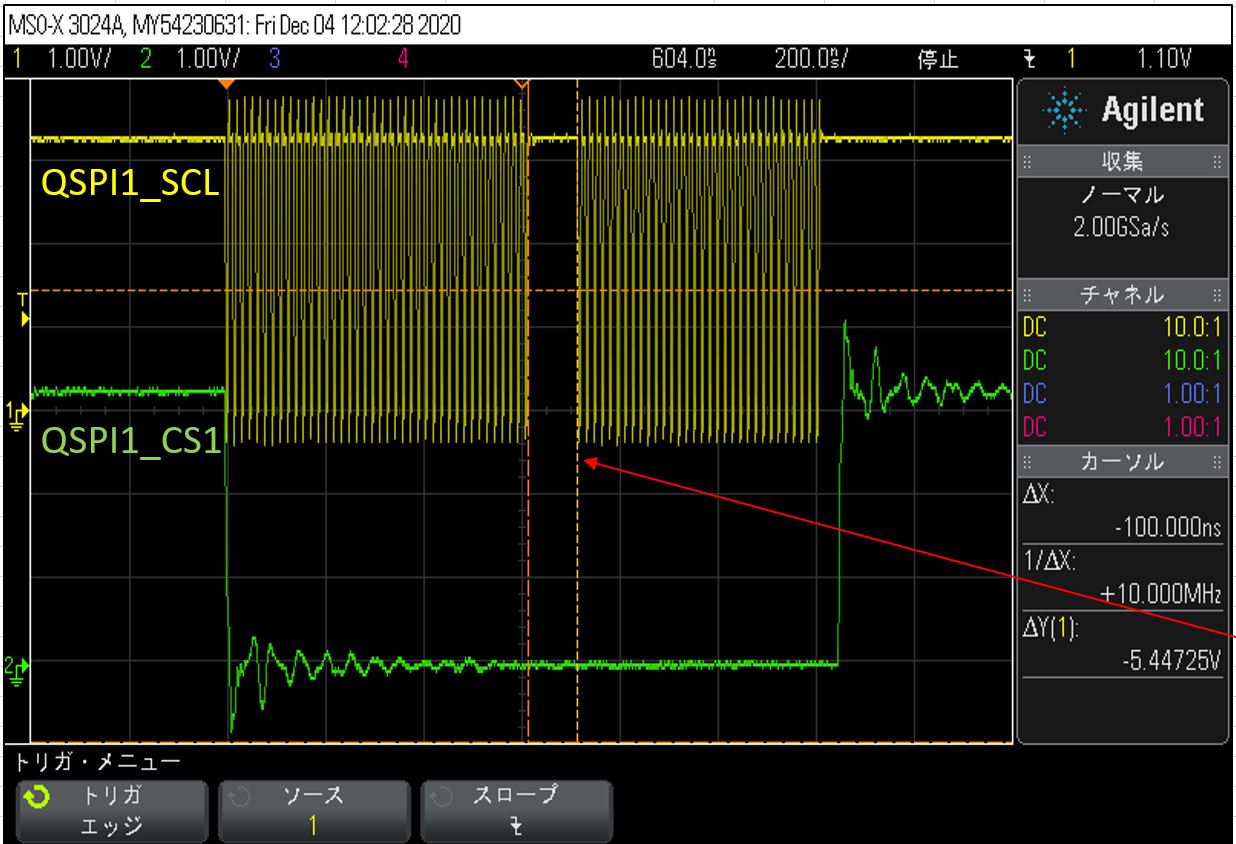

What is the cause of this clock stop?
Also, is there any way to avoid this stop?

My customer supposes that CMD 8bit, Address 16bit, and DummyCycle2bytes are
before this stopping interval, and data 32bit is after this stopping interval.

The register setting is as follows.

Register                       Address               Setting value
CM_DIV_H13_DPLL_PER              0x4a008160         0x00000204
QSPI_SYSCONFIG                           0x4b300010         0x00000004
QSPI_SPI_CLOCK_CNTRL_REG    0x4b300040         0x80000002
QSPI_SPI_DC_REG                          0x4b300044        0x00000050
QSPI_SPI_SETUP1_REG                 0x4b300058        0x09030002
QSPI_SPI_SWITCH_REG                 0x4b300064        0x00000001
CTRL_CORE_CONTROL_IO_2        0x4a002558        0x00000200

Best regards,
Kanae

  • Hi,

    Which SDK and Kernel version is this ?

    Regards

    Vineet

  • Hi Vineet,

    Thank you for your reply.

    My customer commented as follows.

    "This is a read on a U-boot, so I don't think it's related to the TI_SDK.
    I realize that the QSPI module can work without software,
    but why do you need the software version information?"

    Could you please reply why you need the software version information, 
    and the reason of a QSPI clock stop ?

    Best regards,
    Kanae.

  • Hi Vineet and Sitara support members,

    My customer commented again that software version information is not needed in this case.

    He doesn't think it's a matter of not telling them
    because they don't want to disclose the current software version they are using,
    but because it's before Linux boots on the U-boot, I don't think it matters.

    He thinks this is something that only works with the hardware register settings.
    It can also work without software, as described on page 5998 of TRM.

    ============================================================================

    In addition, an interface bridge connects the two ports (configuration port and memory-mapped port)
    of the SFI_MM_IF block to the L3_MAIN interconnect. There are no software controls associated
    with this interface bridge.

    ============================================================================

    Could you please reply why you need the software version information, 
    and the reason of a QSPI clock stop ?

    If you need other information to find out the cause of a QSPI clock stop,
    Please let me know.

    Best regards,
    Kanae.

  • Hi Vineet and Sitara support members,


    As Zack Brown comments on 2020-Jun-9 at the following site,
    I wonder if this is the cause of the problem my customers are experiencing.

    Zack: there might be a delay in updating the busy flag from the memory mapped register.

    e2e.ti.com/.../906346

    Also, this site is "Solved", am I correct in assuming that this is resolved?
    Could you please let me know what you think?

    Best regards,
    Kanae


  • Hi Kanae,

    Thanks for looking it up in E2E. I believe this is the same behavior as that post.

    Regards,
    Stanley

  • Hi Stanley,

    Thank you for your reply.

    So, as per the post on the above site, am I correct in understanding that
    "Switching to using interrupts instead of register polling may help in reducing this unnecessary delay in your code."
    in order to eliminate the clock stopping period?

    Can I recommend this suggestion to my customers?

    Best regards,
    Kanae

  • Sure. Polling the value of register can add additional delay.

  • Hi Stanley,

    Thank you for your support.

    My customer has an additional question.
    The following E2E site has been marked as "Resolved" due to the significant reduction in gap time.
    e2e.ti.com/.../90634

    Zack Brown's post on 6/9/2020 shows the possible causes and suggested countermeasure 
    as follows, is these countermeasure verified by TI?

    >Zack Brown
    If CS more closely matches the duration of clock activity,
    that tells me there might be a delay in updating the busy flag from the memory mapped register.
    Switching to using interrupts instead of register polling may help in reducing this unnecessary
    delay in your code.

    My customer needs a verified solution, so please let us know the results of your verification.

    Best regards,
    Kanae

  • Will check with Zack.

  • The countermeasure was not verified by TI, but was accepted by the customer as fixing his problem.  I stand by that recommendation when using the QSPI Configuration Port.  But from my reading of the registers given above, this customer is using the SFI interface.  So I don't think the solution in the other E2E thread will work.

    Can you confirm that SFI mode is being used when the customer observes this phenomenon?  I'm not sure how much control the user has over timing when SFI mode is being used.  Also, my reading of the registers is different from the description in the original post.  The original post "supposes that CMD 8bit, Address 16bit, and DummyCycle2bytes are before this stopping interval, and data 32bit is after this stopping interval."  However, the registers given would indicate that they are using 8 bits for command, 8 bits for address, and 9 bits for dummy cycles.  Please ask the customer to clarify this.

    -Zack

  • Hi Stanley and Zack,

    Thank you for your supports.
    We will check the items you pointed out and get back to you.

    Best regards,
    Kanae

  • Hi Zack,

    I checked the following items from my customer.

    ===============================================================================
    Zack: Can you confirm that SFI mode is being used when the customer observes this phenomenon?

    >If SFI mode means that the mode using SFI Translator = access using Memory Mapped Port, then "Yes".

    Zack: However, the registers given would indicate that they are using 8 bits for command, 8 bits for address, 
    and 9 bits for dummy cycles. Please ask the customer to clarify this.

    >As for DummyCycle, the register value was incorrectly written.
    Correctly, QSPI_SPI_SETUP1_REG: 0x4b300058 should be "0x00020903".

    ===============================================================================

    If you have unclear part, please point it out. 

    Best regards,
    Kanae

  • Kanae,

    I understand the QSPI_SPI_SETUP1_REG now.  Thanks for the clarification.  When reading from the QSPI as a memory mapped device, the SFI Translator has control over the state machine.  As such, there's nothing that you can do about the delay between the dummy phase and the data phase.  Please let me know if the customer has any other questions.

    -Zack

  • Hi Zack,

    Thanks for your support.

    Am I correct in understanding that the delay between dummy and data is the delay that
    occurs between #4. and #5. as described below in TRM; 24.5.4.1.2 SFI Translator,
    and that there is nothing to do about this delay in SFI mode?

    == In 24.5.4.1.2 SFI Translator =======================================

    A read sequence is converted into the following actions:
    1. SPI chip-select goes active.
    2. Read command byte is issued.
    3. 1 to 4 address bytes, which correspond to the first address supplied, are issued.
    4. 0 to 3 dummy bytes are issued, if “fast read” is supported.
    5. Data bytes are read from the external SPI flash memory.
    6. SPI chip-select goes inactive.

    ================================================================

    Or am I correct in understanding that the countermeasure you suggest in the following site is effective in this case as well?

    "Switching to using interrupts instead of register polling may help in reducing this unnecessary delay in your code."

    e2e.ti.com/.../906346


    I apologize for my lack of understanding, but I would appreciate your help.

    Best regards,
    Kanae

  • Kanae,

    "Am I correct in understanding that the delay between dummy and data is the delay that
    occurs between #4. and #5. as described below in TRM; 24.5.4.1.2 SFI Translator,
    and that there is nothing to do about this delay in SFI mode?"

    That is correct.

    -Zack

  • Hi Zack,

    Thank you for your reply.

    I will explain the above to my customer and make sure
    that he understands that it is a specification of AM5746.

    I appreciate your kind support.

    Best regards,
    Kanae