This thread has been locked.

If you have a related question, please click the "Ask a related question" button in the top right corner. The newly created question will be automatically linked to this question.

AWR1843: Question on Q9 in QSPI timing

Part Number: AWR1843


Hi,

I am confusing of the Q9 in QSPI timing. Would you pls help?

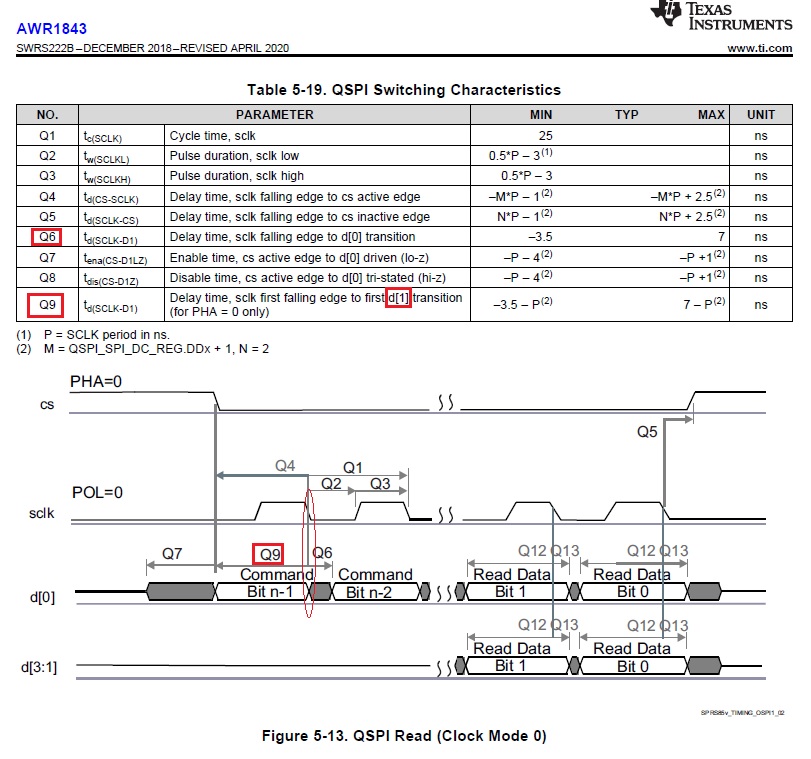
In the table 5-19, it says that Q9 is related to sclk first falling edge. Does it mean the first falling edge of sclk after CS to low (active)?

In table 5-19, it says that Q9 is related to d[1], but in figure 5-13, it only shows Q9 on d[0]. Shall we change d[1] to d[0] for Q9?

If yes, it seems that Q9 is similar to Q6. But if customer uses sclk with 40Mhz, then P=25ns. Then the range of Q9 is -28.5ns ~ -18ns. This range is much difference with Q6 range (-3.5ns~7ns). Is there anything wrong with the min/max value for Q9 in below table? Or I miss anything?
  • Hello Chris,

    Q6 is the delay between the falling edge of the clock and the change on the data lane. ie the grey area marked in the figure. This can be from -3.5 to +7 nsec, indicating that the data can change 3.5 nsec before the clock edge or 7 nsec after the clock edge.

    Q9 is the delay of the first data change from the falling edge of the CS signal . This is 1 sclk period more than Q6.

    Regards,

    Vivek

  • Hello Chris,

    One correction. Q9 is actually the point at which the first bit gets transmitted out before the first SCLK falling edge. Since in this mode the first bit is sent out before the first clock edge.

    Regards,
    Vivek