This thread has been locked.

If you have a related question, please click the "Ask a related question" button in the top right corner. The newly created question will be automatically linked to this question.

CC2652P: Default TX Power / 10 bDm Issues

Part Number: CC2652P
Other Parts Discussed in Thread: SYSCONFIG, , CC1352P

I am checking the output power of my custom board on RF analyzer. 

As per the observations I can see that that on increasing the distance of my transmitter board, the RF Power increases. I saw that on 3m it transmit at 10 dBm power while on 1m it does at 6 dBm.

I this correct. I want to transmit the data always at 10 dBm settings by default.

Below are the settings which are done at sysconfig side :- 

1. TX Used - CC2652P Custom Board

2. RX Used - CC1352P Launchpad

3. Default Tx Power  - 0
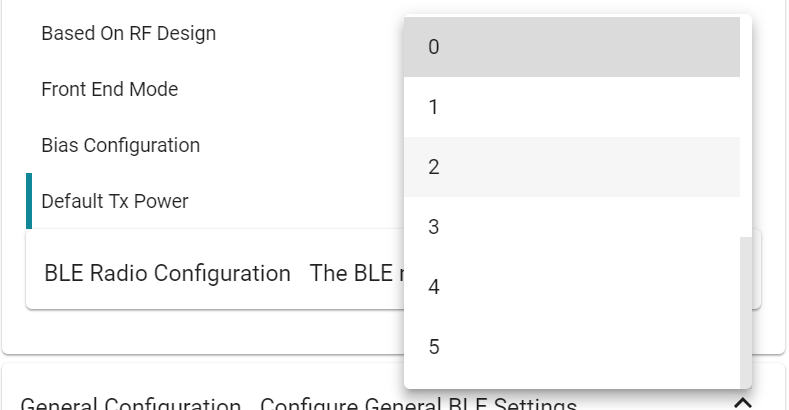
4. High PA Enbled and Tx power set to 10 dBm
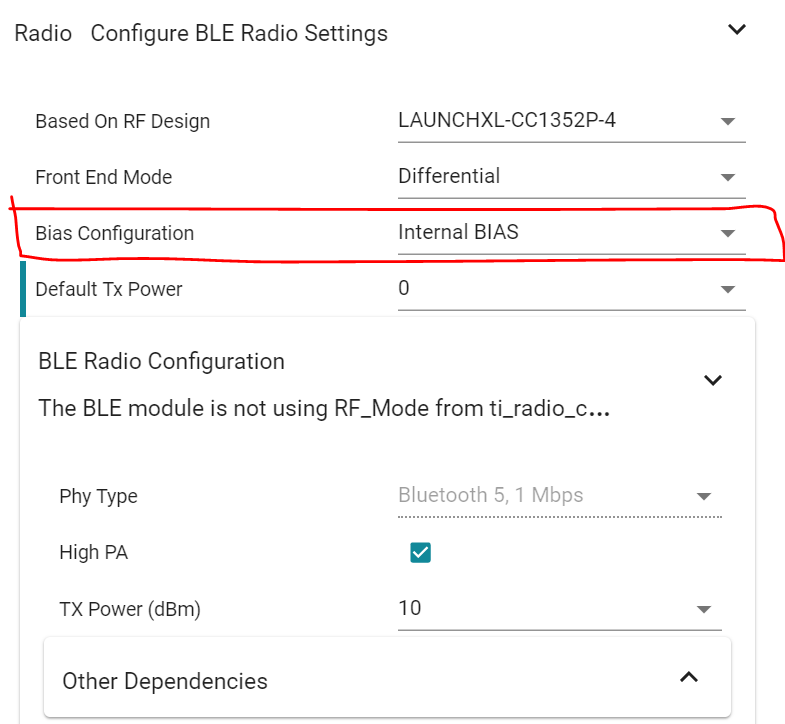
Does setting the Default Tx Power to 0 dBm makes it controlled by controller. Does setting the same to 10 dBm will make it default as 10 dBm even at 3m distance ?

Any more suggestion related to max power ?

Please refer my Old thread for more Information - CC2652P: Tx Power out / Range problem - Bluetooth forum - Bluetooth®︎ - TI E2E support forums


Additionally, Do you have any kind of Guide available for the Different Parameters of SysConfig. I don't see much information available in the i tab. Some of them even don't have i tab.
It would be great if you can send any document with detailed explanation of SysConfig parameters and their actual use.


Regards,
Ankit

  • Ankit,

    Since you are using a RF analyzer, could you try to do your tests using the SmartRF Studio 7? This will help you isolate the code from the hardware while at the same time having full control over the radio and perform the tests with different  protocols, including BLE. A user's guide is shown at:

    https://software-dl.ti.com/lprf/smartrftm_studio/docs/help/html/srfstudio.html

    Does setting the Default Tx Power to 0 dBm makes it controlled by controller. Does setting the same to 10 dBm will make it default as 10 dBm even at 3m distance ?

    The power setting on the code is not related to the distance: this is the output at the radio of the device. Regarding the measurements themselves, one aspect that you might be missing is multiple path interference, which can happen in irradiated tests depending outside of an anechoic chamber. This makes an answer to your question a very difficult one without knowing the environment, thus the testing is your best approach. 

    Also, if your custom board has a connector (SMA, U.FL) you could also verify the settings by performing conducted tests - this will allow an accurate verification of the power at the output of the Radio.

    Hope this helps,

    Rafael

  • Hello Desouza,

    I understand that testing the sensors outside anechoic chamber will cause disturbances. But we make sure our room is completely closed and no BLE networks are shown, we checked the peaks by bringing the Tx close to Receiver of RF Analyzer and saw the peaks rise/ change, so we confirmed that the signal is our BLE, we make sure that sensor is the only 2.4 ghz signal which is close to our Rx so maximum signal strength is with our board and used max peak detection.

    We were using SDK 4.1 which does not have support for PA I guess(As reported in attached thread), I  upgraded the SDK to 5.1, though not tested on the RF analyzer, I checked the RSSI and saw an improvement, I also saw the current consumption and it got doubled nearly 22mA. I conducted some tests with the vehicle environment and saw no improvement there, but if I bring the Rx Antenna outside the Vehicle I can see data.

    FYI - Our 4 custom boards CC2552P are Tx with 10 bDm power and 1 Rx inside the car CC1352P4 Launchpad. But I saw no Improvement. 
    I used SMA antenna port of launchpad the results are even worst.


    Is 10 dBm not enough to pass those thick metal sheets. If it is then can you suggest something by which we can get data inside (Our data freq is more). 
    We do have a (SMA, U.FL) but I think our board is now transmitting with 10 dBm.

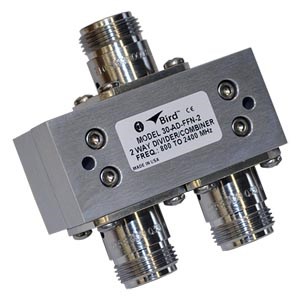
    Also Can you please tell me if we can use Receiving Antenna diversity approach here so that we have 2 antennas and passing through a combiner (2.5 Ghz) which will be connected to SMA pin of Our RX Launchpad CC1352P.
      
    Above Image is Receiver Diversity

    An Example of Combiner


    Note : The Above images are only for example purpose.

    Regards,
    Ankit Tomar

  • Ankit,

    Please apologize for the delay. As I mentioned in my prior reply, multipath reflections and dispersion can be causing the variations in power measurements, even on the interior of a shielded Faraday case. Given you are doing irradiated tests, it is quite difficult to try to reproduce any of your results locally and therefore I am afraid I can't hold .

    I checked the RSSI and saw an improvement, I also saw the current consumption and it got doubled nearly 22mA. I conducted some tests with the vehicle environment and saw no improvement there, but if I bring the Rx Antenna outside the Vehicle I can see data.

    From the current consumption I can infer the +10dBm PA is enabled, but I am unsure what you mean by "if I bring the Rx Antenna outside the Vehicle I can see data". Does it mean that you can't receive anything inside the vehicle? If your transmitter (or transmitters?) are outside the vehicle, then the same principles above are applicable: attenuation and/or reflections might be causing the issues.

    FYI - Our 4 custom boards CC2552P are Tx with 10 bDm power and 1 Rx inside the car CC1352P4 Launchpad. But I saw no Improvement. 
    I used SMA antenna port of launchpad the results are even worst.

    I am assuming you are using only one transmitter at a time, right?

    One additional note: the SMA port is normally disconnected from the RF path on our launchpads - you just need to flip a capacitor on the board. Also, it is not matched to the external antenna, thus it might yield lower output power.

    Is 10 dBm not enough to pass those thick metal sheets. If it is then can you suggest something by which we can get data inside (Our data freq is more). 

    A grounded metal case will block any radio waves across it. We usually have a small opening where we pass coaxial cables through.

    Also Can you please tell me if we can use Receiving Antenna diversity approach here so that we have 2 antennas and passing through a combiner (2.5 Ghz) which will be connected to SMA pin of Our RX Launchpad CC1352P.

    I haven't used an application for Rx antenna diversity on our devices, but a colleague mentioned that one of the cons is the insertion loss on the RF path (intrinsic to the combiner) of about 3.5dBm.

    Hope this helps,

    Rafael

  • Hi,

    From the current consumption I can infer the +10dBm PA is enabled, but I am unsure what you mean by "if I bring the Rx Antenna outside the Vehicle I can see data". Does it mean that you can't receive anything inside the vehicle? If your transmitter (or transmitters?) are outside the vehicle, then the same principles above are applicable: attenuation and/or reflections might be causing the issues.

    Our TX (4 in Nos) are placed outside car. And 1 RX inside Car. By using this approach we are unable to get all 4 TX data inside the car at 100 packets per second speed. I bring antenna outside car and I receive good data more than 90%. But when I take the Rx antenna inside car below roof top I see the data is less. If I had to say specifically I saw less percentage from 3 sensors and no connection from 1 sensors. I saw less data while inside while outside I see good data.

    I am assuming you are using only one transmitter at a time, right?

    No, we are using all 4 TX at same time with 1 RX only i.e. RX will have to receive 400 data per second.

    One additional note: the SMA port is normally disconnected from the RF path on our launchpads - you just need to flip a capacitor on the board. Also, it is not matched to the external antenna, thus it might yield lower output power.

    Yes, I understand that and necessary changes are already done.

    A grounded metal case will block any radio waves across it. We usually have a small opening where we pass coaxial cables through.

    But our Antenna RX is inside the Vehicle Environment.


    Regards