• Join
  • Sign In with my.TI Login
Texas Instruments
  • Products
  • Applications
  • Tools & Software
  • Support & Community
  • Sample & Buy
  • About TI
Sample & Purchase Cart Sample & Purchase Cart
  • Search
  • Advanced
TI E2E™ Community
  • Support Forums
  • Blogs
  • Groups
  • Videos
  • 简体中文
  • More ...
TI Home » TI E2E Community » Support Forums » Amplifiers » Precision Amplifiers » Precision Amplifiers Forum » OPA227 Open Loop Pole Locations
Share
Precision Amplifiers
  • Forum
  • Announcements
  • E2E Wiki
Options
  • Subscribe via RSS
Check out
The Signal blog
  • $core_v2_blog.Current.Name

    Grounding Principles

    Posted 12 hours ago
    by Bruce Trump
    In a previous blog on supply bypassing , I cautioned that poor...
  • $core_v2_blog.Current.Name

    Handy Gadgets and Resistor Divider Calculations

    Posted 8 days ago
    by Bruce Trump
    Handy gadgets make our engineering life easier—the little...
  • $core_v2_blog.Current.Name

    Chopper Op Amps—are they really noisy?

    Posted 15 days ago
    by Bruce Trump
    Chopper op amps offer very low offset voltage and dramatically...

OPA227 Open Loop Pole Locations

OPA227 Open Loop Pole Locations

This question is not answered
Hassan Kelley
Posted by Hassan Kelley
on Dec 27 2012 09:15 AM
Prodigy80 points

What are the locations of the open loop pole frequencies of the OPA227?  I estimate there is a low frequency pole at about 0.08Hz but most op amps have at least one more pole at a frequency higher than the unity gain frequency of the op amp.

I ask because I am designing a low noise composite amplifier with a discrete BJT differential pair front end.  The OPA227 will serve as the second stage amplifier taking the differential output of the first stage from the BJT collectors.  I must know the composite amplifiers open loop response to properly compensate it.  I know the open loop response of the discrete first stage and now only require the open loop response of the OPA227 second stage.

Thanks

--hassan

Report Abuse
  • Reply
You have posted to a forum that requires a moderator to approve posts before they are publicly available.
All Replies
  • Marek Lis
    Posted by Marek Lis
    on Dec 27 2012 11:54 AM
    Genius13480 points
    OPA227 Reference design.tsc

    Hassan,

    Since the Gain Bandwidth Product (GBW) of OPA227 is 8 MHz, the dominant pole location, f1, will be a function of DC Open-Loop Gain (AOL) where f1=8.0e6/AOL_DC; thus, for the typical DC AOLof 160dB (1.0e8) the dominant pole would occur at f1=8.0e6/1.0e8=0.08Hz but for the minimum DC AOL of 132dB (4.0e6) it would occur at 8.0e6/4.0e6=2Hz. 

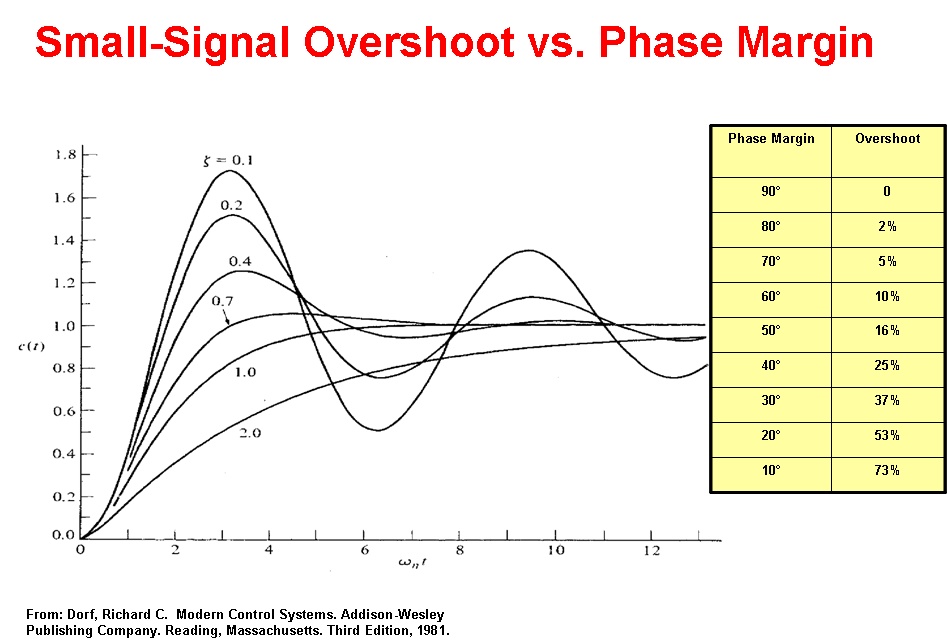
    However, it is the high-frequency pole(s) that determine stability of the overall system as they cause the phase margin to shift from 90 deg to or below zero at the effective bandwidth frequency of the system - see AOL graph below.  In case of OPA227 there also must clearly be a high frequency zero (flattening of AOL curve) followed by at least two high frequency poles but these could be simplified as a single high frequency pole having the same effect on a phase margin - since a single pole causes a phase shift of 45deg at the location of the pole while in the case of OPA227 at unity-gain frequency of 8MHz the phase is shifted by only 30deg (from -90 deg to -120deg), the location of the high frequency pole would have to be around 16MHz.  Of course, as mentioned before, this is over-simplification of the actual system and to analyze stability of the system one also needs to know the open-loop output impedance of OPA227 (not given) at the frequency of its effective bandwidth.  For that reason, the best approach is to apply a small signal (100mVpp square waveform) and to make sure that the output does NOT overshoot by more than 25% assuring at least 40 deg phase margin - see table below.

    Short of doing that, the best way to analyze the system is to use the OPA227 macro-model provided on TI website and to simulate various loading effects - I have attached it in this post for your convenience, or to use the Small-Signal Overshoot vs Load Capacitance graph below to assure 40% overshoot or less for any given combination of gain and capacitive load.

    Regards,

    Marek Lis
    Sr Application Engineer
    Precision Analog - Burr-Brown Products
    Texas Instruments - Tucson

    Report Abuse
    • Reply
    You have posted to a forum that requires a moderator to approve posts before they are publicly available.
TI E2E™ Community
  • Support Forums
  • Blogs
  • Videos
  • Groups
  • Site Support & Feedback
  • Settings
TI E2E™ Community Groups
  • TI University Program
  • Make the Switch
  • Microcontroller Projects
  • Motor Drive & Control
Other Communities
  • Deyisupport
  • Designsomething.org
  • beagleboard.org
  • TI on Element 14
  • TI on TechXchangeSM
Other Technical & Support Resources
  • WEBENCH® Design Center
  • Product Information Centers
  • Technical Documents
  • TI Design Network
  • TI Technical Articles
  • TI Training

All content and materials on this site are provided "as is". TI and its respective suppliers and providers of content make no representations about the suitability of these materials for any purpose and disclaim all warranties and conditions with regard to these materials, including but not limited to all implied warranties and conditions of merchantability, fitness for a particular purpose, title and non-infringement of any third party intellectual property right. TI and its respective suppliers and providers of content make no representations about the suitability of these materials for any purpose and disclaim all warranties and conditions with respect to these materials. No license, either express or implied, by estoppel or otherwise, is granted by TI. Use of the information on this site may require a license from a third party, or a license from TI.

Content on this site may contain or be subject to specific guidelines or limitations on use. All postings and use of the content on this site are subject to the Terms of Use of the site; third parties using this content agree to abide by any limitations or guidelines and to comply with the Terms of Use of this site. TI, its suppliers and providers of content reserve the right to make corrections, deletions, modifications, enhancements, improvements and other changes to the content and materials, its products, programs and services at any time or to move or discontinue any content, products, programs, or services without notice.

Follow Us Texas Instruments on Facebook Texas Instruments on Twitter Texas Instruments on LinkedIn Texas Instruments on Google+
TI Worldwide | Contact Us | my.TI Login | Site Map | Corporate Citizenship | mobile m.ti.com (Mobile Version)

TI is a global semiconductor design and manufacturing company. Innovate with 100,000+ analog ICs and
embedded processors, along with software, tools and the industry’s largest sales/support staff.

© Copyright 1995-2013 Texas Instruments Incorporated. All rights reserved.
Trademarks | Privacy Policy | Terms of Use