This thread has been locked.

If you have a related question, please click the "Ask a related question" button in the top right corner. The newly created question will be automatically linked to this question.

Accurate small current sensing

Other Parts Discussed in Thread: OPA380, VCA820

C

AHi,

Thank you for reading.

I am designing small current sensing. And I read https://training.ti.com/high-speed-transimpedence-amplifier-design-flow

But some of them are talking about photodiodes, and my application may be different.

My requirements include:

Low input resistance, let say <50ohms

Large current dynamic range: 1uA to 1mA (Post-VGA/PGA may be needed)

High bandwidth > 10MHz is preferred.

After this analog front-end, I would prefer a 10-bit ADC with 0-1.8V input range.

And my input devices can be seen as a resistor, not like photodiodes with a capacitor. My parallel capacitor is small.

My confusion includes:

Why do we need capacitor feedback? Is it used for Gain compensation? 

If my measuring devices are just a resistor, can we remove the capacitor feedback?
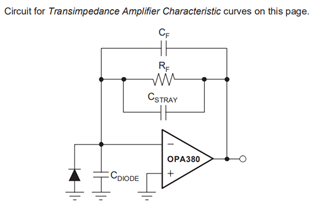
And one of the workable solutions I can use is OPA380. Maybe TI doesn't provide suitably PGA, so I think the post-PGA can be AD8253 by ADI (https://www.analog.com/media/cn/technical-documentation/data-sheets/AD8253_cn.pdf). Sorry to talk your competitive company here. But I would be happy to see if TI provides similar products.

I don't want VGA because it is hard to control the gain exactly accurate and I need another DAC.

But maybe VCA820 is a good backup. 

So my final design may be :

1ua to 1mA -> Transimpedance AMP -> PGA (1 to 1000) -> 10-bit 100MSPS ADC

I would be grateful if you can give me some suggestions.

Thank you very much!

  • Hi Simba,

    Why do we need capacitor feedback? Is it used for Gain compensation?

    The detector capacitance causes an erosion of phase margin of OPAmp. Therefore a phase-lead capacitance in the feedback path is necessary to recover the phase margin. (Phase-lead is the opposite of phase-lag.)

    With low detector capacitance, low phase-lead capacitance is needed. This is the typical trend. But it depends a bit on actual OPAmp.

    If my measuring devices are just a resistor, can we remove the capacitor feedback?

    Not entirely, usually, but can be decreased. Again, this depends on the actual OPAmp.

    Is any cabling involved at the input? I ask, because this would look like unwanted "detector" capacitance Relaxed

    Kai

  • So, I may leave a place for soldering a capacitor.

    How can I measure whether my capacitor is large enough?

    Do we need to measure the exactly parasitic capacitor so that we can calculate the parallel feed resistor?

    Thanks.

  • Hi Simba,

    we can help you to carry out a phase stability analysis, once we know the input capacitance.

    Please tell more about your application. What is mounted to the input? Is a cable involved?

    And yes, I would leave place for a phase-lead capacitor.

    Kai