This thread has been locked.

If you have a related question, please click the "Ask a related question" button in the top right corner. The newly created question will be automatically linked to this question.

OPA2211-EP: Input Common-Mode Voltage Range vs Temperature

Part Number: OPA2211-EP

Hi Team,

Do we have characterization, like a plot response of the input common-mode voltage range of OPA2211-EP versus its whole temperature range?

If we do not have this data per temperature steps, even the input common-mode range at the full temperature range would do. Asking this as the range listed in the datasheet seems to be provided only for 25°C.

Thanks in advance!


Kind Regards,

Jejomar

  • Hi Jejomar,

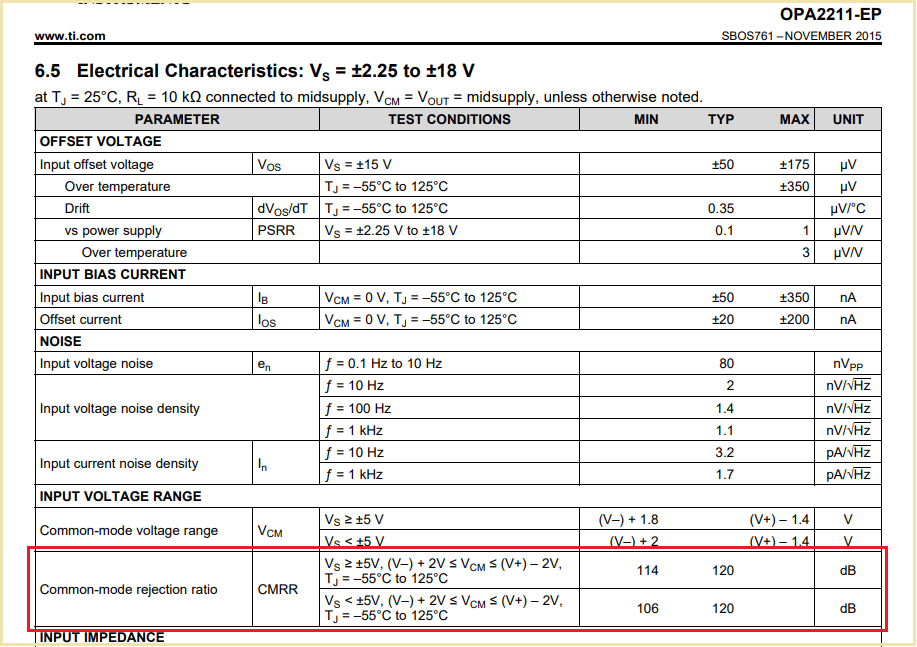
    have seen this in the datasheet?

    This reads like that you should stay 2V away from the supply rails to get the full common mode rejection ratio in the full temperature range. So this is the guaranteed common mode input voltage range in the full temperature range.

    Kai

  • Hi Jejomar,

    Do we have characterization, like a plot response of the input common-mode voltage range of OPA2211-EP versus its whole temperature range?

    I would take Kai's comments from the CMRR figures in the datasheet between -55C to +125C in Tj or  junction temperature. 

    If supply voltage, Vs ≥ ±5V, CMRR low is 114dB or 10^(-114dB/20) = 2 uV/V,  typical value is 120dB or 1uV/V.

    If supply voltage, Vs < ±5V, CMRR low is 106dB or  5uV/V,  typical value is 120dB or 1uV/V.

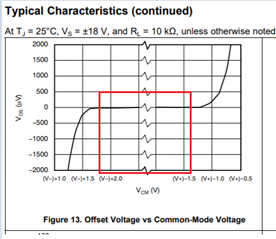
    At Ta=25C, Vos vs Vcm is shown in Figure 13, where Vos = the CMRR figure * Vcm  + Vos at Tamb

    (e.g., Vos at 25C in worst case with Vcm of 10V = 2 uV/V * 10Vcm + 175uV = 195 uV ) 

    If you have additional questions, please let us know. 

    Best,

    Raymond