Other Parts Discussed in Thread: AMC1411, TLV9001
Hi There,
I wonder if TI has a solution for SI8932B-IS. Thanks,
FYI, https://www.skyworksinc.com/-/media/Skyworks/SL/documents/public/data-sheets/si8931-32-datasheet.pdf
This thread has been locked.
If you have a related question, please click the "Ask a related question" button in the top right corner. The newly created question will be automatically linked to this question.
Hello,
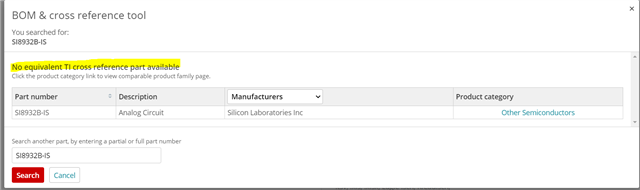
For future reference, TI.com provides a quick BOM & Cross reference tool, where one can search for TI equivalent parts based on part numbers, as shown below.
Click Here to see a list of the Isolated Amplifier portfolio available. I would suggest taking a closer look at AMC1411.
Regards
Cynthia
Hi Cynthia,
I wasn't able to find any equivalent parts in Cross reference tool. Thank you for letting me know a new part, AMC1411.

Q1. Could you also let me know when it would be released?
In addition, customer is using SI8932B-IS, a single ended output device. But AMC1411 has a differential output.
Q2. When I check the Iso Amp list that you attached, TI portfolio supports differential output only. Could you double check if TI has devices with the single ended output ?
Q3. Can customer replace SI8932B-IS with AMC1411 simply by connecting OUTN to GND?
Hi Ella,
AMC1311B is probably the best recommendation to replace SI8932B-IS. The AMC1411 is similar to the AMC1311B but in a wider package that offers higher isolation ratings.
1. No, I cannot discuss release timelines on the public forum.
2. As you mentioned the main difference between the SI8932 and AMC1311B is that the SI8932 has a single-ended output which the AMC1311B does not. However, as explained in this FAQ, there are several things that can be done to accommodate for this difference.
3. As discussed in the FAQ, OUTN should not be directly connected to GND since it is a driven output. It can be left to float or connected to GND through a 10kohm resistor. Keep in mind however that when only measuring OUTP, the the common-mode output voltage can vary +/-50mV, appearing as an offset. If an offset calibration is performed, this is not a concern. For best performance without an offset calibration a differential to single-ended conversion can be performed with an opamp such as TLV9001.