This thread has been locked.

If you have a related question, please click the "Ask a related question" button in the top right corner. The newly created question will be automatically linked to this question.

OPA392: Noise calculation for OPA392

Part Number: OPA392
Other Parts Discussed in Thread: TINA-TI

Hi team,

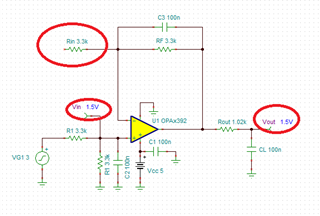
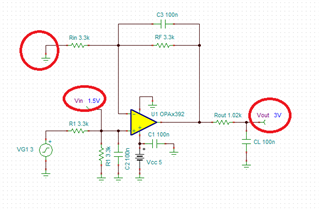
Q1: Use OPA392 as the differential circuit, How to calculate the output noise as below?  Can you send me a detail steps?

Q2: How to calculate the total output noise   as below?  

Is the total output noise correct? G2 is the differential circuit Gain,G2=1, Is this correct?

  • Anyone can reply the question?

  • Tengfei,

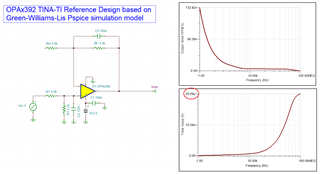
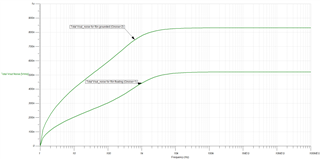
    You may simulate the OPA392 total noise using Tina-TI simulator.  I have done the simulations and in the case without the RC filter at the output, I get the total noise of your configuraton to be 20uVrms or 120uVpp - see below.

    However, adding the low-pass filter at the output, greatly decreases the noise down to 521nVrms or 3.1uVpp - see below.

    For step by step instructions how to hand calculate the noise, please review training video under following link:

    https://training.ti.com/ti-precision-labs-op-amps-noise-spectral-density?context=1139747-1139745-14685-1138803-13232

    Also, please be aware that with the R1 connected to ground, you are referencing the output voltage to ground and thus you may inadvertently push the output too close to the negative rail into non-linear operation - see below.

    Below I have attached Tina-TI schematic for your convenience so you may run your own noise simulations.

    Tengfei OPA392 Noise.TSC

  • Hi Marek,

    Thanks for your reply. Would you help me to calculate the output voltage noise? I want to get how to  calculate the output voltage noise. 

  • Tengfei,

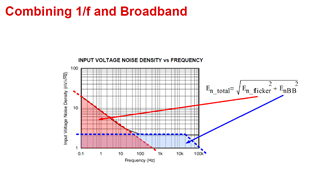
    In order to calculate OPA392 total output noise, first you need to calculate 1/f and broadband noise across configuration noise bandwidth and then combine them together - see below.

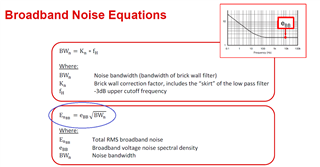
    Below see the equations for 1/f, broadband noise, and noise bandwidth (BWn):

    To this end you need following things:

    1. value of 1/f noise @1Hz

    2. value of broadband noise

    3. Noise bandwidth (BWnoise)

    Since in your configuration any noise generated by the input and feedback resistors is for most part filtered out by 100nF caps across them, we will neglect here the resistor noise and treat the configuration as a buffer so 1/f noise at 1Hz may be read directly from graph below to be around 130nV.

    Removing the output filter for a moment shows 1/f at 1Hz to be 132nV and broadband noise 4.3nV/rt-Hz - see below.

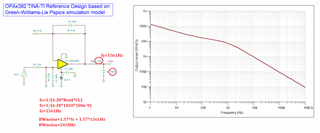
    Low-pass filter at the output cause a signal roll-off at fc=1561Hz and tus results in the noise bandwidth, BWn, of 2450Hz - see below.

    Thus, you may calculate the broadband output noise to be:

    Enbb = 4.3nV/rt-Hz*(2450Hz)^.5 = 212nV

    and 1/f noise, En_flicker = 132nV*[ln(2450Hz/1Hz)]^.5 = 369nV

    Combining 1/f and broadband noise give: Total output noise: (212^2+369^2)^.5 = 425nVrms

    The calculation above neglected the thermal noise of the resistors - challenge for you is to include them in the above calculations.

    Please review the noise training video under following link as I may not provide you with one-on-one tutoring: 

    https://training.ti.com/ti-precision-labs-op-amps-noise-spectral-density?context=1139747-1139745-14685-1138803-13232

  • Hi Marek,

    Why don't multiply by gain? Gain=2, That is 212nV*2=424nV, 369nV*2=738nV. Correct?

  • Tengfei,

    No, this is not correct.  Since you float Rin, it plays no role in setting the gain - it's not existent.  Thus, the noise gain of the configuration is:

    Gain_noise=Vout/Vin=1+RF/Rin = ~1 because Rin->infinity since Rin is floating - see below.

    If you wish for the noise gain to be 2, you must ground the left side of Rin resistor - see below.

    Keep in mind that regardless of the input signal gain (which may be positive or negative), the noise gain is always taken from the perspective of the non-inverting input terminal, IN+.  At this point I would suggest before you continue with noise calculation, you review some basics of how operational amplifiers work.