This thread has been locked.

If you have a related question, please click the "Ask a related question" button in the top right corner. The newly created question will be automatically linked to this question.

TLE2022: Behavior operational amplifier

Part Number: TLE2022
Other Parts Discussed in Thread: TLE2021

Dear Sir or Madam,

we use the operational amplifier TLE2022AID in a circuit and have different behavior with devices from different batches.

Single Supply Voltage OpAmp +5V
non-inverting input +1.3V with respect to GND
inverting input +1.1V with respect to GND

The output then delivers a HIGH as expected for all ICs (no matter from which batch). In the inverted case:

non-inverting input +1.1V with respect to GND
inverting input +1.3V with respect to GND

the output of the OP delivers a LOW as expected.

If we now reduce the voltage at the two inputs of the OP, the behavior of the different batches differs:

non-inverting input +0.3V with respect to GND
inverting input +0.1V with respect to GND

Again, as expected, the output provides a HIGH for all ICs (regardless of which batch). Inverted case:

non-inverting input +0.1V with respect to GND
inverting input +0.3V with respect to GND

some ICs give a HIGH, others correctly a LOW at the output.

Where does this different behavior come from?

Best Regards

  • Hi Philipp,

    can you post a schematic?

    Kai

  • Hi Philipp,

    Kai is correct, we have to see the TLE2022 application schematic to be able to assist. Is this a new TLE2022 application, or an existing application that has never had an issue before?

    Did you purchase the TLE2022 product from TI directly, from a TI authorized distributor, or another source? That is critical for us to know.

    Regards, Thomas

    Precision Amplifiers Applications Engineering

  • Hi Kai, 

    thank you for your reply. The Test set-up is quite simple. This is just to verify the behaviour og the TLE2022. 

    Best Regards

    Philipp

  • Hi Thomas, 

    thank you also for your reply. The issue concerns an existing application which never had that issue before. I than made a test set-up to check the behaviour. See my post 2mins ago.

    I'll check where we purchased these devices and post again.

    Best regards

    Philipp

  • Here the requested information:

    The batch which is working as expected was bought in 2020 from Rehag Elektronik GmbH. The other batch was bought in 2022 from Mouser Electronics.

    Best Regards

    Philipp

  • Hi Philipp,

    take care, your test setup is risky: When exceeding the differential input voltage beyond the maximum allowed +/-600mV, you may barbecue the OPAmp. I would urgently recommend to add 10k resistors in series to each input to provide some input current limiting. See the "absolute maximum ratings" of datasheet.

    There's another issue: The TLE2022 is a dual OPAmp. When testing the one internal amplifier you should not let float the other. So make the other internal amplifier run in its linear operating range by connecting its +input to middsupply -by the help of a voltage divider- and by connecting its -input to its output, forming a simple voltage follower.

    As there's a big chance that you have already killed the OPAmp, I would take a fresh OPAmp, add the two 10k resistors to the inputs and try again.

    Some additional hints:

    1. OPAmp are sensitive to ESD. So please use ESD protection measures during the testing.

    2. Add a 100R isolation resistor to the output of OPAmp.

    3. Only apply the input voltages after fully powering up the OPAmp.

    4. Don't allow the input voltages to exceed the supply voltage (<0V or >+5V).

    Kai

  • Hi Philipp,

    So it appears that the TLE2022 is being tested as a comparator and in which case the op amp should produce an output that follows the simple rules of a comparator. If it doesn't produce the correct output state, then that raises suspicions about the product validity and quality.

    You mention "The other batch was bought in 2022 from Mouser Electronics" which is the one that has devices that are producing the unexpected output state. Although Mouser sources TI product I am not sure they are a Authorized TI Distributor. Unfortunately, if they are not one we have no way of knowing the true origin of the product. 

    The worldwide chip shortage has resulted in widespread chip counterfeiting that has created many problems for the valid IC producers such as TI.

    Regards, Thomas

    Precision Amplifiers Applications Engineering

  • Hi Kai,

    i'm aware of this limitations. But just to be sure i made a new test setup as you recommended. The behaviour is exactly the same. 

    Best Regards

    Philipp

  • Hi Thomas, 

    yes you're right. It's a simple test. But i have to correct the information about the sources of the devices. The information got flipped, so the bad batch is from Rehag Elektronik GmbH, the good batch is from Mouser Electronics. Just to get this right.

    Best Regards

    Philipp

  • One last question, just to be sure:

    Using TLE2022 as comperator, is 

    non-inverting input +0.3V with respect to GND
    inverting input +0.1V with respect to GND

    respectivly

    non-inverting input +0.1V with respect to GND
    inverting input +0.3V with respect to GND

    a valid operating point?

    Thank you.

    Best Regards

    Philipp

  • Hi Philipp,

    The information got flipped, so the bad batch is from Rehag Elektronik GmbH, the good batch is from Mouser Electronics.

    Thanks for this important information!! I'm very happy to hear this because our company here in Germany orders many many components from Mouser as well Sweat smile

    Well, sad to say, but I think that Rehag has sold you fake chips.

    Using TLE2022 as comperator, is 

    non-inverting input +0.3V with respect to GND
    inverting input +0.1V with respect to GND

    respectivly

    non-inverting input +0.1V with respect to GND
    inverting input +0.3V with respect to GND

    a valid operating point?

    Let's wait what Thomas is saying to this, but I think, that the TLE2022 -allthough not being a comparator- should properly work with these input signals. But to be pretty sure I would need to see the full schematic which you may not want to publish here for obvious reasons...

    Kai

  • Hi Philipp,

    I will ask Thom to reply to your inquiry on Monday. 

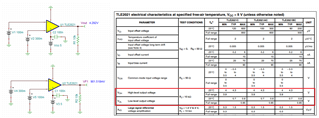
    If the above conditions are simulated, the results are shown below. The simulation seems to follow what the datasheet is prescribed at Vcc = 5Vdc. 

    TLE2021 as Comparator 07292022.TSC

    If you have additional questions, please let us know. 

    Best,

    Raymond

  • Hi Philipp,

    The input voltage levels being applied +1.1 V, +1.3 V and +0.3 V, +0.1 V all fall within Common-mode input voltage range (Vicr) of the TLE2021. Therefore, valid conditions are present for the TLE2021 to fully act as a comparator and produce the correct output state. Raymond's two simulation examples show correct behavior.

    If an incorrect state is observed at the output, then that is likely an indicator that the Vicr of the "mystery" op amp is being violated. Some op amps output phase invert when their Vicr is violated. They may also stop functioning altogether as an op amp.

    Regards, Thomas

    Precision Amplifiers Applications Engineering

  • Adding to other comments, TLE2022 should NOT be used as a comparator because of the back-to-back input protection diodes, which will result in erroneous tripping point when the inputs are taken more than few hundred millivolts apart resulting in one of the input diodes turning on - see below.  

    Also, pulling the input terminals apart would require addition of a series input resistor to limit the input current to 1mA in order to prevent damage - see below.