This thread has been locked.

If you have a related question, please click the "Ask a related question" button in the top right corner. The newly created question will be automatically linked to this question.

OPA2613: SPICE/TINA Model Behaviour

Part Number: OPA2613


Hi, I am attempting to use the OPA2613 as a constant current driver which will be generating a base output current with a number of pulses overlaid.

So far I've tried to set the amplifier up just for the base output current and have seen some odd behaviour in the SPICE and TINA models I cant account for. 

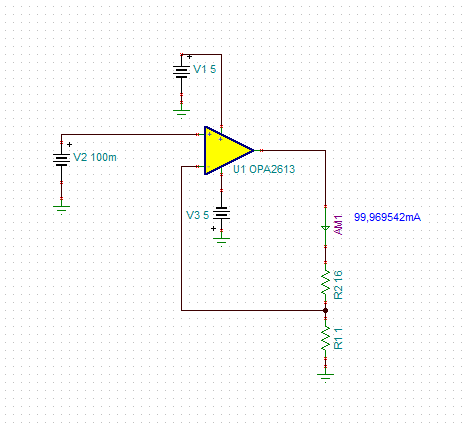
In TINA, I've set the device up to try drive 100mA into a load by providing 100mV into the +ve terminal and taking feedback from a 1 ohm sense resistor to the -ve input.
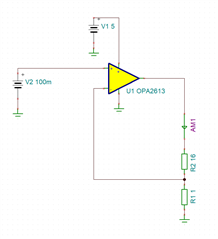
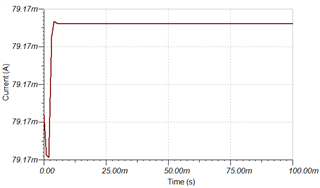
When I run a transient analysis, I get about 79mA from the opamp. From the datasheet, the input offset voltage or input offset current don't account for this as far as I understand.
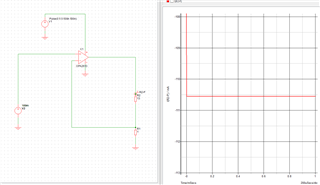
The behaviour of the PSPICE model in Simetrix is even stanger, where the device manages to sink current despite being setup in single supply.
Have I made a critical misunderstanding of the datasheet for this device?

Is the TINA/SPICE model behaving as intended or have I driven it into some kind of edge case?

Thanks in advance for your help

simple_driver.TSC

  • Hi Dylan,

    When designing a circuit before checking if the amplifier is stable along with other more advanced metrics it is always good to do quick checks to make sure you are not violating input common-mode voltage ranges as we as output voltage ranges with signals you plan to use. From your initial DC test with a 5V single supply, the circuit is violating the input common-mode range of the amplifier. In this configuration, the input voltage should be about 1.4V from each rail. When violating these ranges, the amplifier is not in a linear state and usually results in erroneous signals at the output. This information can be seen in the datasheet under Electrical Characteristics for the VS = +5V section.

    Best Regards,

    Ignacio

  • Hi Dylan,

    you violate the input voltage range and output voltage range of OPA2613. See page 5 of datasheet.

    Kai

  • Whoops, good catch. Thanks Ignacio.