A related question is a question created from another question. When the related question is created, it will be automatically linked to the original question.
If you have a related question, please click the "Ask a related question" button in the top right corner. The newly created question will be automatically linked to this question.
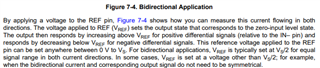
Just like the snippet you posted above, the Vref level sets the output of the device to the required condition for a zero-input level, and the output moves around this setpoint based on the current flow through the shunt resistor.
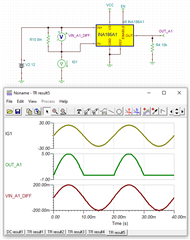
When Vref = GND (used for uni-directional current measurements), the output is set to 0V (or pretty close to), and will increase accordingly for positive current flow (IN+ to IN-). You can see in the simulation below that when Vref = GND, the output only moves above 0V when the current flowing is positive between the inputs, and doesn't move below 0V for negative currents.
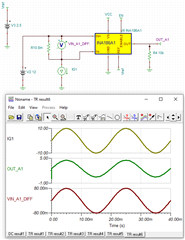
When Vref = Vs/2 (used for bi-directional current measurements), the output is set to mid-supply and will increase above this point for positive currents and decrease for negative currents. You can see in the simulation below that when Vref = Vs/2, the output moves up and down around Vref and can measure both positive and negative flowing currents.
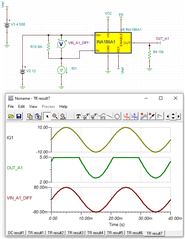
For your specific example of when Vref = 4.508V (assuming Vs = 5V), the output would increase above this point to Vs (which is specified to Vs - 20mV) for positive currents and decrease for negative currents. I can imagine one would only use this specific case if the negative currents were drastically higher than the positive currents intended to be measured, since the output could only increase by <~0.5V for positive currents, but could decrease ~4.5V for negative currents. Finally. you can see in the simulation below that when Vref = 4.508V, the output moves up and down around Vref and can measure both positive and negative flowing currents, but saturates at Vs quickly with positive currents.
Please let us know if you have any further questions.