This thread has been locked.

If you have a related question, please click the "Ask a related question" button in the top right corner. The newly created question will be automatically linked to this question.

TLV9064: Monte Carlo Analysis with PSpice

Part Number: TLV9064


Hi team,

My customer is using PSpice to implement Monte Carlo analysis. My question is:

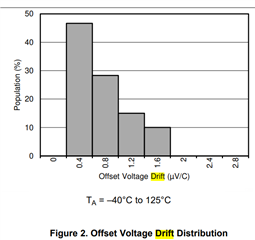
1. What is the offset/drift error value set in the TLV9064 PSpice model? Is it a fixed typical value or like the figure shown in 8.11 (figure 1 and figure 2)?

2. If it is variable, in addition to the tolerance of resistance and capacitance, does PSpice take into account the error change of the TLV9064 in Monte Carlo analysis?

Best regards,

Rannie

  • Hi Rannie,

    1. What is the offset/drift error value set in the TLV9064 PSpice model? Is it a fixed typical value or like the figure shown in 8.11 (figure 1 and figure 2)?

    We set the offset error value for our models on the typical value found in the electrical characteristics table shown below. We do not take into account the drift as we set our models for 25C behavior. 

    2. If it is variable, in addition to the tolerance of resistance and capacitance, does PSpice take into account the error change of the TLV9064 in Monte Carlo analysis?

    Monte Carlo analysis won't vary the op amp models. There is a way to change the offset voltage, but it's a little convoluted and I've never tried it before. Basically you will use a current source to generate a voltage across the resistor. That way when you run the monte carlo simulation, the resistor will vary causing the voltage sources to change across the non-inverting input pin, indirectly changing the offset voltage.

    I added a second source in the example below with one of the voltages with flipped polarity so that it covers both the negative offset voltage range and positive. Additionally I have an offset voltage nullifier to center the offset to zero to make the math easier. 

    As you can see it's a little convoluted and would require additional math to ensure you capture the full range of the expected offset voltage. 

    To summarize, it's possible but requires a bit of work. 

    Best Regards,

    Robert Clifton 

  • Hi Robert,

    thanks for your kindly reply.

    Another question is: What's the maximum value and minimum value of drift? In DS, there is only a typical value. Thanks!

    Best regards,

    Rannie

  • Hi Robert,

    What's the relationship between this figure and the value of ±0.53uV/C?

    Best regards,

    Rannie

  • Hi Rannie,

    Another question is: What's the maximum value and minimum value of drift? In DS, there is only a typical value.

    We don't guarantee a max/min value. That said, the offset voltage drift does follow a Gaussian distribution so the typical value will represent about 68% of the total number of units with a large enough sample size. 

    What's the relationship between this figure and the value of ±0.53uV/C?

    This is the offset voltage distribution. You can see that the typical value represents the majority of the units falling into the curve. This also gives you and the customer a better idea of where the tail effectively "ends". Now because we don't guarantee a min/max offset voltage drift, there could be devices that drift further than the data shown here, but they would be a very small percentage of the total population. 

    Best Regards,

    Robert Clifton