This thread has been locked.

If you have a related question, please click the "Ask a related question" button in the top right corner. The newly created question will be automatically linked to this question.

XTR111: output TR or FET selection

Part Number: XTR111

Hi team,

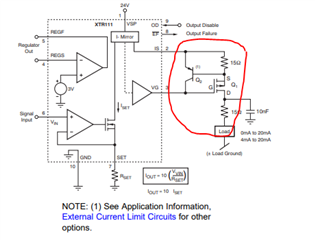
When we used XTR111, we found that the accuracy deviation was very large (0.9%) when outputting 20mA current at high temperature. Under the same circumstances, the voltage accuracy of the front stage is very accurate. Do you have any suggestions for output TR or FET selection?
Thanks

Lillian

  • Hi Lillian,

    The data sheet makes some recommendations for FETs:

    The data sheet also recommends a 2907-type of pnp for Q2; example here:

    https://www.onsemi.com/pdf/datasheet/pn2907-d.pdf

    If you post the circuit schematic, the voltages and currents measured, we can look to see if there's any issues.

    Regards,
    Mike

  • Hi Mike,

    Thanks for your reply!

    We already saw the recommendations in d/s, but could you help check which spec of FET will influence the accuracy and how to influence? could you help explain more for this?

    Thanks

    Lillian

  • The choice of transistor does not matter for accuracy. The XTR111 regulates the voltage at the VG pin so that the current flowing out of the IS pin is correct.

    If you see errors, they are caused by the XTR111's RSET measurement or current mirror. (If the errors are consistent, you might be able to adjust RSET.)

  • Hi Lillian,

    Agreed with Clemens.  The benefit of the XTR111 approach here is that it will control the gate voltage to regulate the current.  If the FET needs a VGS voltage of  -1 V to conduct 1 mA, then the amplifier forces -1 V VGS across the FET.  If it needs -1.2 V for 1 mA, then the amplifier will force the gate voltage so that -1.2 V VGS is achieved.  

    I don't believe the accuracy problems would be related to the FET unless the FET is somehow forced into triode, or the circuit is otherwise not operating in the normal linear state.  Do you have any more data on what the voltages are for the problematic condition?  Ideally, if we could get all of the voltages on the FET (gate, drain, source), the voltage at pin 2 of the XTR111,  and the supply and output voltages, it would help in debugging the problem.

    Regards,
    Mike

  • Hi Mike,

    The reason we think transistor does matter for accuracy is the accuracy of current output will improve when the Q2 is unmounted.

    Please refer to the table for detail.

    Thanks

    Lillian

  • It appears there is some leakage through Q2. To avoid this, use a serial current limit circuit (see figure 37b).

  • Hi Lillian,

    Per usual, I agree with Clemens.  There is probably leakage through Q2, and depending on the MOS threshold, the leakage could be higher or lower.   Current that flows through Q2 would be subtracted from the output current at the load, meaning then that the total load current will be reduced. Can you confirm for all FETs, when Q2 is removed, there is no accuracy issue?

    Could you also show the DC voltage of the Source, Gate, and Drain of the MOSFET in the case listed above?

    Regards,
    Mike