A related question is a question created from another question. When the related question is created, it will be automatically linked to the original question.
If you have a related question, please click the "Ask a related question" button in the top right corner. The newly created question will be automatically linked to this question.
LM311: Enquiry for part LM311H/NOPB failed DIP test (270112)
Also, can you request the date and lot codes off the package and packing label (or photos). And possibly a photo of an un-dipped device showing the leads and markings.
These are commercial devices and the leads are SnAgCu plating.
Have they been using these devices in the past? Or first time?
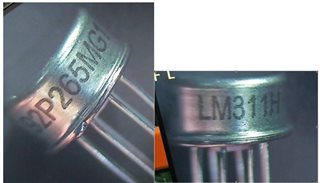
Can you provide the date and lot codes off the package and packing label (or photos) see photo
Possibly a photo of an un-dipped device showing the leads and markings. see photo
These are commercial devices and the leads are SnAgCu plating. Have you been using these devices in the past? Or first time? à This is 1st time used for one of new FA under Bentek Family.
We do not need another picture of the label - we were able to get the lot information.
We would like a better, close-up picture of the failed device leads. The first picture is a bit blurry.
But what we really need to know is that testing standard are they testing the leads too and what is the failure criteria? The packaging people are interested.
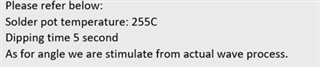
As highlighted earlier, the part has gone through the dip test (common practice for all old date code parts). From the result posted earlier, the leads showing contamination where it failed our test. We did provide the information earlier in terms of how we conduct the dip test. This should be sufficient information to prove that the part failed.
If customer has provided clearer picture of the defect, will update accordingly.
This particular lot was assembled by a subcontractor. That adds another layer to the investigation. I have re-started internal contacts.
At this point, I would prepare the customer to make a return claim through Mouser (I assume you are familiar with the process). Just send a few of the 'Failed" units (2-3) for investigation.
We are not saying that there is something wrong - as this same lot of several thousand units was sent to many other customers with no complaints.
My feeling is that there is a good chance it may be rejected as a cosmetic failure as it was still able to be soldered.