This thread has been locked.

If you have a related question, please click the "Ask a related question" button in the top right corner. The newly created question will be automatically linked to this question.

JFE150: Loop Analysis

Part Number: JFE150
Other Parts Discussed in Thread: OPA202,

Tool/software:

I'm studying slpa018 application note, I have some questions about article,
Question 1:H

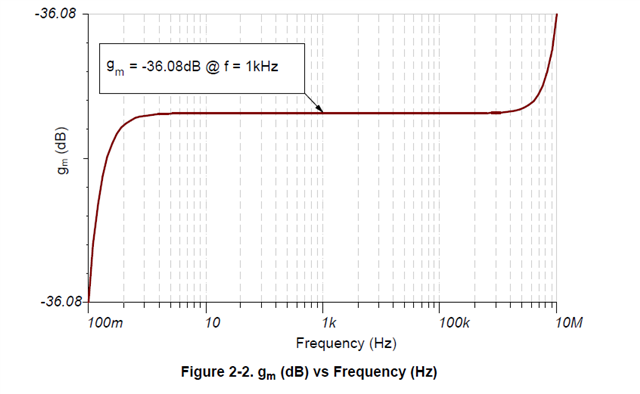
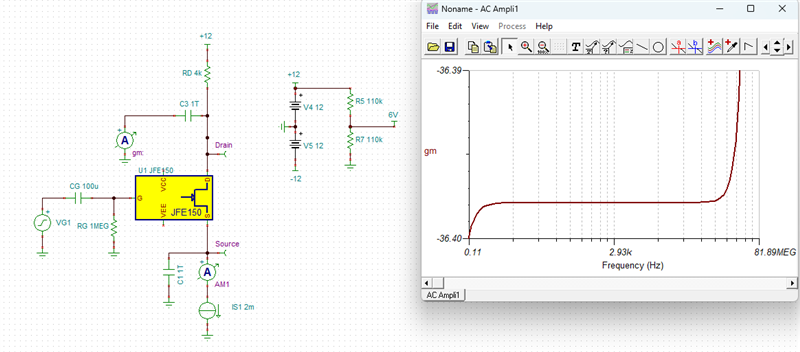
gm vs frequency curve above seems like a simulation result of TINA, isn't ture? If it is, how to simulate gm like this in TINA? As I konw, gm curve is argument of FETwhich is simulated in Virtuoso or else etc.
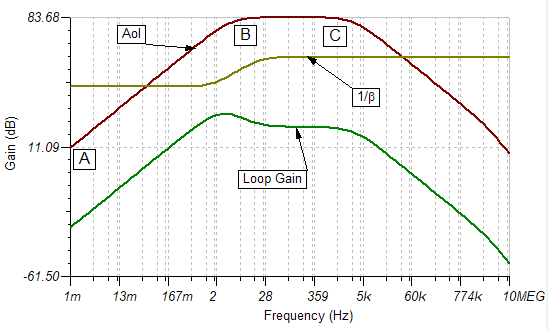
Figure 2-5. Loop Parameters (dB) vs Frequency (Hz)

Question 2:

Why there is a 20dB/Dec from A to B? possibly because from A to B in frequency, RD and CD form a high pass filter. Capacitor CD can be viewed as a resistor whose value is larger than RD, ids flow into RD mostly to generate a voltage (of course it’s small signal), and impedance of CD decrease as frequency increase, which make OPA202 inverting amplifier configuration. At frequency above B, CD is shorted compared to RD, so RD is grounded and make no influence, ids flow through R1 to produce output of OPA202. Is it true?

But why there is a -20dB/Dec from C? I think maybe R1 and C1 interact a pole, but 1/(2*pi*R1*C1) is about 16kHz, in fact point C frequency is 2.95kHz, so I’m confused. How to calculate point C frequency ?

  • Hi Yang, 

    Thank you for reading my application note! To simulate gm you may use my simulation below. I have attached my simulations at the bottom of this post. 

    The circuit for simulating gm is shown below. A constant current source is used to force a desired Ids current. A 1TF capacitor is connected to the source of the JFET such that at frequency the source is ground. This ensures modulation of Vgs. Given that the current source has an ideal infinite resistance we want to make sure we bypass that resistance at frequency in order to keep the source at AC ground. Otherwise the circuit acts as a source follower. A 1TF capacitor is added at the drain such that at frequency all the AC drain current flows through C3. A current meter is added in order to measure gm. The 2mA DC current flows through RD = 4k. RD ensures a desired VDS voltage is achieved. The DC parameters can adjusted as desired to determine different values of gm. 

    gm is in decibels so I convert to mS. as shown below. 

    Why there is a 20dB/Dec from A to B? possibly because from A to B in frequency, RD and CD form a high pass filter. Capacitor CD can be viewed as a resistor whose value is larger than RD, ids flow into RD mostly to generate a voltage (of course it’s small signal), and impedance of CD decrease as frequency increase, which make OPA202 inverting amplifier configuration. At frequency above B, CD is shorted compared to RD, so RD is grounded and make no influence, ids flow through R1 to produce output of OPA202. Is it true?

    Yes this is correct. 

    But why there is a -20dB/Dec from C? I think maybe R1 and C1 interact a pole, but 1/(2*pi*R1*C1) is about 16kHz, in fact point C frequency is 2.95kHz, so I’m confused. How to calculate point C frequency ?

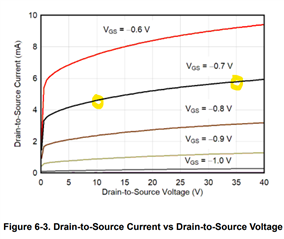
    This is a bit complicated. However I appreciate the question as it made me think a little deeper into the circuit. I was just looking at this and will try my best to explain. The output impedance of the JFET plays a role here. The ro of the JFET can be approximately calculated from the IDS vs VDS curve. The circuit is biased at 2mA of IDS. This means the Vgs is approximately -0.7V (see Figure 6-1 in the product datasheet). Looking at the curve below we can approximate the slope of the curve to determine 1/ro. 1/ro is the slope of the curve. So we can flip the slope calculation to determine ro.  

    ro = 25/(1.6*10^-3) = 15.625k

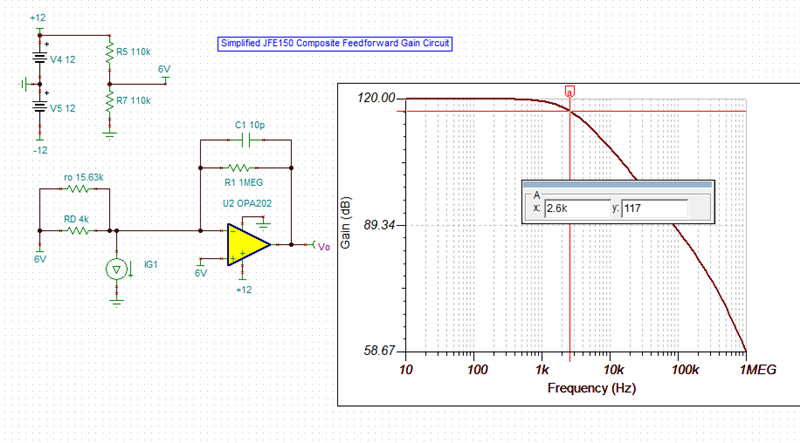
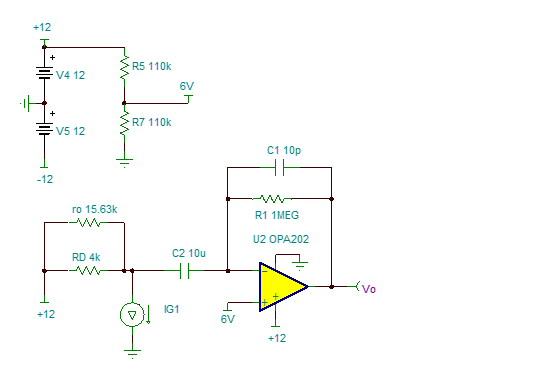
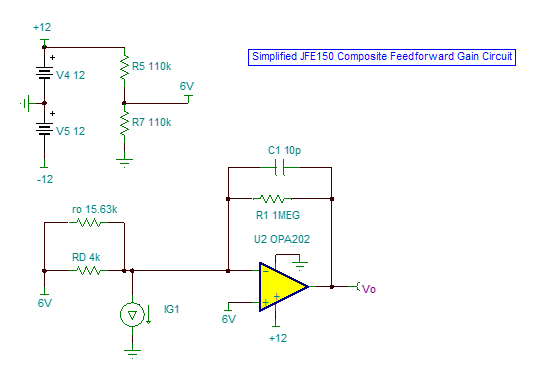
    I can now create a simplified model of the OPA202 transimpedance section of the circuit to analyze the feedforward gain of the composite circuit. I shorted capacitor Cd because it is 10uF and is a short at the frequency we are interested in looking at. It just forms the high pass filter section with RD as you mentioned. You can put it into the simulation to see. Below you can see the simplified model gives a corner frequency of 2.6kHz. This is fairly close to the corner frequency of 2.94kHz I get from the full composite circuit of the app note (see below). To be precise we would have to exactly know ro. The small discrepancy comes in because I am ballparking the number from the plot. I would call this close enough. 

     Understand upper corner frequency in A.TSCJFE150 gm (1) (1).TSC

    I hope you find this information helpful. 

    Best Regards, 

    Chris Featherstone

  • Hi Yang, 

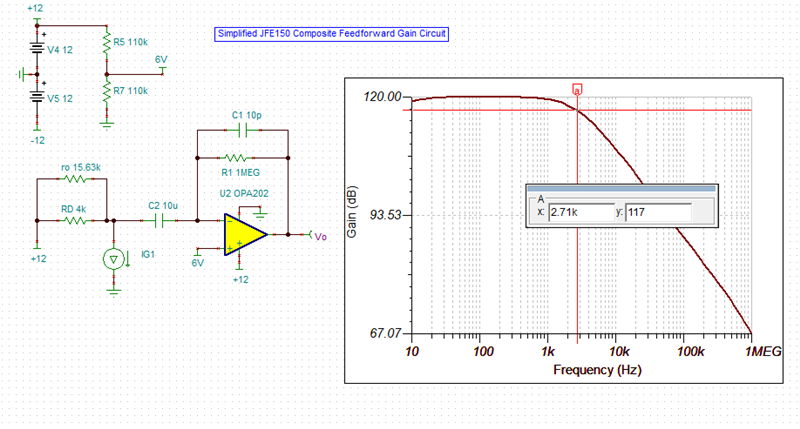
    To follow up on my last post. To be a little more precise I should have biased the RD resistor to the 12V supply and not 6. See the modification below. This gets us a little closer in the simplified transimpedance model. 

     8623.Understand upper corner frequency in A.TSC

    Best Regards, 

    Chris Featherstone

  • Hi Yang, 

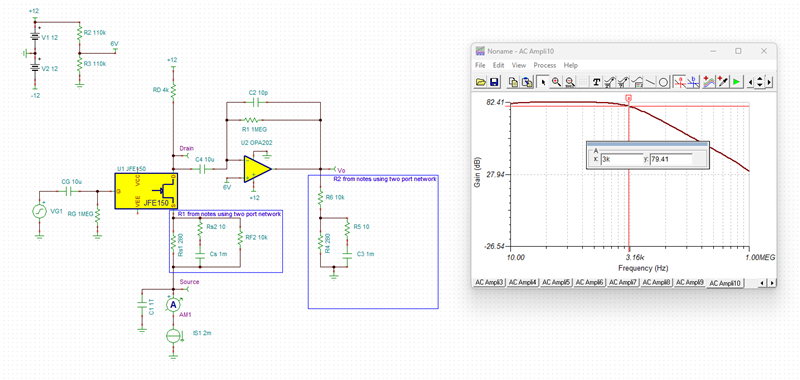
    To be even more accurate albeit more complex you can use the two port network method from my hand written notes for the JFE150EVM. These notes were the very beginning of my analysis on this circuit a few years ago. Page 3 is the two port calculations. Basically I break the beta network into equivalent impedances hanging of the source node and output of the OPA202 in order to form the feedforward circuit. This still isn't perfect and there is probably some nuances I am neglecting in the sim. This does get us very close to the composite circuit frequency for the A curve in the app note. I now get 3kHz as opposed to the 2.94KhZ from the app note. The tina sim can be found at the bottom of this post. 

    See page 3 from these notes

    Two Port Network (2).pdf

    Click the image below to see in better resolution

    Understand upper corner frequency in A Two Port Model.TSC

    If your are interested in my Matlab code it is here and can be adjusted to fit whatever circuit configuration you are using. 

    Matlab Code:

    s = tf('s');
    Rs1 = 100;
    Rs2 = 10;
    Csource = 100*10^(-6);
    Rf =1000;


    % This section deals with the Beta newtork. If Aol is very large then the
    % closed loop gain is approximately 1/beta
    Zs = Rs2 + 1/(s*Csource); % This works
    %bode(Zs)

    Zsprime = Rs1*Zs /(Rs1 + Zs);

    OneOverBeta = (1+Rf/Zsprime) %this is 1/beta fix this so it makes sense

    Beta = Zsprime/(Zsprime+Rf)

    %Acl = 1/Beta;

    %bode(Acl)

    %This is extra code
    %B = (960*(s+100))/(106*(s+9.434))/((960*(s+100))/(106*(s+9.434))+10000);
    %bode(1/B);
    %This is the end of extra code

    % This section deal with the gain circuit which we will call the Aol
    % circuit of our system.

    ZC10 = 1/(s*500E-12);
    R10 = 1E6;
    RD = 4E3;
    ZCD = 1/(s*100E-6) ;
    ZCG = 1/(s*100E-6) ;
    gm = 10E-3;
    R1 = Zsprime*Rf/(Zsprime+Rf);
    R2 = Rf + Zsprime;
    RG = 1E6;

    % Feedback components around the Op Amp

    Z10 = ZC10*R10/(ZC10+R10);

    % Rg in parallel with R1 +1/gm
    R1prime = R1 +1/gm;

    Rin = R1prime * RG/(R1prime + RG);

    % RD and CD in parallel

    ZD = RD*ZCD/(RD+ZCD);

    Aol = Rin*ZD/(R1prime * (Rin + ZCG)) * Z10/ZCD


    opts = bodeoptions
    opts.Title.FontSize = 14;
    opts.FreqUnits = 'kHz'
    opts.Title.String = 'JFE150EVM Bode'
    opts.Xlim = ([0.001 10E6])
    opts.Ylim = ([0 80])
    bode(Aol, opts)
    hold on
    bode(OneOverBeta, opts)

    hold on
    ACL = Aol/(1+Aol*Beta)
    bode(ACL, opts)

    hold on


    %h = gcr
    %setoptions(h,'FreqUnits','Hz')
    %h.AxesGrid.Grid = 'on'
    %xlim([0 10E6])
    %ylim([0 60])

    Best Regards, 

    Chris Featherstone

  • Hi  Chris,

    I discover some other characteristics of the circuit you offer. I am not sure whether they are correct. 

    I reset C1 to 100pF、1nF、10nF and find corresponding -3dB frequencies are 1.08kHz、161.5Hz、24.14Hz.

    If I use circuit below to peform same simulation, reset C1 to 100pF、1nF、10nF and find corresponding -3dB frequencies are 1.59kHz、158.1Hz、15.88Hz.

    I suspect there is a 50pF input capacitor of OPA202, which is added to C1 = 10pF to form a 60pF and interact with R1 = 1Meg to have 1/(2*pi*60pF*1Meg)= 2.65kHz pole. To conform this I reset C1 to 50pF and find that -3dB frequency is 1.59kHz. When C1 is 1nF or bigger, OPA202's input capacitor make little influence to -3dB frequency. I don't konw if it's right, I'm looking forword your expert review.

    What I want to know is whether there is a way to analysis -3dB frequency of circuit, which is equation include R1、C1、ro、RD and etc. In fact I suspect whether ro and RD have  infulence on -3dB frequency if voltage of their two terminal is  constant 6V.  I will simulate under different situation.

    I will look your post carefully and consult you in time. I hope it doesn't bother your time.

    Best Regards, 

    Yang Fan

  • Hi Yang, 

    This circuit is very complicated with two loops. You can decrease the frequency corner with passives however you wouldn't be able to extend the -3dB frequency in the feedforward gain curve with passive components alone. You have to choose a higher speed amplifier in order to extend the frequency. I will try to explain this reasoning below. 

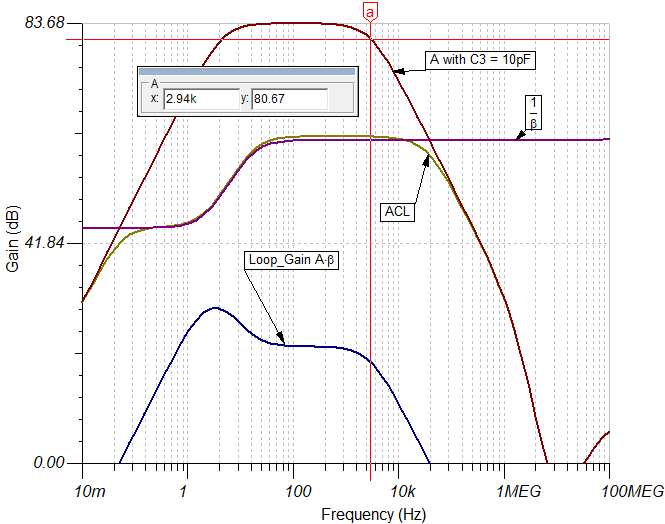
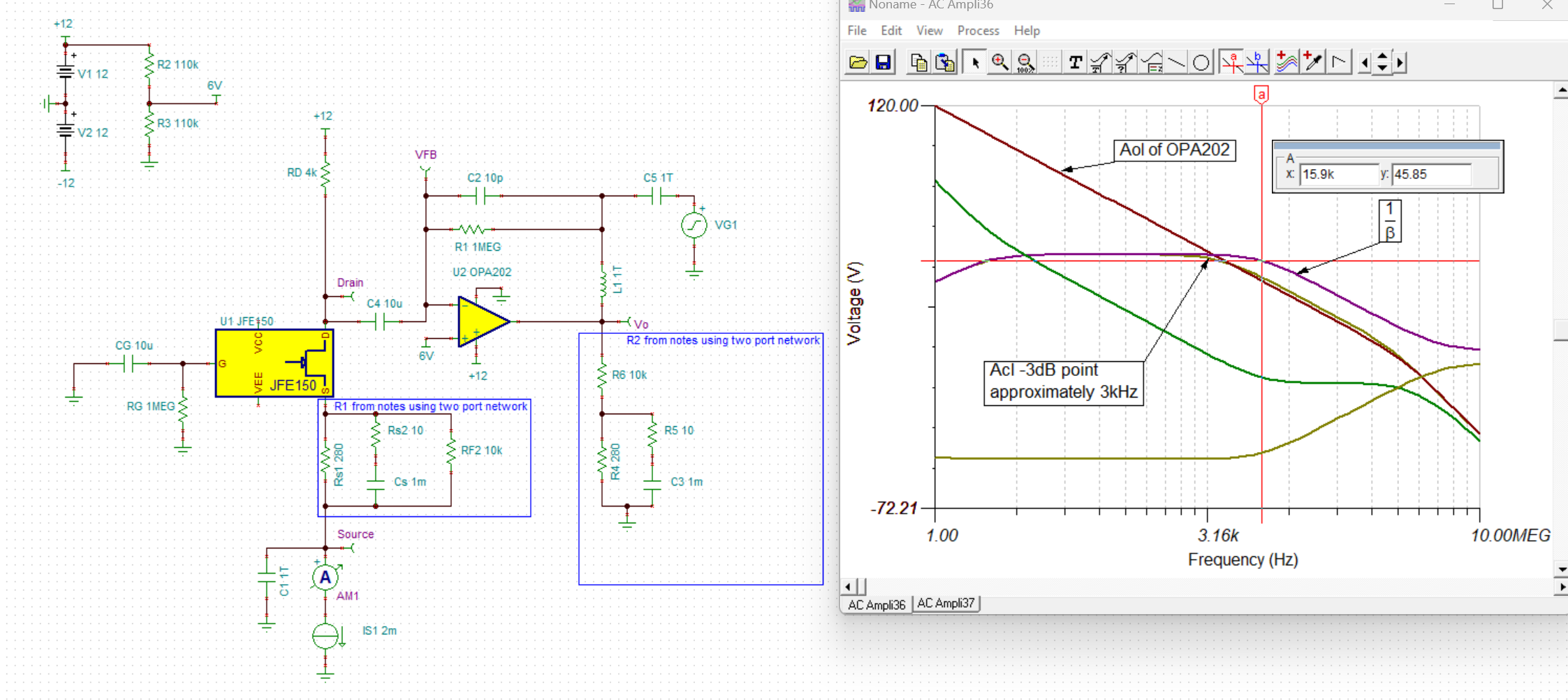
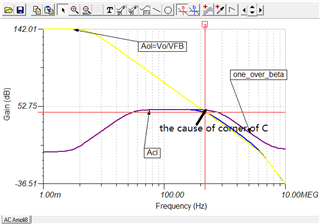
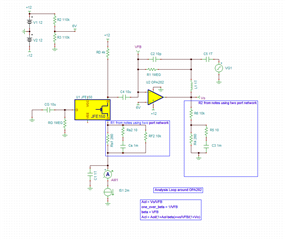
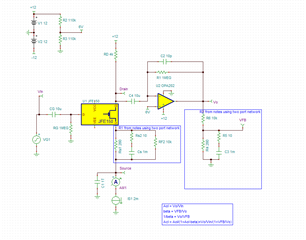
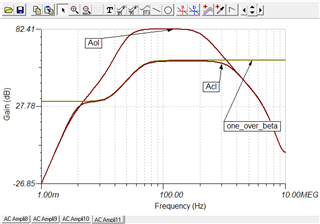
    In my application note I call the feedforward gain A. A is a combination of the JFET gain and the OPA202. There is another loop in the circuit that I did not break inside the circuit. The second loop is around the OPA202 alone. Below I have broken this loop to demonstrate what is causing this corner to occur around 3kHz. You can see that the OPA202 has it's own Aol that decreases over frequency. When Aol and 1/beta meet there is a -3dB point at roughly 3-4kHz. This is controlled by the OPA202 itself and the miller capacitance inside of the OPA202. In order to extend the frequency an op amp that is higher speed may be chosen.  The beta network of this loop is made up of the 1M resistor and the 10pF cap. These two components form a pole at 15.9kHz as seen below in the 1/beta curve. You may pull this corner in. There isn't a calculation to provide for the corner in the A curve. I hope this clarifies what exactly is creating this point however. 

    Here is the tina simulation for this analysis. 

    Second Loop Break Analysis.TSC

    Best Regards, 

    Chris Featherstone

  • Hi  Chris,

    I study your two port network.pdf and MATLAB code, it's very good derivation and very detailed. To be honest, I have been a bit more confused. I try to explain my confusion by a few question.

    You explain why there is a corner  at C below curve in last post, which is a loop around OPA202. Aol curve of OPA202 inteact with 1/beta curve in OPA202's loop to form corner C.

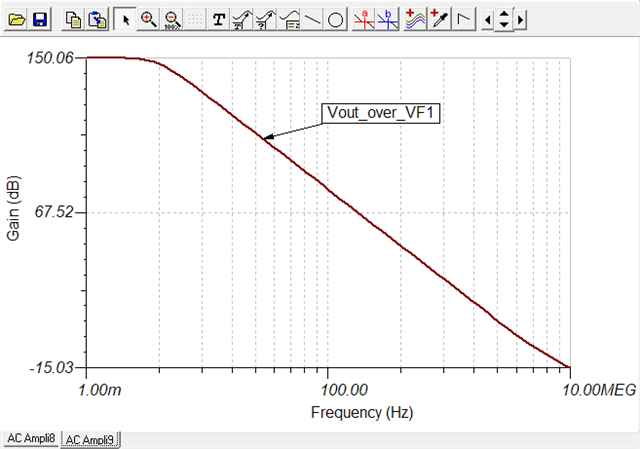
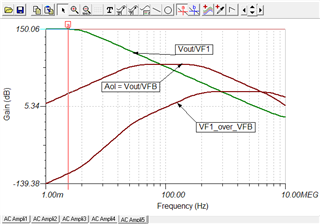
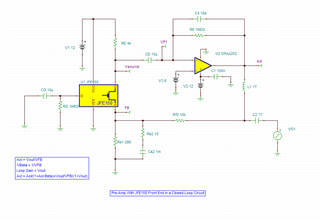
    Now there is a question, in opa202's loop, Acl = Aol /(1+Aol*beta)=Vo/VFB/(1+Vo), the curve of Acl as shown above, I don't konw if it is right in this way? Acl is close transfer function of VFB to Vo, so Acl = Aol /(1+Aol*beta)=Vo/VFB/(1+Vo)  curve should be same as Vout/VF1 in below circuit? But simulation result shows that Vout/VF1 is different from Acl of opa202'loop. Is there something wrong?

    Besides Aol = Vout/VFB in below ciucuit have corner B which is calculated by 1/(2*pi*RD*CD), what I am curious is can I find this corner frequency by some way like reading corner frequency in curve of VF1/VFB(in fact no) or some other voltage transfer curve, because Corner B is made of RD and CD so I think it will appear in transfer curve not only in Aol=Vout/VFB. Could you tell me if it  exists?

    In your two port network.pdf, detailed derivation is presented, whcih offer a equation of transfer function of vin to vo. Corresponding circuit as below.

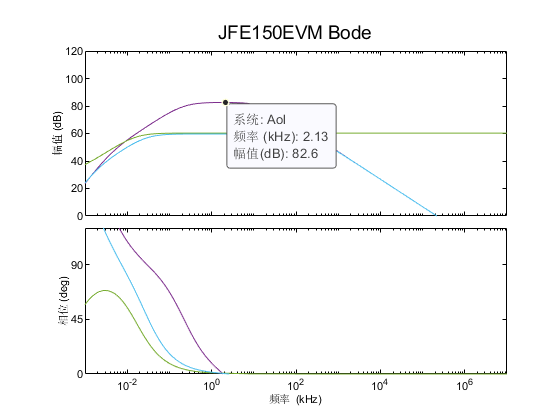
    Aol = Vo/VIn, beta = VFB/Vo, 1/beta = Vo/VFB, Acl = Aol/(1+Aol*beta)=Vo/Vin/(1+VFB/Vo). Simulation results is same as Figure 2.5 of initial loop analysis of slpa018.pdf although with little discrepancy. Besides, your MATLAB code calculate result of equation of Aol、1/beta、Acl, which are derivation results of two port network.pdf. I revise arguments in code to accordance with circuti above, MATLAB code results shown below,  flatten area of Aol curve is same as   results above. But corner frequency is different. I don't konw the reason.

    clear;
    s = tf('s');
    Rs1 = 280;
    Rs2 = 10;
    Csource = 1000*10^(-6);
    Rf =10E3;


    % This section deals with the Beta newtork. If Aol is very large then the
    % closed loop gain is approximately 1/beta
    Zs = Rs2 + 1/(s*Csource); % This works
    %bode(Zs)

    Zsprime = Rs1*Zs /(Rs1 + Zs);

    OneOverBeta = (1+Rf/Zsprime) %this is 1/beta fix this so it makes sense

    Beta = Zsprime/(Zsprime+Rf)

    %Acl = 1/Beta;

    %bode(Acl)

    %This is extra code
    %B = (960*(s+100))/(106*(s+9.434))/((960*(s+100))/(106*(s+9.434))+10000);
    %bode(1/B);
    %This is the end of extra code

    % This section deal with the gain circuit which we will call the Aol
    % circuit of our system.
    R10 = 1E6;
    RD = 4E3;
    CD = 10E-6;
    CG = 10E-6;
    RG = 1E6;
    C10 = 10E-12;
    gm = 15.7E-3;
    ZC10 = 1/(s*C10);
    ZCD = 1/(s*CD) ;
    ZCG = 1/(s*CG) ;
    R1 = Zsprime*Rf/(Zsprime+Rf);
    R2 = Rf + Zsprime;


    % Feedback components around the Op Amp

    Z10 = ZC10*R10/(ZC10+R10);

    % Rg in parallel with R1 +1/gm
    R1prime = R1 +1/gm;

    Rin = R1prime * RG/(R1prime + RG);

    % RD and CD in parallel

    ZD = RD*ZCD/(RD+ZCD);

    Aol = Rin*ZD/(R1prime * (Rin + ZCG)) * Z10/ZCD


    opts = bodeoptions
    opts.Title.FontSize = 14;
    opts.FreqUnits = 'kHz'
    opts.Title.String = 'JFE150EVM Bode'
    opts.Xlim = ([0.001 10E6])
    opts.Ylim = ([0 120])
    bode(Aol, opts)
    hold on
    bode(OneOverBeta, opts)

    hold on
    ACL = Aol/(1+Aol*Beta)
    bode(ACL, opts)

    hold on


    %h = gcr
    %setoptions(h,'FreqUnits','Hz')
    %h.AxesGrid.Grid = 'on'
    %xlim([0 10E6])
    %ylim([0 60])

    Best Regards, 

    Yang Fan

  • Hi  Chris,

    I want to konw what role the capacitor play? Seems that it doesn't have influence on stability of loop of opa202. How to properly choose its value?

    Best Regards, 

    Yang Fan

  • Hi Yang, 

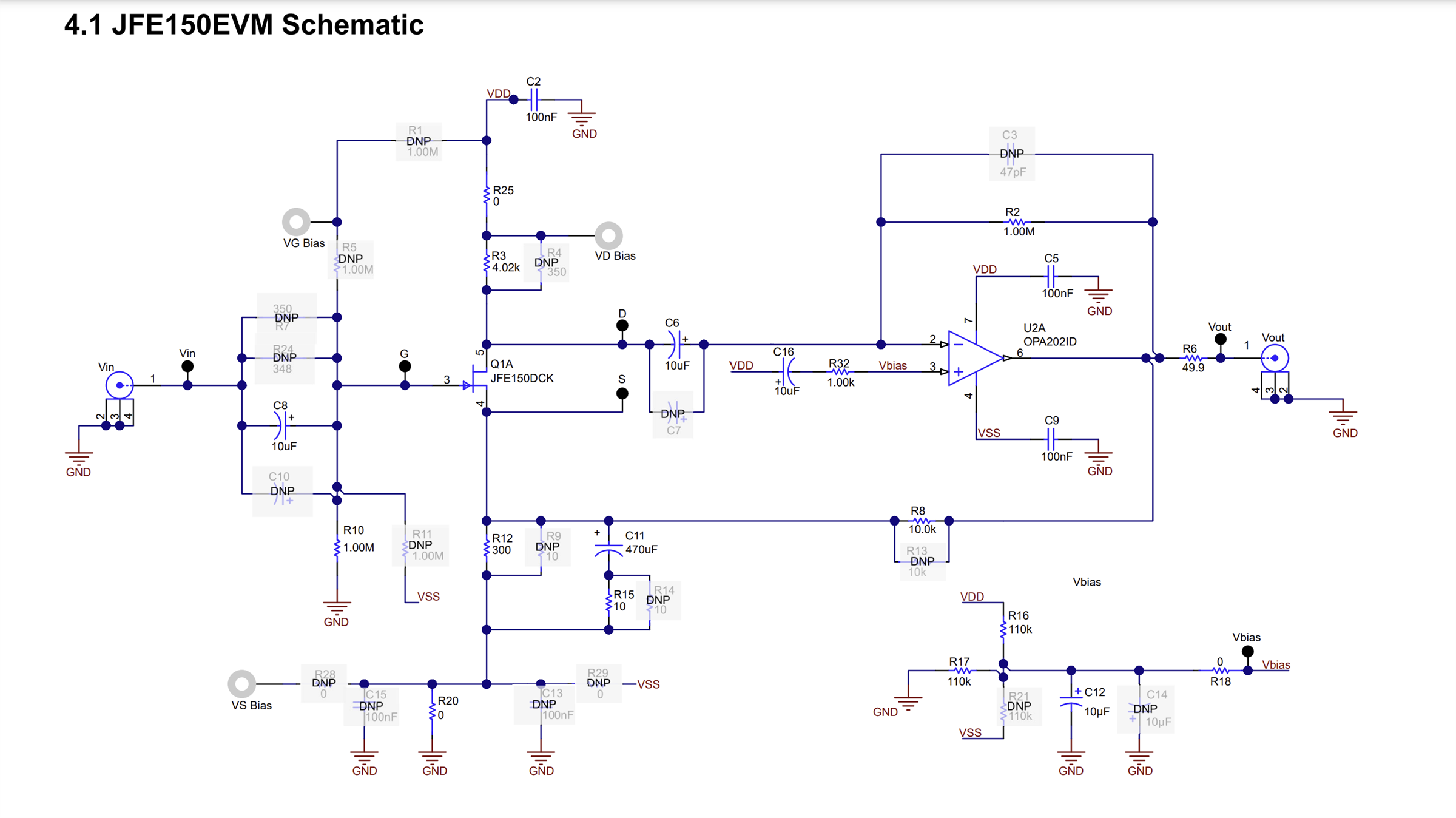
    The capacitor around the OPA202 isn't currently doing anything because the corner frequency is in the 1/beta curve and comes after the OPA202 aol corner created by the miller cap. I put it in the app note and the EVM for the circuit as a placeholder. If I were to use a high speed amp the capacitor may be needed for stability. You can see below I put a lot of options on the EVM. This was during the time where I was creating the EVM and the application note in parallel and gave myself plenty of options to modify and make measurements to understand the circuit. 

    Here is a link to the evaluation module:

    https://www.ti.com/tool/JFE150EVM#tech-docs

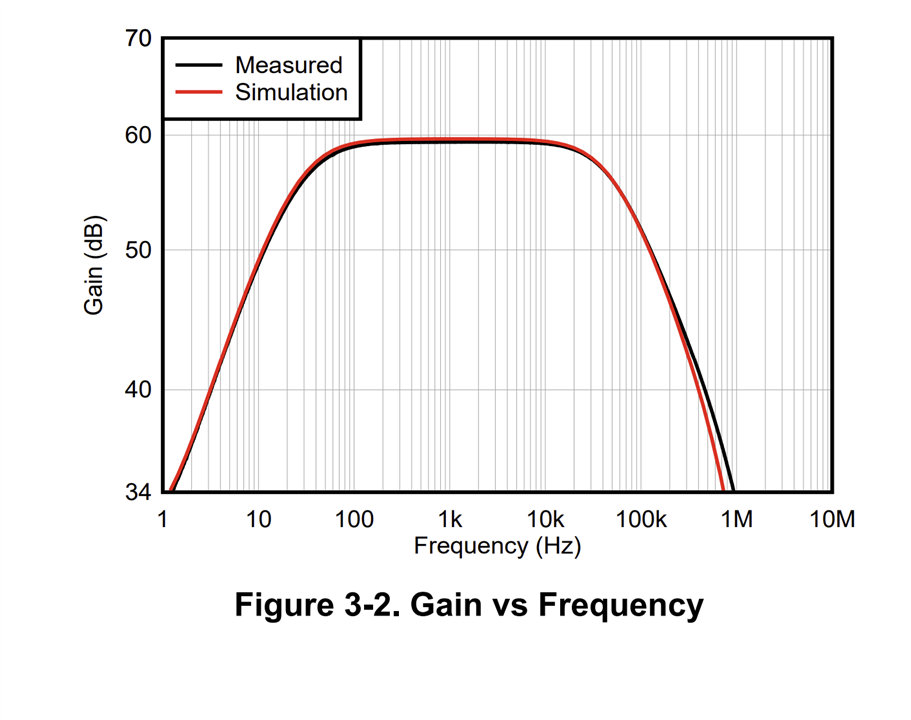
    This is the measured vs simulated curve for the EVM. 

    I would need some time to look at the questions above. 

    Best Regards, 
    Chris Featherstone

  • Hi  Chris,

    Thank you for your interpretation, which help me konw about loop of circuit.

    Best Regards, 

    Yang Fan