This thread has been locked.

If you have a related question, please click the "Ask a related question" button in the top right corner. The newly created question will be automatically linked to this question.

THS2630: IC over heat

Part Number: THS2630

Tool/software:

Hi,

I am using three THS2630 ICs to convert signals to differential voltages, which are then sent to the ADC.

My Vcom is set to 2.048V, and the power input is ±14V.

During testing, I ground the input pin, both VOUT- (pin #5) and VOUT+ (pin #4) measured 2.048V.

After powering on, I noticed that the current draw from my power supply is high (0.14A) compared to a PCB without the THS2630 (0.04A). Additionally, the temperature on the surface of the IC is quite high, around 60~70°C.

Using a multimeter to check the diode voltage on each pin of the IC, I found that VOUT- only has 0.4V, while the rest of the I/O pins are all above 1V.

Is this behavior normal for this IC?

According to the datasheet, the quiescent current should be a maximum of 13.2mA.

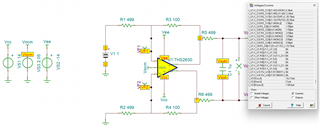
I have attached the electrical schematic of the THS2630 section.

I would appreciate any advice. Thank you!

Adam Shiau

  • Hello Adam,

    For an initial quick investigation: could you increase the values of Rf and Rg in your circuit?  A Rf value of 100 Ohms is quite low, which could be contributing to your increased current draw.

    Can you use an ammeter on the FDA supplies to see if the Iq of the THS2630 is the expected value of 13.2mA?

    Section 8.1.2 discusses driving a capacitive load; you may want smaller output resistors than 499 Ohms to drive a capacitor.

    Best,

    Alec

  • Hi Alec,

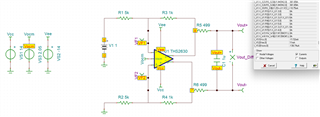
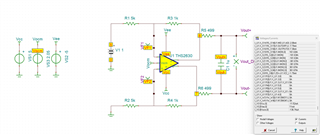
    I ran a simulation in TINA for this simple circuit, and below are the results of my calculations.

    For my case, I used three THS2630 amplifiers with Rg = 499 Ω and Rf = 100 Ω.

    The theoretical power supply current from simulation is 27.17 mA × 3 = 81.51 mA,

    which is close to my observed value of 100 mA.

    The simulation also shows that reducing Rg and Rf has little effect on power dissipation unless the power rail is changed from ±14 V to ±5 V.

    1. 

    Rg = 499 Ω, Rf = 100 Ω, Vcc = 14 V, Vee = -14 V:

    • I_Vcc = -16.17 mA, I_Vee = 11 mA, Power dissipation = 366.38 mW

    2.

    Rg = 5 kΩ, Rf = 1 kΩ, Vcc = 14 V, Vee = -14 V:

    • I_Vcc = -11.52 mA, I_Vee = 11 mA, Power dissipation = 315.28 mW

    3. 

    Rg = 5 kΩ, Rf = 1 kΩ, Vcc = 5 V, Vee = -5 V:

    • I_Vcc = -11.52 mA, I_Vee = 11 mA, Power dissipation = 112.6 mW

  • Hello Adam,

    Thank you for providing updated details on the THS2630s in your system.

    Let me take a look and see if I can simulate any improvements.  

    Best,

    Alec

  • Hello Adam,

    In your board design do you have a large copper plane for GND and power?  As the DGN has a thermal pad, it needs to be tied to whichever supply can sink heat best.  In your schematic this is V+, but in practice whichever supply has more copper would be best.  GND is also an option.

    Best,

    Alec