This thread has been locked.

If you have a related question, please click the "Ask a related question" button in the top right corner. The newly created question will be automatically linked to this question.

TLC272B: IDR

Part Number: TLC272B
Other Parts Discussed in Thread: TLC272

Tool/software:

Hello TI Team,

We are received the FA report from your side, below are the FA details,

FINAL REPORT 2024-07-05 – Rev. A 2024-09-25 – Rev. B QEM-CCR-2406-00271 [ / CFR-THA-24-182]

Below are the more part related information,

Customer Name: JABIL

Customer Contact: Pravin Hiwarkar

Customer Site: PUNE (INDIA)

End Customer Event Type / Origin of Detection: In-Circuit Test (ICT) Customer Contact(s)

Failure discription - 

Boards have got failed at ICT testing, for Digital test and powered analog test for components D44,D41,D2 9,D26,D23,D21,D9,D6,D3,D1. | After debug analysis we found that it is Dual AMPLIFIER, and we don't get out voltage.

Our Question >> It seems this part is not compatible with our customer circuit, now we would like to know what changes you will suggest to make this part work fine in our customer Circuit?

Awaiting your immediate support and feedback.

Regards,

Pravin Hiwarkar.

SQE - JABIL Pune.

Mob No - 09370751126QEM-CCR-2406-00271 Rev.B (1).pdf

  • Please show the schematic, and specify the supply voltages and the voltages at the input pins.

  • Hello Pravin, Clemens

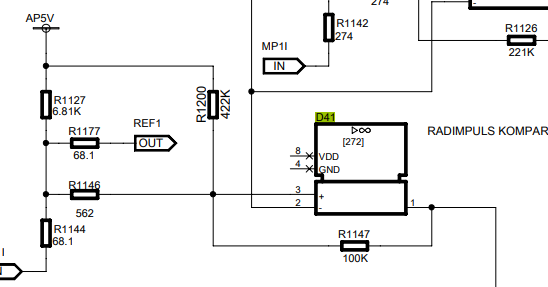
    I was working this issue as an internal thread. The schematic is a hysteresis comparator. The input pins 2,3 were driven by zero current compliance resources. The power supply was 0V, 5V. Output pin 1 was measured and 3.5V to 5V expected. 

    Both low or high output are possible. The comparator input and history (if inputs are within hysteresis zone), must be set for a reliable ICT pin 1 result. The ICT test must be rewritten to ensure proper input so that output will be certain.

    Pravin, do the boards pass later production tests?

  • Hello Ron & Clemens,
    Thank you for your feedback,
    Regarding your below concern, 
    Do the boards pass later production tests?,  >>> No, we have tried to do the further test after the ICT failure, but it is not getting pass for further tests [FVT] as well.
    Jabil Analysis – 
    But now after our in-depth analysis we came to know that,
    Malaysia Location manufactured parts are getting failed =100% and
    All the Mexico location manufactured parts are getting passed = 100 %.
     
    RISK - 
    Also, for the both the parts manufactured at two different locations (Malaysia & Mexico) have same MPN.
    So, this will be a big risk for the end customers as both parts behavior is very different.
    So, we are not able to produce as product is failing 100% with Malaysia make part.
     
    History - and recommendation - 
    Also, please note that, this part is used since long back in this design with no failure but suddenly with the use of Malaysia make parts it is started failing.
    request you to suggest , how we can use this part in the existing design or any recommendation for change in design.
    Pl. refer Schematic diagram for your ready reference.
    Awaiting your feedback.
    Regards,
    Pravin Hiwarkar
    SQE
  • The old die (Mexico) did not have rail-to-rail outputs:

    The new die (Malaysia) does have rail-to-rail outputs, so the output voltage, when used as a comparator, is higher (starting at VDD).

    The VOH specification in the datasheet does not have a maximum, so both dies are inside the guaranteed limits.

    As far as I can see, this is not a problem. Just change the upper limit in your tests. (What exactly are you testing in your further tests?)

  • Pravin,

    This is not an non inverting amplifier (G=1.24) setup. That would require negative feedback from pin 1 to pin 2. The schematic shows positive feedback, pin 1 to pin 3.

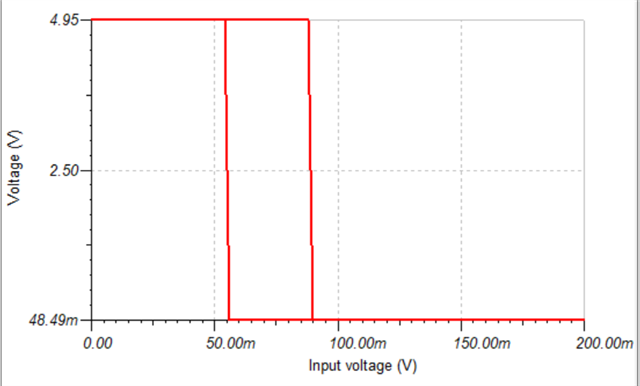
    If the lower left node was ground then the sweep of pin2 input voltage (X-axis) would have this output (Y-axis).  The VOH sets the voltage where output falls.  For 5V this occurred at 90mV; it would be about 72mV for a 4V VOH  (90mV/(5V/4V))

    If the purpose of the hysteresis is to remove switching chatter noise; then changing 100k to 124k should work for both VOH

    If the hysteresis switch points are critical then there may not be an easy solution to accept both VOH levels.

    What are the input voltages and desired output voltages?

  • Pravin,

    In the power point report, the two output voltage were 3.37V and 5.01V, so I expect VDD is a little bit higher than 5V; closer to 5.1V or 5.2V

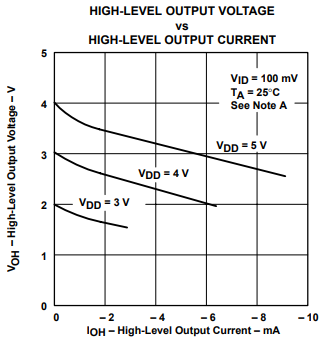
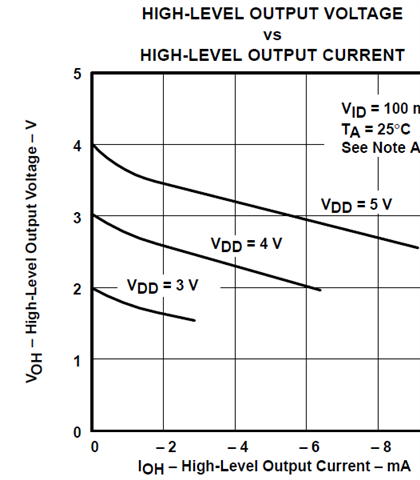
    Left side show a significant load. Malaysia VOH curve at right side of image (very little voltage loss for this load). 


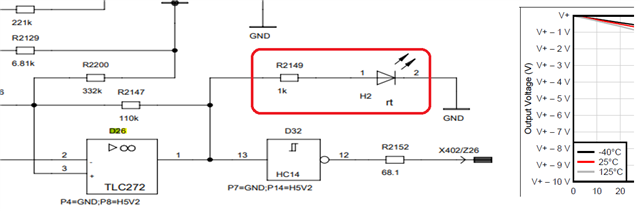
    These voltages occur because both samples are in VOH (output high) mode with this significant load. Malaysia parts can give 5.01V; the LED will be brighter and the HC14 is fine with this input voltage (HC14 also powered with 5V). Mexico parts can output 3.37V; this is still a VOH; the LED will be dimmer and the HC14 is fine with this input voltage.

    I don't see how 3.37V or 5V at pin1 (that isn't used elsewhere) does not make exactly the same VOL output from the HC14. The HC14 "fixes" any VOH difference in the TLC272. Only the LED brightness change remains.

    Mexico curve below. Slightly higher VOUT with VDD closer to 5.1V

    Is there any time where the HC14 output is incorrect? 

  • Hello Ron,

    Thank you for your detailed feedback, we are working with our team to get the feedback for you on your all above questions.

    Meanwhile, we would like to get the below information as well,

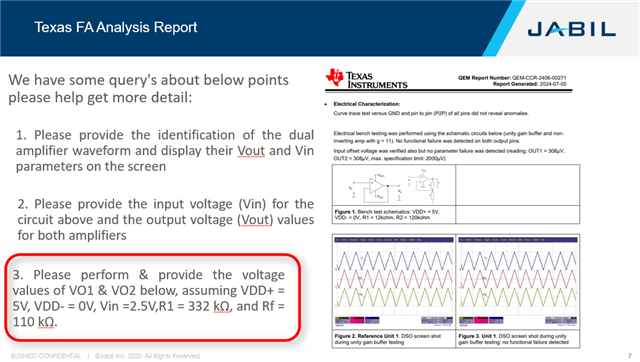
    Request to provide your feedback on below highlighted with the RED circle.

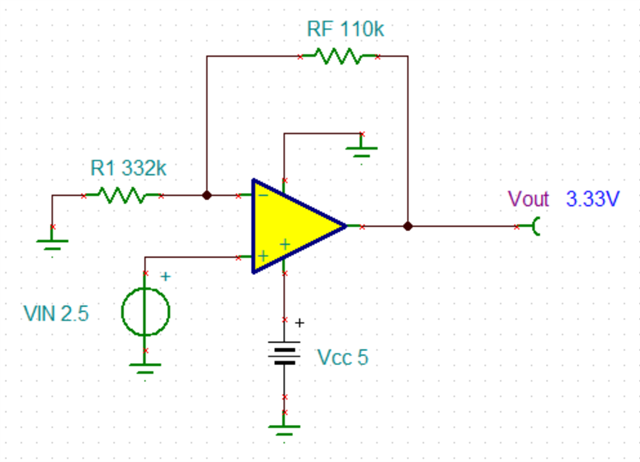
    •       Please perform & provide the voltage values of VO1 & VO2 below, assuming VDD+ = 5V, VDD- = 0V, Vin =2.5V,R1 = 332 kΩ, and Rf = 110 kΩ.

    Thank you and regards,

    Pravin H.

    .TLC272BID Failure analysis - 04 Oct.pptx

  • Pravin,

    Answer to 3 below. This setup (below) is nothing like the customer's application circuit. In the customer's circuit, the 110k feedback resistor connects to non-inverting input.   

  • Hello Ron,

    We had a call with our end customer Hitachi (Thales), they are working internally with their R & D team.

    We will share your inputs which may be helpful for them. 

    We will revert back on your concerns once we received any feedback from our end customer.

    Thank you,

    Regards,

    Pravin Hiwarkar.