This thread has been locked.

If you have a related question, please click the "Ask a related question" button in the top right corner. The newly created question will be automatically linked to this question.

OPA4376: Open loop output

Part Number: OPA4376
Other Parts Discussed in Thread: TLV9004,

Tool/software:

Hi team,

My customers tried to observe the open loop output of OPA4376 and TLV9004, found below behaviors. Could you explain why OPA4376 always goes to zero output but TLV9004 always goes to VCC?

we also tried to simulate in Tina, TLV9004 aligns with simulation results, but OPA4376 doesn't (it goes to VCC at the beginning, then goes to zero). could you help explain why?  
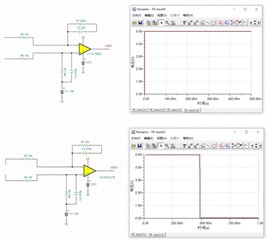
thanks a lot.

Best regards,

Yang

  • There is no such thing as "without input". When you leave the input pins floating, then their voltages are random, and the results are random.

    The simulation models do not emulate all behaviours, especially not floating voltages or the results of insufficient supply voltage.

  • Hi Clemens,

    thanks for your reply. what confused me is, if it's random, we tested multiple times (cycle power up and down) and in 5pcs samples. the results are the same. Shall different sample behave differently?  

  • If you short the inputs, the internal differential voltage between them is its input offset voltage, Vos, which in the case of no feedback connection will be gained up by the open-loop gain, AOL. In the case of OPA4376 with max offset of +/-25uV and min AOL of 120dB (1,000,000), this means that the output will try to go to: Vout = Vos*1e6 = +/-25uV*1e6 = +/-25V but since OPA4376 is powered from 5V single supply, the output can only go either close to 0 or 5V (depending on the polarity of the offset voltage). 

    Now, with both inputs floating, a mismatch between IB's will cause additional differential input voltage between the input terminals that likewise will be gained up by the AOL resulting in pushing the output further against one of its rails. For these reasons, the output of all op amps under such conditions will collapse close to one of its rails and there is no way of telling which one because it is a function of the randomness of Vos and IB polarities.