This thread has been locked.

If you have a related question, please click the "Ask a related question" button in the top right corner. The newly created question will be automatically linked to this question.

LMP2011: Single Supply PSPICE bias point convergence problem

Part Number: LMP2011
Other Parts Discussed in Thread: TINA-TI

Tool/software:

Hello,

When using the LMP2011 PSpice model (Rev C., snom113c..zip), PSpice encounters convergence issues when trying to calculate the model's bias point. Initial bias point calculation fails and after GMIN stepping and Power supply stepping,  the pseudo transient algorithm is invoked. However the pseudo transient calculation does not converge to a result - even when letting it run for about a minute or so. 

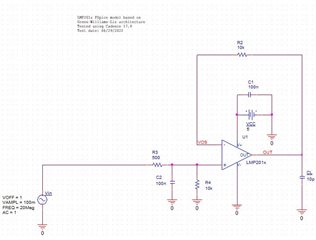
This is only a problem though, when the model is operated in single supply mode, i.e., V- connected to ground. You can reproduce this behavior in the example project provided in snom113c.zip. When VEE is set to 0Vdc then the example also uses pseudo transient bias point calculation for bias point calculation and it takes a while before a bais point is found. If the external circuitry of the opamp is a bit  more complex (for example connect the non-inverting input over a 10k resistor to ground),  then the pseudo transient calculation takes even longer time. In my circuit with a more complex circuit it never converges.

Lowering PTRANABSTOL and PTRANVNTOL does not help.

Skipping the initial bias point calculation (SKIPBP = true) avoids this problem but is not really a solution in my case.

Are there any hints or ideas how to work around this issue?

Best regards,
Klaus

  • Hi Klaus,

    Could you please try going to "Edit simulation profile" -> "Options" -> "Analog Simulation" -> "Auto Converge" and then checking the "Auto Converge" box? Please let me know if this helps your initial bias point calculation to converge.

  • Hi,

    No. Activating "Auto Converge" does not help.

  • Hi Klaus,

    I see. I was able to replicate the issue per the instructions in your post on the test circuit from ti.com, but I was wondering if the "Auto Converge" option on PSpice at least helps the simulation complete on your more complex circuit.

    I tried to use the TINA-TI model for the LMP2011, and that seemed to simulate faster with the single supply configuration. I'm not sure if that's a result of the TINA simulator doing something different when compared to PSpice, but it definitely takes a bit longer even on TINA when I switch from dual supply to single supply. If it's not too difficult, could you please try recreating your circuit in TINA to see if it is able to complete the bias point there?

    Please give me some time to check the hierarchical model to see if I can pin down why this issue arises.

  • Hi Klaus,

    Could you please try simulating with the file attached to the bottom of this reply?

    I've disabled an internal clamp, and that seemed to help convergence with the single supply configuration.

    snom113c-disabledclamp.zip

  • Hi again,

    Good and bad news. The modified model works like a charm when it comes to finding the bias point. PSpice does now find the bias point immediately without invoking any of the backup methods (Gmin stepping, pseudo-transient).

    The bad news is though that I get hundreds of the following, strange warnings (just copied the last two here)

    WARNING -- Exceptionally high value of junction voltage (3.006e+01) or low value of thermal voltage (2.586e-02) is seen in device X_U6.Dinn1 that may lead to math overflow.
    To avoid this, try to lower the junction voltage by increasing RS (Series Resistance) or N (ideality factor) parameter values in the model.

    WARNING -- Exceptionally high value of junction voltage (3.006e+01) or low value of thermal voltage (2.586e-02) is seen in device X_U6.Dinp2 that may lead to math overflow.
    To avoid this, try to lower the junction voltage by increasing RS (Series Resistance) or N (ideality factor) parameter values in the model.

    ERROR(ORPSIM-15138): Convergence problem in Transient Analysis at Time =  59.60E-21.
             Time step =  59.60E-21, minimum allowable step size =  1.000E-18

    The strange thing is that X_U6 is another, different opamp connected over a 10k resistor to the output of the LMP201x model. It seems as if something is injected into X_U6 from the LMP201x model. So perhaps the clamp in the model is important.As you can see from the convergence error message this happens during the very first calculation steps and there is no data produced. So I can't tell you what it is that is injected into the downstream model. 

    If I don't connect anything to the LMP201x' output the simulation runs fine though. Of course that is then not the circuit I need to simulate.

    Best regards,
    Klaus

  • Hi Klaus,

    Could you please share with me your full circuit? I've sent you a friend request so that you could share it with me through private messages.

  • Hi Ho,

    Unfortunately this didn't work. The friend request just led me to page stating that "You do not have any friendship requests to review". And I could not send you my project anyway, because that would require an NDA. The error is also extremely unpredictable, even slight changes in the circuit make it disappear or show up again. The LMP2011 is part of a complex control loop and breaking the feedback at any place makes the error disappear. Therefore I still assume that it does inject something into the circuit. I played a bit around with the example project and changed it to 

    When you simulate this with a maximum step size setting of 0.1n you will see that the output initially goes negative! This does not happen when you increase the maximum time step or lower the frequency of the source. The reason for this seemingly extreme setting is that the my project involves a 20 MHz carrier, hence the need for the fine time steps. I believe that these negative voltage peaks cause the PSpice internal warnings/errors from above.

    But to make a long story short, I think we can close this issue. It is just not worth your or mine time to investigate this issue further. 

    Best regards,
    Klaus