This thread has been locked.

If you have a related question, please click the "Ask a related question" button in the top right corner. The newly created question will be automatically linked to this question.

TLV9151: TLV Shutdown and mux friendly explanation

Part Number: TLV9151
Other Parts Discussed in Thread: OPA192, OPA197

Tool/software:

Hello, 

I have some question regarding the shutdown function of the TLV9151S that mean TLV9151 with Shutdown function. 
I'm not sure I understand everything so: 

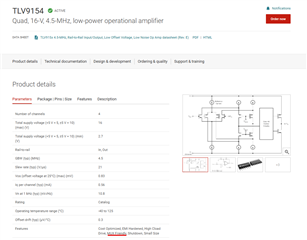
- The TLV9151 is defined as mux freindly on the website page, but not in the datasheet, It is mux friendly ?   
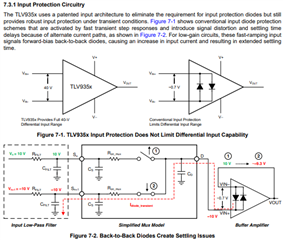
- If yes, is the "Mux friendly" is The TLV9151 similar to the description present in the TLV9351S datasheet ?
- More practically In the case of a simple negative feedback assembly with the TLV9151S what will happen to the IC when 16V is applied to Vout when shutdown enabled ? What will Happen to IN + ? 
- What will happen if the IC is not powered but grounded when 16V applied to Vout ? 
- The "7.4 Device Functional Modes" introduce me a doubt about working supply range, it's 16V or (+/- 8V) ?

Thank-you for support !
 

  • A mux-friendly opamp does not have diodes between the input pins. Any opamp whose absolute maximum ratings allow large differential input voltages is mux friendly.

    In shutdown, the output is disabled, i.e., it has a high impedance, and any voltage between V− and V+ can be applied.

    The absolute maximum ratings do not allow voltages above V+.

    This device does not have a ground pin. When you connect V− and V+ to ±8 V, the voltage between V− and V+ is 16 V.

  • Ok, so a large "Input voltage range" indicate me the device is mux friendly ? 
    If V- is connected to 0V and V+ to 16V it's also 16V. I still not understand the sentence: 

    "The maximum power supply voltage for the TLV915x is 16 V (±8 V)"  

    It's 16V (±8 V) or 16V (V+ - V-) ??

    Thank-you.

  • In the datasheet, all voltages are relative to the V− pin.

    You can connect V+ and V− to voltages that you call +8 V and −8 V. But as far as the datasheet is concerned, these voltages are 16 V and 0 V.

  • Hi Adam,

    - The TLV9151 is defined as mux freindly on the website page, but not in the datasheet, It is mux friendly ? 

    I agree with Clemens assessment. Mux-friendly op amp refers to an op amp that is designed to work with multiplexers in a switched systems. It requires to have following characteristics.

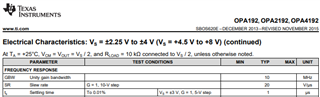
    a. Fast settling time (e.g. OPA192)

    b. high input impedance

    c. low input Ib current

    d. capable to handle or withstand input transient events

    e. wide bandwidth for ADC application

    f. low offset and drift

    g. wide input differential and common mode signal swing (generally does not have back to back diode protection at input from large differential input voltages). 

    Here are some references about an example of mux-friendly op amps - opa192, opa197 etc.. 

    https://www.ti.com/lit/ab/sbot040c/sbot040c.pdf?ts=1736819863765&ref_url=https%253A%252F%252Fwww.ti.com%252Fproduct%252FOPA2141

    TLV9151 may be used as mux-friendly op amp, but It depends what your Muxing and ADC application are. How the settling time is required for your ADC sampling period and at what percentage signal level.

    - What will happen if the IC is not powered but grounded when 16V applied to Vout ? 

    This is not a standard ADC operational events. Please describe the application and how the overvoltage events are taken place. The concerns here are how to protect the output of op amp under the scenario. Your question seems to be an automotive rather than ADC application. TLV9151 is capable to withstand up to 20V(abs. max) supply voltage, but the application has to limit the sink current in order to protect the op amp. Anyway, I need to details of the output overvoltage scenario to evaluate the op amp protection. 

    Please let us know if there are additional questions. 

    Best,

    Raymond