This thread has been locked.

If you have a related question, please click the "Ask a related question" button in the top right corner. The newly created question will be automatically linked to this question.

THP210: Amplifier input common mode limit, versus datasheet example with an unipolar supply

Part Number: THP210
Other Parts Discussed in Thread: OPA1637, THS4551

Tool/software:

First, I would like to thank TI for releasing this high-voltage, low-speed precision fully differential amplifier (FDA). It is very convenient for use with classic +/- 15 V bipolar supplies (or even at a bit less than that). I have a few successful design with it that seem to be performing better than their predecessors built with two or more discrete op amps.

-

The amplifier datasheet, however, seems to suggest that THP210 would also work with low-voltage unipolar supplies down to 3 V.

There are also examples, like Figure 9-10 with a 30 kHz low-pass filter (third-order Butterworth) with a gain of 5 on a unipolar 5 V supply.

The example does not specify the voltage at VOCM node, but for any valid value, this example, however, seems to violate the specified input common mode limit (VICM > VS- + 1 V) for all possible input voltages with a valid output voltage through an ideal FDA with gain 5.

The PSPICE model for the amplifier also confirms this misbehaviour, and that it is due to VICM limits.

-

Is the example a bad example of the use of this FDA, or are the VICM and the PSPICE model too pessimistic about the valid operating window of the amplifier?

In the example, at VOCM = 2.5 V, the VICM would be just 0.4 V when the input is in the middle of the valid range. This would mean that the VS- would need to be at most -0.6 V for guaranteed correct operation. And, even at the highest valid VOCM (which leaves no room for actual signals with the shown VS+), one would not get past 0.8 V VICM which would still need a negative supply of at least -0.2 V.

This is with a +5 V supply, which is quite a bit above the minimum specified supply of +3 V.

-

Which FDA would you recommend for such low-voltage unipolar application where dc precision and good low-frequency noise performance would be highly advantageous, and where the signal bandwidth need is less than 100 kHz?

I have a few ideas of drop-in replacement from your catalogue of low-voltage FDA, but they all seem to have quite a bit more noise at low frequencies.

As, alternatively, I think, the only valid solution with THP210 would require all signals referred to a virtual ground near the mid-supply level. This of course greatly reduces the versatility of having an FDA, and would have very marginal headroom for operation at, say, a hypothetical 3.3 V application.

  • HI Lari,

    You are correct that the THP210 is currently our high DC accuracy, lowest offset and low offset drift fully-differential amplifier, offering very low 1/f noise (low frequency) noise with low frequency noise 1/f corner around 100Hz .

    As you have mentioned, the THP210 input common-mode, VICM, requires a 1V headroom below the positive (V+) supply, and above the negative (V-) supply where VICM is the voltage at the input terminals of the device.  The VICM limitation can often be a limiting factor when applying bipolar ± input signals in single-ended to differential converter circuits, while powering the THP210 with unipolar supplies.  On these cases, one can modify the circuit to use ± bipolar supplies or a small negative supply to overcome the VICM limitations. In other cases, depending on the gain, signal amplitude, supply and circuit constraints, the VOCM voltage "could" be adjusted to a slightly higher voltage to overcome the input common-mode limitation. As you have suggested, another option is to refer the inputs to a common-mode within range.

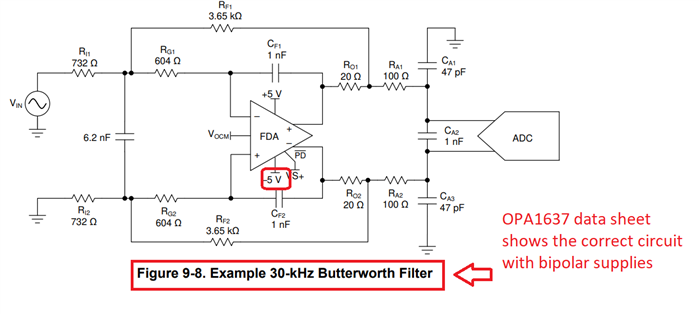
    Regarding the circuit example of Figure 9-10 on THP210 datasheet, this circuit was actually intended, simulated, tested and verified using ±bipolar supplies and since the circuit is on a gain, the only feasible option is to use bipolar supplies. The original intended 30-kHz MFB filter circuit appears on the OPA1637 data sheet, on Figure 9-8, p24 showing correctly ±bipolar supplies. The OPA1637 is essentially an audio version of the THP210, which uses the same core amplifier with identical spec, but only slightly more relaxed offset and offset drift specifications; and slightly more open quiescent current consumption spec.   Hence, it appears the THP210 data sheet 9-10 data sheet figure/description is incorrect showing unipolar supply. The other circuits examples use differential input signals, where input common-mode is not an issue, although the circuit descriptions could use more clarification on the input common-mode. I will provide this feedback to the Systems team to correct THP210 Figure 9-10.

     Figure on OPA1637 data sheet, shows the correct circuit as tested, with bipolar supplies:

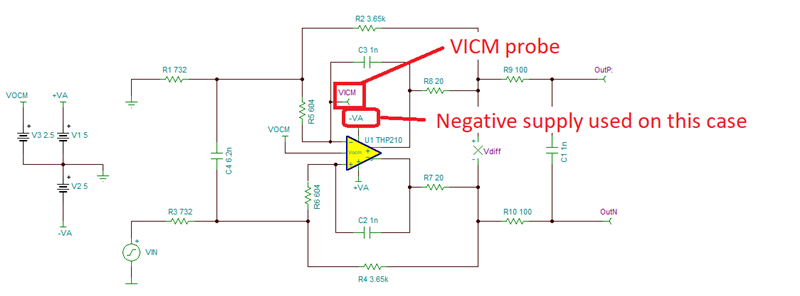
    Below, is the THP210 simulation with bipolar ±5V supplies, VICM fluctuates between +40mV and +800mV approx. for a ±0.9V bipolar input and ±4.54V output signal with VOCM=+2.5V. Hence, THP210 requires a negative supply more negative than (V-) < -1V, to meet VICM headroom spec.


    The closest FDA we currently offer, that offers good DC precision while allowing a larger range of VICM is the THS4551; and can work optimally at the lower supply levels...  The device offers very good DC precision and very low broadband noise, but the 1/f noise is higher than THP210. The THS4551 input common-mode, low voltage range extends to the negative supply; or slightly below depending on temperature.

    THS4551 input common-mode spec:

    Also, please let me know if you have questions or you need us to look at other solutions.

    Thank you and Kind Regards,

    Luis