This thread has been locked.

If you have a related question, please click the "Ask a related question" button in the top right corner. The newly created question will be automatically linked to this question.

TL072: Question about IP/CP Die Differences?

Part Number: TL072


Tool/software:

I've seen posted a few times around the forum that the TL072IP/TL072CP vary: "TL072CP and TL072IP have different internal silicon dies". Can I get some clarity as to what this means in terms of interchangeability? Is it different quality material? Different fabrication processes? Different testing prior to release? Thanks, any extra clarity on this would be greatly appreciated.

  • Hi Connor, 

    "TL072CP and TL072IP have different internal silicon dies"

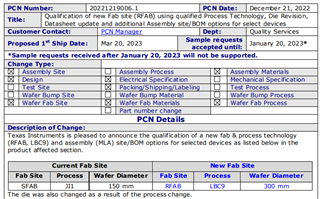
    Per the PCN issued on 12/21/2022, the FAB process has changed and Si design has changed as well. However, the post-PCN device is equivalent to the old process Si die. Since FAB has changed, certain features may be slightly different vs. the old die, but the performance, functionality and behaviors of the part are remained unchanged as specified in the PCN. 

    https://mm.digikey.com/Volume0/opasdata/d220001/medias/docus/5046/PCN20221219006.1.pdf

    Both TL072IP/TL072CP are dip packages. Eventually, all TLV07x family will be sourced from the latest or post-PCN Si die. Meantime, it is possible that you are getting old die or new die depending on the date code, since the current inventory may have both op amps with old and new Si die.   

    If you have additional questions, please let me know. 

    Best,

    Raymond

  • Hi Raymond,

    I had not caught that. Thank you for bringing this to my attention. As a follow-up, all parts I would be purchasing have date codes from 2024+. If this is the case (and I'm assuming that at this point all devices I'd intend to purchase would be from RFAB), would the internal silicon of these devices be the same? Or there are still different fabrication steps used for the CP devices when compared to the IP devices?

    Thanks again,

    Connor

  • Hi Connor, 

    all parts I would be purchasing have date codes from 2024+.

    It is very likely that you will be getting the op amp with the latest Si die from RFAB process. 

    would the internal silicon of these devices be the same? Or there are still different fabrication steps used for the CP devices when compared to the IP devices?

    Yes, the internal Si die will be sourced the same. The previous FAB has been closed and no longer producing the old Si die. If any authorized TI distributors still have old inventory, it is possible that you may still getting old Si die. If the date code is shown 2024+, then it is likely that you are getting the latest Si die or the post-PCN op amps. I am not certain if there is a way to specify to the seller when you do the purchasing. I am not familiar with the process. 

    If you have other questions, please let us know. 

    Best,

    Raymond 

  • Hi Raymond,

    This is useful to know, thanks again. I just want to confirm my understanding at this point -- In the linked discussion here, someone else was asking about differences (granted this was 5 years ago). In his response, another TI employee, Ron Michallick, said that "TL072CP and TL072IP have different internal silicon dies".

    Reading your answer, it sounds like now the fab process for these two devices is the same in RFAB, however I'm assuming that testing conditions vary between the IP (higher temp rated) and CP (lower temp rated) devices?

    Thanks a lot for the help,

    Connor

  • Hi Conner, 

     "TL072CP and TL072IP have different internal silicon dies".

    That was then. We (previous PRAMPS Application team) are responsible for supporting General purpose op amps since last Nov, and the PCN has been executed and it is the final. 

    I'm assuming that testing conditions vary between the IP (higher temp rated) and CP (lower temp rated) devices?

    Yes, you should spec. out TL072IP for your application, and it is cheaper as well. 

    If you have other questions, please let us know. 

    Best,

    Raymond