Part Number: LMH34400DRLEVM
Other Parts Discussed in Thread: LMH34400, LMH13000, LMH13000RQEEVM, LMG1025-Q1EVM
Tool/software:
Please advise a photodiode for Lifi with LMH34400?
thanks
Andrew.
This thread has been locked.
If you have a related question, please click the "Ask a related question" button in the top right corner. The newly created question will be automatically linked to this question.
Part Number: LMH34400DRLEVM
Other Parts Discussed in Thread: LMH34400, LMH13000, LMH13000RQEEVM, LMG1025-Q1EVM
Tool/software:
Please advise a photodiode for Lifi with LMH34400?
thanks
Andrew.
Hi Andrew,
Few parameters you need to consider before choosing a photodiode for LMH34400 integrated TIA-


So, considering these parameters you can choose a suitable photodiode for LMH34400.
Regards,
Aditya Gosavi
Thank you. I found S5973. It's not cheap. I'm planning on -10V for -Vbias. One choice brings with it other questions. Which low-noise DC/DC should be chosen for -10V. Which emitter is suitable LED or Laser. :) :( Andrew.
Hi Andrew,
For choosing a DC/DC converter please refer:
For laser driver please check out:
Regards,
Aditya Gosavi
Hi, I think it will work. LMH13000RQEEVM is very new and demo is not for sale. I have LMG1025-Q1EVM. I think it will work for me to test the idea. I want to transmit information to the drone up to 300 meters. For starters in one direction. PS: github.com/.../laser_audio_sim
Please find the link for LMH13000 EVM .
Also please note LMH13000 allows easy data amplitude modulation using VSET pin.
A part like LMH13000 has separate control for IOUT amplitude ( using VSET pin) and IOUT pulse width using LVDS pin. This allows for easy control of IOUT and thereby easy control of laser power output.
I have a question for TI specialists. With laser 905 and high power there is LMG1025. What drivers are there for blue and green lasers of lower power up to 1 ampere at a frequency of up to 100 MHz? LMH13000 - not on sale yet. I don't want to wait six months to test the idea.
Lmh13000 has been released to market completely and you will see the updated material without the preview marking on Ti before end of this week .
if you want we can send you some free samples without any problems
you can also see a completely released and updated datasheet on ti.com
please feel free to reach out to me at shree@ti.com
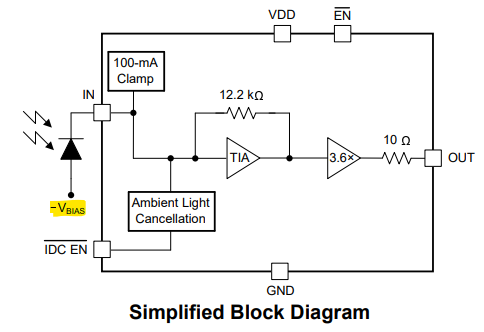
I wonder what application scenarios TI had with this board? There is a capacitor at the input C2 and a capacitor at the output C7. Did you plan to connect a photodiode or APD at all?
Hi Andrew,
C2 and C7 caps are meant for AC coupling the TIA input and output, or to block any DC voltage. If you want to bias the APD you need to connect a biasing resistor through Vbias.
Regards,
Aditya Gosavi
thanks for the answer. I'm trying to understand why it was necessary to do this for TIA. If I leave the AC Coupling
. I lose the band. Since the recovery will not be the fastest. For a good Lifi, the bandwidth is always not enough. How to Effectively Design and Optimize the TIA Interfaces of LIDAR Systems | Analog Devices
Ragards,
Andrew.
Hi Andrew,
You’re right to consider the trade-offs here. AC coupling is primarily used to block DC offsets and allow independent biasing of the TIA input/output, which is important in integrated systems where biasing flexibility is needed—especially when interfacing with photodiodes or APDs.
That said, it does introduce a high-pass filter effect (set by the coupling cap and input resistance), which can limit the low-frequency response and hence reduce effective bandwidth. In high-speed applications like LiFi or LIDAR, it’s crucial to size these components carefully to ensure minimal impact on the required signal bandwidth.
Hope this clarifies things—happy to discuss further if needed.
Best,
Aditya
I bought your KIT and didn't look at the circuit. Now to use it for LiFi. I need to change it, unsolder and replace the elements. The capacitor can be easily replaced with a resistor. But to protect the input, i need to put a TVS with a small capacity. Maybe I need to cut the board, etc. I only have one KIT. :( probably KIT will go on the shelf and I will make my own board.
Hi Andrew,
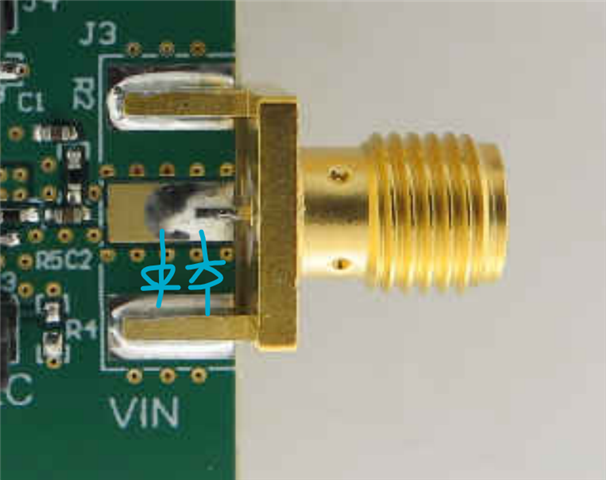
If you want to put TVS diodes to Vin, you can use the SMA connector and its adjacent GND pins to connect the diodes. Please refer the screenshot below-

I am not sure I understand why you would need to cut the board- could you clarify that part?
Regards,
Aditya
Thank you. I completely forgot about SMA. Maybe you can recommend a suitable TVS?
Hi Andrew,
Please check TI TVS diodes portfolio: https://www.ti.com/passive-discrete/diodes/tvs-diodes/products.html to select suitable tvs diode as per your requirements.
Regards,
Aditya