This thread has been locked.

If you have a related question, please click the "Ask a related question" button in the top right corner. The newly created question will be automatically linked to this question.

TLV9034: Comparators Schematic Check

Part Number: TLV9034
Other Parts Discussed in Thread: LM339

Tool/software:

Hello

I would like to design a circuit that detects if a fuse is blown or not in a 600V 60Hz AC system. In the picture below, F1_P and F1_S are two sides of a fuse, and I am measuring the voltage across them with respect to the signal ground of my circuit. As long as the fuse is fine, the LED turns on; if the fuse is blown, the LED turns off.

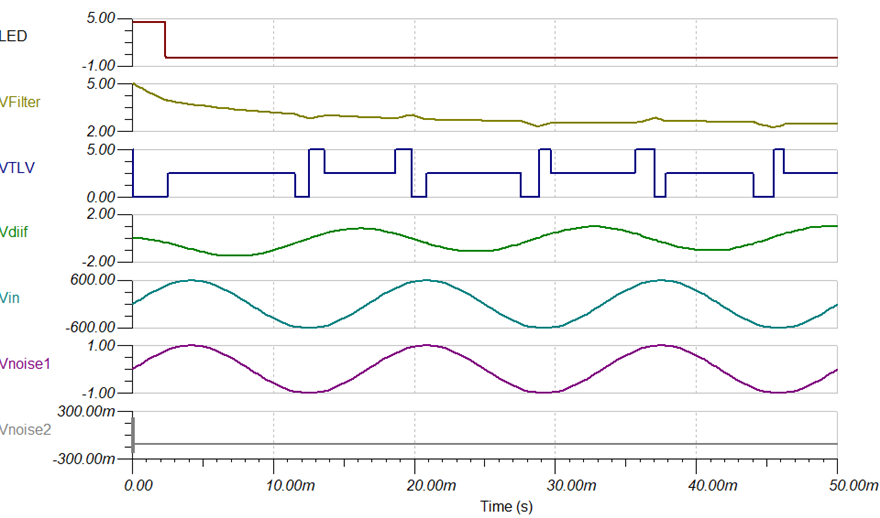
To elaborate further, I used an RC circuit in the output of the TLV to filter out the square wave caused by a blown fuse condition. So, after the filter, the output would be around 2.5V, then I have two other comparators with 1V and 4V levels. If the output of the low-pass RC filter is either 0V or 5V, it will turn on the LED; if not (fuse blown and Vfilter=2.5V), the LED turns off. I attached the simulation result using TINA

I would appreciate any help and comments regarding this design :-)

TINA simulation for when the fuse is OK:

TINA simulation for when the fuse is blown:

  • Hello Amirhosein,

    You really should have some negative clamping on the inputs. It is not good to pull the inputs below ground.

    The model is "complaining" that there is an input violation by forcing the output to Vs/2 - that is why you have the funny tri-level output on VTLV (the real device will not do that - but it may misbehave depending on the severity of the violation).

    See the LM339 appnote on negative input protection (different device, but the concept is the same).

    Application Design Guidelines for LM339, LM393, TL331 Family Comparators

    I would recommend the "split" divider circuit shown in section 6.9.3.

    Basically, on the positive swing, the diode is out of the circuit and is a "normal" divider. But on the negative swing, the diode clamps and creates a second divider to further attenuate the negative voltage.

  • Dear Paul

    Hope you are doing great

    Thank you for your response and your time

    In my TINA simulation, if I use a bigger capacitors for C1 and C6, like 220nF, both my - and + input voltages respect to the ground will be in range of (-200mV,+200mV), even without using protection diodes. Do you think it is a good idea?

    I attached a link to my simulation result

    www.mediafire.com/.../file

  • Hello Amirhosein,

    Adding larger capacitors does attenuate, but you are also adding more delay.

    I still think the split clamping dividers are a better as the attenuation only occurs outside of the threshold area - so you have better resolution and no delay.

    We cannot view files hosted on external sites. Please attach your simulation to the post using the "Insert" menu->"Image/Video/File"-> Upload (under the entry box).