This thread has been locked.

If you have a related question, please click the "Ask a related question" button in the top right corner. The newly created question will be automatically linked to this question.

OPA4171-Q1: comparator application

Part Number: OPA4171-Q1
Other Parts Discussed in Thread: OPA2171, LM2902, LM2903, LM2901

Tool/software:

Hi team, 

I want to check with you if OPA2171/4171-Q1 can be used as comparator input? I saw some amplifiers without bi-directional diode at input side can be used as comparator inputs. 

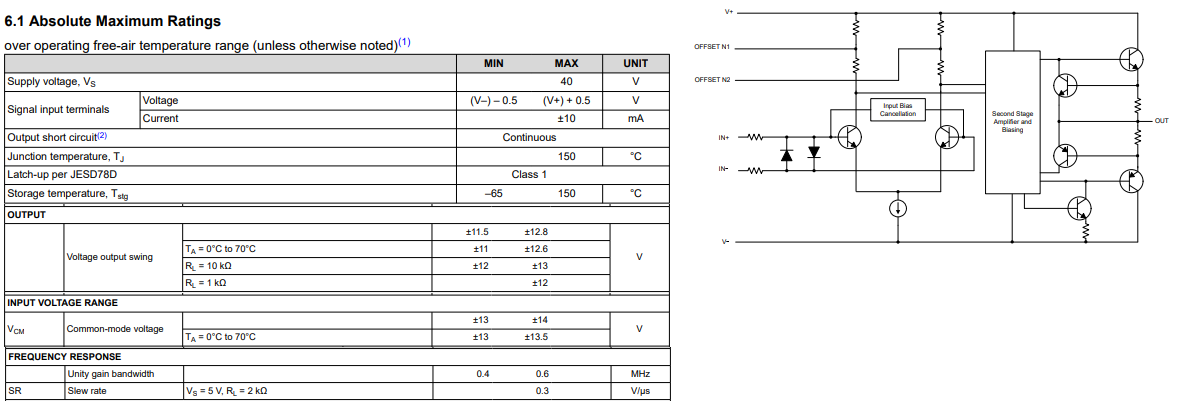
OPAx171-Q1 have these diode at input side. Does this mean OPAx171 cannot be used as comparator? How should we know which amplifier can be used as comparator? 

I want to check LM2902/4-Q1 as well. 

Thanks!

Ethan Wen

  • Hi Ethan, 

    OPAx171-Q1 have these diode at input side. Does this mean OPAx171 cannot be used as comparator?

    OPAx171-Q1 will work as compactor functionally, but the op amp's input will saturate if the differential input exceeds +/-0.5V, and the op amp is not going to response fast due to the low slew rate and possible overdrive recovery related issues at output. If the application is a slow and crude comparator, it may be acceptable, but be aware of the issues in the configuration. 

    Based on the abs. max. ratings, the op amp's input has back to back diodes, so the differential input signal will be clamped within +/-0.5V to +/- 0.7Vdc, if the input is larger than a diode drop. So the comparator is a slow and crude one vs. real comparator. Also, you have some input and output limitations in this part, since the OPA4171-Q1 is NOT RRIO op amps. Personally, I do not recommend it and used as a comparator. 

    If you have other questions, please let me know. 

    Best,

    Raymond

  • Hi Ethan,

    Is there a particular reason for using an op-amp? Offset? Supply voltage? Push-Pull output? We do have "real" 40V comparators (TLV18xx families).

    The LM2903 and LM2901 are the comparator sister-device of the LM2902/4 op-amps - no differential clamps.

    As Raymond mentioned, Op-amps can be slower or less accurate because large input differential voltages can saturate the input stage, shifting offsets and causing more delay. Bipolar output devices really do not like to be "slammed" into the rail (higher supply currents due to saturated bases).