This thread has been locked.

If you have a related question, please click the "Ask a related question" button in the top right corner. The newly created question will be automatically linked to this question.

INA199: Cut off frequency

Part Number: INA199
Other Parts Discussed in Thread: TIDA-00753

Hi Experts, 

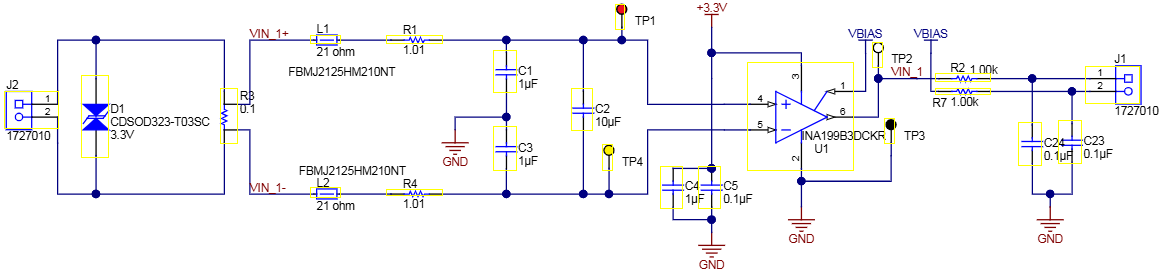
I have a question regarding TIDA-00753. I need to understand how R1,R4,C1,C2 and C3 filter values are calculated in this desgin. Do we have an application note that helps explain this? Thanks. image.png
Regards,

Marvin


  • Marvn, 

    Thanks for the question. We address how to calculate this type of filter in the Analog pocket reference:

    With the addition of the common mode caps, the cutoff frequency calculation changes to:

    Removal of these caps reverts the equation to its original form by negation of the CCM1 term (note that the term is "one half of CCM1". The guide makes this term look like the capacitor value is in the denominator and it is not) . For the values populated in the TIDA, this sets the device BW to 7.5kHz. 

  • Hi Carolous,

    Thank you for this. I just have a follow up question, why was 7.5kHz selected for TIDA-00753?

    Regards,

    Marvin

  • Hi Marvin,

    I can answer this since Carolus is out of office for the holiday. This reference app note was written 10 years ago at this point, so we don't know what the exact reasoning the authors used is, but I can give some general guidelines that might indicate the reason:

    The current frequency is 50-60Hz in the app note, so generally at least 600Hz is necessary to ensure that the bandwidth is high enough to sense the current with no attenuation. At least 2kHz is good to ensure that there is no phase delay in the signal, and will also help to improve the transient response for other failures on the lines.

    The noise from the sensor is very small as calculated in the App note, so there aren't many downsides to keeping the filter bandwidth large.

    This large bandwidth is probably unnecessary for the application (fault detection though torque monitoring) most of the time, but the increased bandwidth will help to speed up any critical alert failures.

    Let me know if you have any more questions,

    Levi DV