A related question is a question created from another question. When the related question is created, it will be automatically linked to the original question.
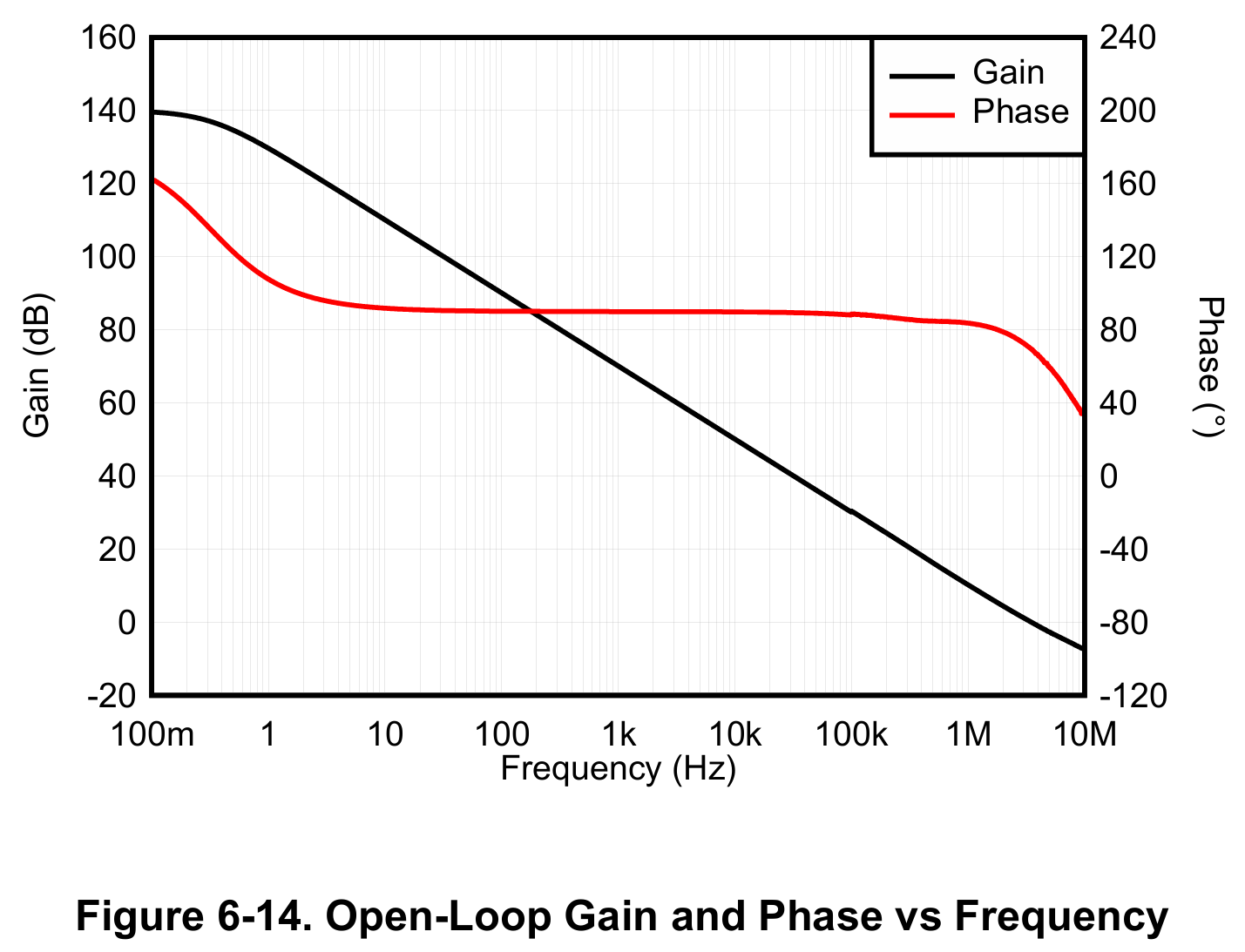
For all op amps the phase shift near DC is 180°. This is accounting for the inversion, so the open-loop test signal is applied to the inverting input. At low frequency the op amp has a single pole (sometimes called the "dominant pole"). The dominant pole introduces a 90º phase shift. The phase shift for the dominant pole will at a frequency one decade below the pole and finish one decade after the pole for a total phase shift of 90º. Near the unity gain bandwidth (where AOL = 0dB), most op amps will have additional poles and zeros. The additional poles and zeros will make further changes in the phase. In this example, and in most op amps the phase begins to drop below 90º near the unity gain frequency. This Stability app note covers a simple model of an op amp in section 7. The effect of the dominant and secondary poles and zeros on phase is covered in more detail. If you review many op amp data sheets you will see a plot with a similar phase to what is shown here. Note that the graph here makes the phase look like it starts at 200º. This is really a rounding error and the phase actually starts at 180°.
So, whether it start from 180 or 0 degree at low frequency determined by the point where signal is injected, if the the plot obtained with signal injected into inverting input, it will start from 180 degree, right?
You are correct. The standard is to apply the signal to the inverting input, because this gives insight into phase margin. Phase margin relates to the stability of the op amp. The stability app note linked above gives details on this topic.
I see some opamps' phase plot starting from 0 degree at low frequency, such as opa277. Does it mean it use a different signal injection point when testing or the measured phase was minused 180 manually before drawing?
Yes. You are correct. The common standard is to inject on the inverting input so that the phase shift starts at 180 deg. The OPA277 starts at zero, so the phase margin is given by PM = 180 + Phase_on_graph. For example if the phase on the graph reads -120, the phase margin is 180 + (-120) = 60deg. If the phase starts at 180, you can directly read the phase as the phase margin.