This thread has been locked.

If you have a related question, please click the "Ask a related question" button in the top right corner. The newly created question will be automatically linked to this question.

OPA172: Transimpdance servo amplifier

Part Number: OPA172

Hi Experts,

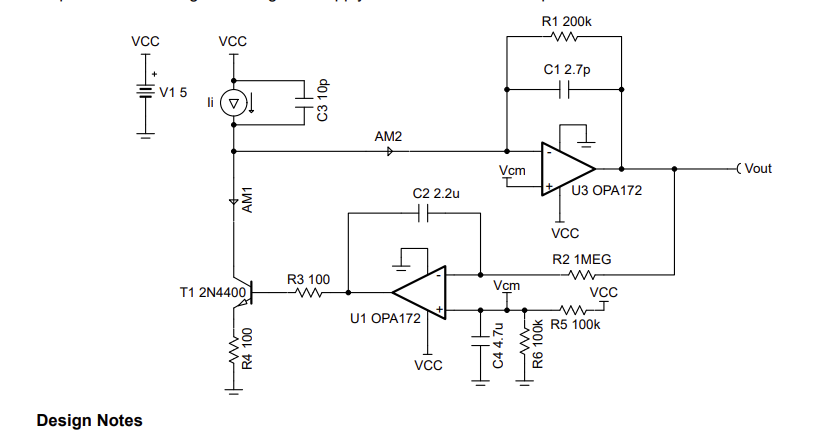
In the TI document SBOA324A "AC-TRANSIMPEDANCE AMPLIFIER CIRCUIT", on page 1(see below attachment), we have OPA172 in a servo DC ( or low frequency) tracking aplication, that esentially cancels out low frequency signals form Vout. 

What is the advantage of using this DC servo tracking circuit  vs just putting a high pass (C, R)  filter at the OPA output-Vout?
OPA172 TIA.png

Regards,

Marvin

  • Marvin,

    Deleted original response ( one of my colleagues made a good point and suggestion).

    If you place an AC coupling (HPF) at the output, then all the photodiode current (DC and AC ) need to flow through into the transimpedance amplifier.  The transimpedance gain needs to be set to allow a linear swing for the entire signal.  The AC part of the signal may be small, but the DC may be large.  Thus, the gain will need to be set low to accommodate the large DC current.  If you use this circuit, the transimpedance input current is only the AC current.  Thus, the gain can be set much higher then it would be without the servo.

    I hope this helps.  Sorry for the misguided original response.

    Art