This thread has been locked.

If you have a related question, please click the "Ask a related question" button in the top right corner. The newly created question will be automatically linked to this question.

LM311: Frequency Characteristics

Part Number: LM311
Other Parts Discussed in Thread: TLV1831, TLV1871, TLV3511

Dear Team,

My customer has used the LM311 in their application. When they evaluated the LM311 at a new project, they found a issue in their application. Then, they ask us to provide the following technical information of the LM311 to handle that issue.

(1) Frequency gain and frequency phase characteristics when the input terminal V(in+) = V(in-)
(2) Approximate frequency band in which the gain is 1 times or more
        Based on the Response time value of "6.7 Switching Characteristics" in the data sheet, it is assumed that 1/165 ns = 6 MHz to 1/115 ns = 8.7 MHz, what is your view.

Best Regards,

Koshi Ninomiya


  • Hello Koshi-san,

    The LM311 is a comparator with a digital output. 

    Gain/Phase graphs not used for comparators. Comparators are essentially uncompensated, open-loop saturated amplifiers.

    The comparators main spec is propagation delay - the time it takes or the output to respond to the input.

    Rember that you have both a rising and falling edge in a full cycle - each with it's own response time (tpLH and tpHL).

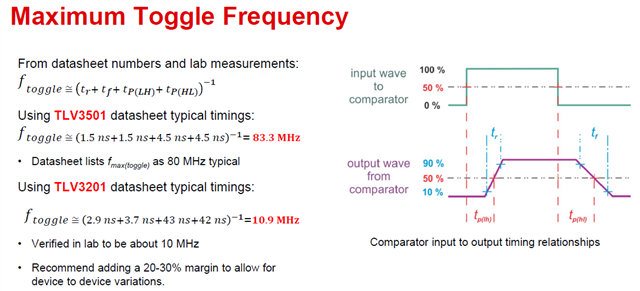
    The "rule of thumb" is Fmax = 1 / (tpHL + tpLH). 

    The more accurate formula also takes into account rise and fall times, as shown above.

    So for the LM311, using the datasheet numbers:

    Fmax =  1/(tpLH + tpHL) = 1/(115ns + 165ns) = 3.57MHz (best case)

    The datasheet does not give rise/fall times. But because this is a open-collector output, the tpLH will be significant. I will infer the risetime from the graphs.

    Fmax = 1 / (tr + tf + tpLH + tpHL) = 1 / (100ns + 50ns + 115ns + 165ns) = 1/430ns = 2.32MHz.

    And to be conservative, I would knock off 30% to allow for headroom.

    Is there a particular reason to use the LM311? We have more modern replacements, such as the TLV1871, TLV1831 family, or the high speed TLV3511 family.

  • Paul san, thank you very much for your kind response.
    I now understand that the frequency range in which the LM311 has a gain greater than 1 extends up to several MHz.

    In the circuit I am responsible for, we have identified abnormal oscillation caused by loopback.

    If the LM311 is the cause, I now see that countermeasures targeting effects up to a few MHz should be effective. I will give it a try.

    Regarding products other than the LM311, we are using many TI products—not only comparators—so I will discuss with Ninomiya san the possibility of having you provide a broad review of your recommended new products.
    Thank you again.