This thread has been locked.

If you have a related question, please click the "Ask a related question" button in the top right corner. The newly created question will be automatically linked to this question.

TAS5805M: How to use TAS5805M to design audio 2.1 mode based on linux firmware platform

Part Number: TAS5805M
Other Parts Discussed in Thread: TAS5805, TAS2563

Hello TI,


I would like to consult some items with you, thanks


  • Does the latest V6.18 Kernel of Linux support audio 2.1 mode (Left channel, Right channel and Subwoofer)driver of TAS5805M ?
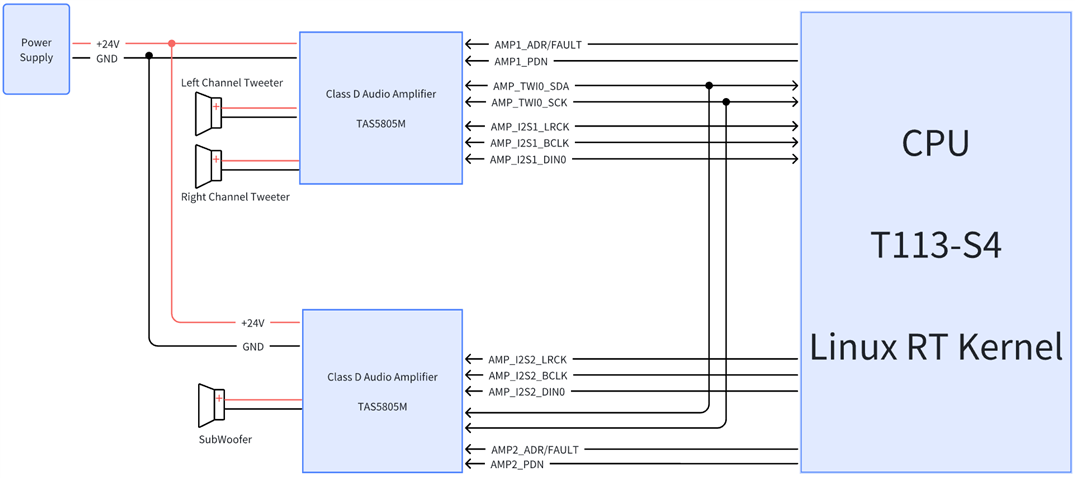
  • We already used two TAS5805M to design audio 2.1 mode hardware, based on the typical application of TAS5805M on the date sheet , common used one I2S signal and the audio sign is from one chip output to another input. 

           Does TI have such hardware and firmware design on the final products? If yes, could you please share reference design for us, thanks.
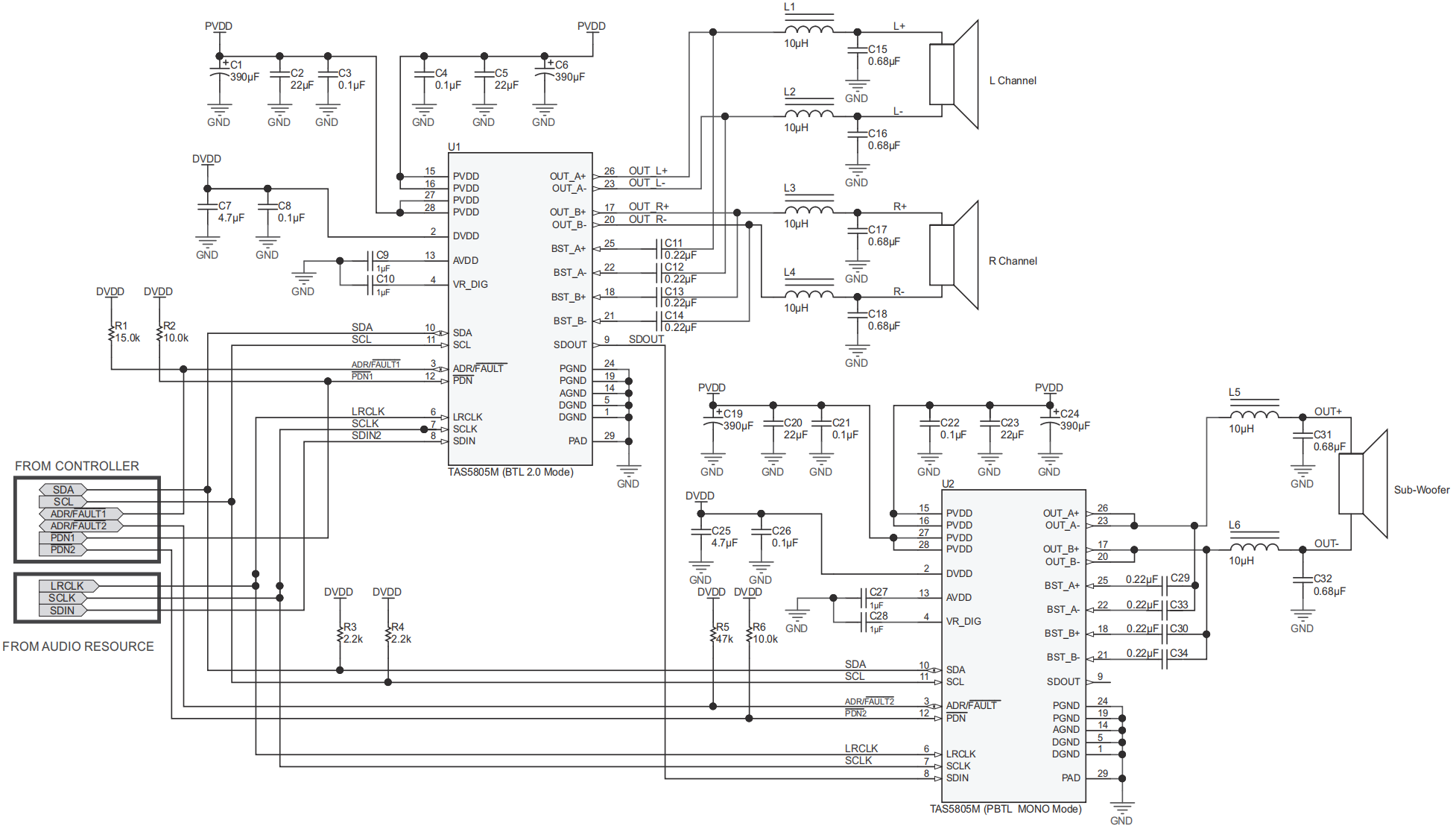
TAS5805M HW.png

  • yes, it can support. Let me know the kernel version in detail, especially the sublevel version of 6.18. Thanks.

  • We are used V5.4 version kernel and copied driver of TAS5805M from the latest V6.18 version kernel(this kernel is just download from net). The code is attached for reference, this driver need to load one bin file, but we do not have this bin file, could you please provide this file?
    BTW, any debug an adjustment method of this application based on 2.1 mode? thanks.

  • We are used V5.4 version kernel and copied driver of TAS5805M from the latest V6.18 version kernel(this kernel is just download from net). The code is attached for reference, this driver need to load one bin file, but we do not have this bin file, could you please provide this file?
    BTW, any debug an adjustment method of this application based on 2.1 mode? thanks.

  • // SPDX-License-Identifier: GPL-2.0
    //
    // Driver for the TAS5805M Audio Amplifier
    //
    // Author: Andy Liu <andy-liu@ti.com>
    // Author: Daniel Beer <daniel.beer@igorinstitute.com>
    //
    // This is based on a driver originally written by Andy Liu at TI and
    // posted here:
    //
    //    https://e2e.ti.com/support/audio-group/audio/f/audio-forum/722027/linux-tas5825m-linux-drivers
    //
    // It has been simplified a little and reworked for the 5.x ALSA SoC API.
    
    #include <linux/module.h>
    #include <linux/moduleparam.h>
    #include <linux/kernel.h>
    #include <linux/firmware.h>
    #include <linux/slab.h>
    #include <linux/of.h>
    #include <linux/init.h>
    #include <linux/i2c.h>
    #include <linux/regmap.h>
    #include <linux/gpio/consumer.h>
    #include <linux/regulator/consumer.h>
    #include <linux/atomic.h>
    #include <linux/workqueue.h>
    #include <linux/version.h>
    
    #include <sound/soc.h>
    #include <sound/pcm.h>
    #include <sound/initval.h>
    
    /* Datasheet-defined registers on page 0, book 0 */
    #define REG_PAGE		0x00
    #define REG_DEVICE_CTRL_1	0x02
    #define REG_DEVICE_CTRL_2	0x03
    #define REG_SIG_CH_CTRL		0x28
    #define REG_SAP_CTRL_1		0x33
    #define REG_FS_MON		0x37
    #define REG_BCK_MON		0x38
    #define REG_CLKDET_STATUS	0x39
    #define REG_VOL_CTL		0x4c
    #define REG_AGAIN		0x54
    #define REG_ADR_PIN_CTRL	0x60
    #define REG_ADR_PIN_CONFIG	0x61
    #define REG_CHAN_FAULT		0x70
    #define REG_GLOBAL_FAULT1	0x71
    #define REG_GLOBAL_FAULT2	0x72
    #define REG_FAULT		0x78
    #define REG_BOOK		0x7f
    
    #define REG_SIG_CH_CTRL		0x28
    
    /* DEVICE_CTRL_2 register values */
    #define DCTRL2_MODE_DEEP_SLEEP	0x00
    #define DCTRL2_MODE_SLEEP	0x01
    #define DCTRL2_MODE_HIZ		0x02
    #define DCTRL2_MODE_PLAY	0x03
    
    #define DCTRL2_MUTE		0x08
    #define DCTRL2_DIS_DSP		0x10
    
    /* This sequence of register writes must always be sent, prior to the
     * 5ms delay while we wait for the DSP to boot.
     */
    static const uint8_t dsp_cfg_preboot[] = {
    	0x00, 0x00, 0x7f, 0x00, 0x03, 0x02, 0x01, 0x11,
    	0x00, 0x00, 0x00, 0x00, 0x00, 0x00, 0x00, 0x00,
    	0x00, 0x00, 0x7f, 0x00, 0x03, 0x02,
    };
    
    static const uint32_t tas5805m_volume[] = {
    	0x0000001B, /*   0, -110dB */ 0x0000001E, /*   1, -109dB */
    	0x00000021, /*   2, -108dB */ 0x00000025, /*   3, -107dB */
    	0x0000002A, /*   4, -106dB */ 0x0000002F, /*   5, -105dB */
    	0x00000035, /*   6, -104dB */ 0x0000003B, /*   7, -103dB */
    	0x00000043, /*   8, -102dB */ 0x0000004B, /*   9, -101dB */
    	0x00000054, /*  10, -100dB */ 0x0000005E, /*  11,  -99dB */
    	0x0000006A, /*  12,  -98dB */ 0x00000076, /*  13,  -97dB */
    	0x00000085, /*  14,  -96dB */ 0x00000095, /*  15,  -95dB */
    	0x000000A7, /*  16,  -94dB */ 0x000000BC, /*  17,  -93dB */
    	0x000000D3, /*  18,  -92dB */ 0x000000EC, /*  19,  -91dB */
    	0x00000109, /*  20,  -90dB */ 0x0000012A, /*  21,  -89dB */
    	0x0000014E, /*  22,  -88dB */ 0x00000177, /*  23,  -87dB */
    	0x000001A4, /*  24,  -86dB */ 0x000001D8, /*  25,  -85dB */
    	0x00000211, /*  26,  -84dB */ 0x00000252, /*  27,  -83dB */
    	0x0000029A, /*  28,  -82dB */ 0x000002EC, /*  29,  -81dB */
    	0x00000347, /*  30,  -80dB */ 0x000003AD, /*  31,  -79dB */
    	0x00000420, /*  32,  -78dB */ 0x000004A1, /*  33,  -77dB */
    	0x00000532, /*  34,  -76dB */ 0x000005D4, /*  35,  -75dB */
    	0x0000068A, /*  36,  -74dB */ 0x00000756, /*  37,  -73dB */
    	0x0000083B, /*  38,  -72dB */ 0x0000093C, /*  39,  -71dB */
    	0x00000A5D, /*  40,  -70dB */ 0x00000BA0, /*  41,  -69dB */
    	0x00000D0C, /*  42,  -68dB */ 0x00000EA3, /*  43,  -67dB */
    	0x0000106C, /*  44,  -66dB */ 0x0000126D, /*  45,  -65dB */
    	0x000014AD, /*  46,  -64dB */ 0x00001733, /*  47,  -63dB */
    	0x00001A07, /*  48,  -62dB */ 0x00001D34, /*  49,  -61dB */
    	0x000020C5, /*  50,  -60dB */ 0x000024C4, /*  51,  -59dB */
    	0x00002941, /*  52,  -58dB */ 0x00002E49, /*  53,  -57dB */
    	0x000033EF, /*  54,  -56dB */ 0x00003A45, /*  55,  -55dB */
    	0x00004161, /*  56,  -54dB */ 0x0000495C, /*  57,  -53dB */
    	0x0000524F, /*  58,  -52dB */ 0x00005C5A, /*  59,  -51dB */
    	0x0000679F, /*  60,  -50dB */ 0x00007444, /*  61,  -49dB */
    	0x00008274, /*  62,  -48dB */ 0x0000925F, /*  63,  -47dB */
    	0x0000A43B, /*  64,  -46dB */ 0x0000B845, /*  65,  -45dB */
    	0x0000CEC1, /*  66,  -44dB */ 0x0000E7FB, /*  67,  -43dB */
    	0x00010449, /*  68,  -42dB */ 0x0001240C, /*  69,  -41dB */
    	0x000147AE, /*  70,  -40dB */ 0x00016FAA, /*  71,  -39dB */
    	0x00019C86, /*  72,  -38dB */ 0x0001CEDC, /*  73,  -37dB */
    	0x00020756, /*  74,  -36dB */ 0x000246B5, /*  75,  -35dB */
    	0x00028DCF, /*  76,  -34dB */ 0x0002DD96, /*  77,  -33dB */
    	0x00033718, /*  78,  -32dB */ 0x00039B87, /*  79,  -31dB */
    	0x00040C37, /*  80,  -30dB */ 0x00048AA7, /*  81,  -29dB */
    	0x00051884, /*  82,  -28dB */ 0x0005B7B1, /*  83,  -27dB */
    	0x00066A4A, /*  84,  -26dB */ 0x000732AE, /*  85,  -25dB */
    	0x00081385, /*  86,  -24dB */ 0x00090FCC, /*  87,  -23dB */
    	0x000A2ADB, /*  88,  -22dB */ 0x000B6873, /*  89,  -21dB */
    	0x000CCCCD, /*  90,  -20dB */ 0x000E5CA1, /*  91,  -19dB */
    	0x00101D3F, /*  92,  -18dB */ 0x0012149A, /*  93,  -17dB */
    	0x00144961, /*  94,  -16dB */ 0x0016C311, /*  95,  -15dB */
    	0x00198A13, /*  96,  -14dB */ 0x001CA7D7, /*  97,  -13dB */
    	0x002026F3, /*  98,  -12dB */ 0x00241347, /*  99,  -11dB */
    	0x00287A27, /* 100,  -10dB */ 0x002D6A86, /* 101,  -9dB */
    	0x0032F52D, /* 102,   -8dB */ 0x00392CEE, /* 103,   -7dB */
    	0x004026E7, /* 104,   -6dB */ 0x0047FACD, /* 105,   -5dB */
    	0x0050C336, /* 106,   -4dB */ 0x005A9DF8, /* 107,   -3dB */
    	0x0065AC8C, /* 108,   -2dB */ 0x00721483, /* 109,   -1dB */
    	0x00800000, /* 110,    0dB */ 0x008F9E4D, /* 111,    1dB */
    	0x00A12478, /* 112,    2dB */ 0x00B4CE08, /* 113,    3dB */
    	0x00CADDC8, /* 114,    4dB */ 0x00E39EA9, /* 115,    5dB */
    	0x00FF64C1, /* 116,    6dB */ 0x011E8E6A, /* 117,    7dB */
    	0x0141857F, /* 118,    8dB */ 0x0168C0C6, /* 119,    9dB */
    	0x0194C584, /* 120,   10dB */ 0x01C62940, /* 121,   11dB */
    	0x01FD93C2, /* 122,   12dB */ 0x023BC148, /* 123,   13dB */
    	0x02818508, /* 124,   14dB */ 0x02CFCC01, /* 125,   15dB */
    	0x0327A01A, /* 126,   16dB */ 0x038A2BAD, /* 127,   17dB */
    	0x03F8BD7A, /* 128,   18dB */ 0x0474CD1B, /* 129,   19dB */
    	0x05000000, /* 130,   20dB */ 0x059C2F02, /* 131,   21dB */
    	0x064B6CAE, /* 132,   22dB */ 0x07100C4D, /* 133,   23dB */
    	0x07ECA9CD, /* 134,   24dB */ 0x08E43299, /* 135,   25dB */
    	0x09F9EF8E, /* 136,   26dB */ 0x0B319025, /* 137,   27dB */
    	0x0C8F36F2, /* 138,   28dB */ 0x0E1787B8, /* 139,   29dB */
    	0x0FCFB725, /* 140,   30dB */ 0x11BD9C84, /* 141,   31dB */
    	0x13E7C594, /* 142,   32dB */ 0x16558CCB, /* 143,   33dB */
    	0x190F3254, /* 144,   34dB */ 0x1C1DF80E, /* 145,   35dB */
    	0x1F8C4107, /* 146,   36dB */ 0x2365B4BF, /* 147,   37dB */
    	0x27B766C2, /* 148,   38dB */ 0x2C900313, /* 149,   39dB */
    	0x32000000, /* 150,   40dB */ 0x3819D612, /* 151,   41dB */
    	0x3EF23ECA, /* 152,   42dB */ 0x46A07B07, /* 153,   43dB */
    	0x4F3EA203, /* 154,   44dB */ 0x58E9F9F9, /* 155,   45dB */
    	0x63C35B8E, /* 156,   46dB */ 0x6FEFA16D, /* 157,   47dB */
    	0x7D982575, /* 158,   48dB */
    };
    
    #define TAS5805M_VOLUME_MAX	((int)ARRAY_SIZE(tas5805m_volume) - 1)
    #define TAS5805M_VOLUME_MIN	0
    
    struct tas5805m_priv {
    	struct i2c_client		*i2c;
    	struct regulator		*pvdd;
    	struct gpio_desc		*gpio_pdn_n;
    
    	uint8_t				*dsp_cfg_data;
    	int				dsp_cfg_len;
    
    	struct regmap			*regmap;
    
    	int				vol[2];
    	bool				is_powered;
    	bool				is_muted;
    
    	struct work_struct		work;
    	struct mutex			lock;
    };
    
    static void set_dsp_scale(struct regmap *rm, int offset, int vol)
    {
    	uint8_t v[4];
    	uint32_t x = tas5805m_volume[vol];
    	int i;
    
    	for (i = 0; i < 4; i++) {
    		v[3 - i] = x;
    		x >>= 8;
    	}
    
    	regmap_bulk_write(rm, offset, v, ARRAY_SIZE(v));
    }
    
    static void tas5805m_refresh(struct tas5805m_priv *tas5805m)
    {
    	struct regmap *rm = tas5805m->regmap;
    	unsigned int fs;
    	unsigned int chan, g1, g2;
    	unsigned int dctrl2, clkdet;
    	unsigned int bck, sig_ch;
    
    	dev_dbg(&tas5805m->i2c->dev, "refresh: is_muted=%d, vol=%d/%d\n",
    		tas5805m->is_muted, tas5805m->vol[0], tas5805m->vol[1]);
    
    	regmap_write(rm, REG_PAGE, 0x00);
    	regmap_write(rm, REG_BOOK, 0x8c);
    	regmap_write(rm, REG_PAGE, 0x2a);
    
    	/* Refresh volume. The actual volume control documented in the
    	 * datasheet doesn't seem to work correctly. This is a pair of
    	 * DSP registers which are *not* documented in the datasheet.
    	 */
    	set_dsp_scale(rm, 0x24, tas5805m->vol[0]);
    	set_dsp_scale(rm, 0x28, tas5805m->vol[1]);
    
    	regmap_write(rm, REG_PAGE, 0x00);
    	regmap_write(rm, REG_BOOK, 0x00);
    
    	/* Set/clear digital soft-mute */
    	regmap_write(rm, REG_DEVICE_CTRL_2,
    		(tas5805m->is_muted ? DCTRL2_MUTE : 0) |
    		DCTRL2_MODE_PLAY);
    
    	regmap_read(rm, REG_CHAN_FAULT,   &chan);
    	regmap_read(rm, REG_GLOBAL_FAULT1, &g1);
    	regmap_read(rm, REG_GLOBAL_FAULT2, &g2);
    	regmap_read(rm, REG_BCK_MON, &bck);
    	regmap_read(rm, REG_SIG_CH_CTRL, &sig_ch);
    	dev_dbg(&tas5805m->i2c->dev, "live fault CHAN=0x%02x G1=0x%02x G2=0x%02x BCK=0x%02x SIG=0x%02x\n", chan, g1, g2, sig_ch);
    
    	regmap_read(rm, REG_DEVICE_CTRL_2, &dctrl2);  /* 0x03 */
    	regmap_read(rm, REG_CLKDET_STATUS, &clkdet);  /* 0x39 */
    	regmap_read(rm, REG_FS_MON,          &fs);    /* 0x37 */
    	dev_dbg(&tas5805m->i2c->dev, "REG: DCTRL2=0x%02X CLKDET=0x%02X FS_MON=0x%02X\n",
    			dctrl2, clkdet, fs);		
    }
    
    static int tas5805m_vol_info(struct snd_kcontrol *kcontrol,
    			     struct snd_ctl_elem_info *uinfo)
    {
    	uinfo->type = SNDRV_CTL_ELEM_TYPE_INTEGER;
    	uinfo->count = 2;
    
    	uinfo->value.integer.min = TAS5805M_VOLUME_MIN;
    	uinfo->value.integer.max = TAS5805M_VOLUME_MAX;
    	return 0;
    }
    
    static int tas5805m_vol_get(struct snd_kcontrol *kcontrol,
    			    struct snd_ctl_elem_value *ucontrol)
    {
    	struct snd_soc_component *component =
    		snd_soc_kcontrol_component(kcontrol);
    	struct tas5805m_priv *tas5805m =
    		snd_soc_component_get_drvdata(component);
    
    	mutex_lock(&tas5805m->lock);
    	ucontrol->value.integer.value[0] = tas5805m->vol[0];
    	ucontrol->value.integer.value[1] = tas5805m->vol[1];
    	mutex_unlock(&tas5805m->lock);
    
    	return 0;
    }
    
    static inline int volume_is_valid(int v)
    {
    	return (v >= TAS5805M_VOLUME_MIN) && (v <= TAS5805M_VOLUME_MAX);
    }
    
    static int tas5805m_vol_put(struct snd_kcontrol *kcontrol,
    			    struct snd_ctl_elem_value *ucontrol)
    {
    	struct snd_soc_component *component =
    		snd_soc_kcontrol_component(kcontrol);
    	struct tas5805m_priv *tas5805m =
    		snd_soc_component_get_drvdata(component);
    	int ret = 0;
    
    	if (!(volume_is_valid(ucontrol->value.integer.value[0]) &&
    	      volume_is_valid(ucontrol->value.integer.value[1])))
    		return -EINVAL;
    
    	mutex_lock(&tas5805m->lock);
    	if (tas5805m->vol[0] != ucontrol->value.integer.value[0] ||
    	    tas5805m->vol[1] != ucontrol->value.integer.value[1]) {
    		tas5805m->vol[0] = ucontrol->value.integer.value[0];
    		tas5805m->vol[1] = ucontrol->value.integer.value[1];
    		dev_dbg(component->dev, "set vol=%d/%d (is_powered=%d)\n",
    			tas5805m->vol[0], tas5805m->vol[1],
    			tas5805m->is_powered);
    		if (tas5805m->is_powered)
    			tas5805m_refresh(tas5805m);
    		ret = 1;
    	}
    	mutex_unlock(&tas5805m->lock);
    
    	return ret;
    }
    
    static const struct snd_kcontrol_new tas5805m_snd_controls[] = {
    	{
    		.iface	= SNDRV_CTL_ELEM_IFACE_MIXER,
    		.name	= "Master Playback Volume",
    		.access	= SNDRV_CTL_ELEM_ACCESS_TLV_READ |
    			  SNDRV_CTL_ELEM_ACCESS_READWRITE,
    		.info	= tas5805m_vol_info,
    		.get	= tas5805m_vol_get,
    		.put	= tas5805m_vol_put,
    	},
    };
    
    static void send_cfg(struct regmap *rm,
    		     const uint8_t *s, unsigned int len)
    {
    #if 1	
    	unsigned int i;
    
    	for (i = 0; i + 1 < len; i += 2)
    		regmap_write(rm, s[i], s[i + 1]);
    #else
    	unsigned int i, val;
    	struct tas5805m_priv *tas5805m;
    	for (i = 0; i + 1 < len; i += 2)
    	{
    		regmap_write(rm, s[i], s[i + 1])
    		regmap_read(rm, s[i], &val);
    		if (val != s[i + 1])
    			dev_err(&tas5805m->i2c->dev, "REG 0x%x wanted 0x%x got 0x%x\n", s[i], s[i + 1], val);
    		else
    			dev_dbg(&tas5805m->i2c->dev, "REG 0x%02X = 0x%02X\n", s[i], val);
    	}	
    #endif
    
    }
    
    /* The TAS5805M DSP can't be configured until the I2S clock has been
     * present and stable for 5ms, or else it won't boot and we get no
     * sound.
     */
    static int tas5805m_trigger(struct snd_pcm_substream *substream, int cmd,
    			    struct snd_soc_dai *dai)
    {
    	struct snd_soc_component *component = dai->component;
    	struct tas5805m_priv *tas5805m =
    		snd_soc_component_get_drvdata(component);
    
    	switch (cmd) {
    	case SNDRV_PCM_TRIGGER_START:
    	case SNDRV_PCM_TRIGGER_RESUME:
    	case SNDRV_PCM_TRIGGER_PAUSE_RELEASE:
    		dev_dbg(component->dev, "clock start\n");
    		schedule_work(&tas5805m->work);
    		break;
    
    	case SNDRV_PCM_TRIGGER_STOP:
    	case SNDRV_PCM_TRIGGER_SUSPEND:
    	case SNDRV_PCM_TRIGGER_PAUSE_PUSH:
    		break;
    
    	default:
    		return -EINVAL;
    	}
    
    	return 0;
    }
    
    /* 20251227 */
    static int tas5805m_wait_i2s_clock(struct regmap *rm)
    {
    	unsigned int fs, bck;
    	int timeout = 100; /* 100ms */
    
    	while (timeout--) {
    		regmap_read(rm, REG_FS_MON, &fs);
    		regmap_read(rm, REG_BCK_MON, &bck);
    
    		if (fs == 0x09 && bck == 0x40) {
    			pr_info("tas5805m: I2S clock detected FS=0x%x BCK=0x%x\n",
    				fs, bck);
    			return 0;
    		}
    
    		usleep_range(1000, 2000);
    	}
    
    	pr_err("tas5805m: I2S clock not detected\n");
    	return -ETIMEDOUT;
    }
    
    
    static void do_work(struct work_struct *work)
    {
    	struct tas5805m_priv *tas5805m =
    	       container_of(work, struct tas5805m_priv, work);
    	struct regmap *rm = tas5805m->regmap;
    
    	dev_dbg(&tas5805m->i2c->dev, "DSP startup\n");
    
    	mutex_lock(&tas5805m->lock);
    	/* We mustn't issue any I2C transactions until the I2S
    	 * clock is stable. Furthermore, we must allow a 5ms
    	 * delay after the first set of register writes to
    	 * allow the DSP to boot before configuring it.
    	 */
    
    	/* 等待 I2S 时钟真的稳定 */
    	tas5805m_wait_i2s_clock(rm);
    
    	usleep_range(5000, 10000);
    	send_cfg(rm, dsp_cfg_preboot, ARRAY_SIZE(dsp_cfg_preboot));
    	usleep_range(5000, 15000);
    	send_cfg(rm, tas5805m->dsp_cfg_data, tas5805m->dsp_cfg_len);
    
    /*	usleep_range(5000, 15000);
    	regmap_write(rm, REG_PAGE, 0x00);
    	regmap_write(rm, REG_BOOK, 0x00);
    	regmap_write(rm, REG_SIG_CH_CTRL, 0x79);
    */
    	tas5805m->is_powered = true;
    	tas5805m_refresh(tas5805m);
    	mutex_unlock(&tas5805m->lock);
    }
    
    static int tas5805m_dac_event(struct snd_soc_dapm_widget *w,
    			      struct snd_kcontrol *kcontrol, int event)
    {
    	struct snd_soc_component *component = snd_soc_dapm_to_component(w->dapm);
    	struct tas5805m_priv *tas5805m =
    		snd_soc_component_get_drvdata(component);
    	struct regmap *rm = tas5805m->regmap;
    
    	if (event & SND_SOC_DAPM_PRE_PMD) {
    		unsigned int chan, global1, global2;
    
    		dev_dbg(component->dev, "DSP shutdown\n");
    		cancel_work_sync(&tas5805m->work);
    
    		mutex_lock(&tas5805m->lock);
    		if (tas5805m->is_powered) {
    			tas5805m->is_powered = false;
    
    			regmap_write(rm, REG_PAGE, 0x00);
    			regmap_write(rm, REG_BOOK, 0x00);
    
    			regmap_read(rm, REG_CHAN_FAULT, &chan);
    			regmap_read(rm, REG_GLOBAL_FAULT1, &global1);
    			regmap_read(rm, REG_GLOBAL_FAULT2, &global2);
    
    			dev_dbg(component->dev, "fault regs: CHAN=%02x, "
    				"GLOBAL1=%02x, GLOBAL2=%02x\n",
    				chan, global1, global2);
    
    			regmap_write(rm, REG_DEVICE_CTRL_2, DCTRL2_MODE_HIZ);
    		}
    		mutex_unlock(&tas5805m->lock);
    	}
    
    	return 0;
    }
    
    static const struct snd_soc_dapm_route tas5805m_audio_map[] = {
    	{ "DAC", NULL, "DAC IN" },
    	{ "OUT", NULL, "DAC" },
    };
    
    static const struct snd_soc_dapm_widget tas5805m_dapm_widgets[] = {
    	SND_SOC_DAPM_AIF_IN("DAC IN", "Playback", 0, SND_SOC_NOPM, 0, 0),
    	SND_SOC_DAPM_DAC_E("DAC", NULL, SND_SOC_NOPM, 0, 0,
    		tas5805m_dac_event, SND_SOC_DAPM_PRE_PMD),
    	SND_SOC_DAPM_OUTPUT("OUT")
    };
    
    static const struct snd_soc_component_driver soc_codec_dev_tas5805m = {
    	.controls		= tas5805m_snd_controls,
    	.num_controls		= ARRAY_SIZE(tas5805m_snd_controls),
    	.dapm_widgets		= tas5805m_dapm_widgets,
    	.num_dapm_widgets	= ARRAY_SIZE(tas5805m_dapm_widgets),
    	.dapm_routes		= tas5805m_audio_map,
    	.num_dapm_routes	= ARRAY_SIZE(tas5805m_audio_map),
    	.use_pmdown_time	= 1,
    	.endianness		= 1,
    };
    
    static int tas5805m_mute(struct snd_soc_dai *dai, int mute, int direction)
    {
    	struct snd_soc_component *component = dai->component;
    	struct tas5805m_priv *tas5805m =
    		snd_soc_component_get_drvdata(component);
    
    	mutex_lock(&tas5805m->lock);
    	dev_dbg(component->dev, "set mute=%d (is_powered=%d)\n",
    		mute, tas5805m->is_powered);
    
    	tas5805m->is_muted = mute;
    	if (tas5805m->is_powered)
    		tas5805m_refresh(tas5805m);
    	mutex_unlock(&tas5805m->lock);
    
    	return 0;
    }
    
    #if KERNEL_VERSION(5,4,61)
    static const struct snd_soc_dai_ops tas5805m_dai_ops = {
            .trigger                = tas5805m_trigger,
            .mute_stream            = tas5805m_mute,
    //        .no_capture_mute        = 1,
    };
    
    #else
    static const struct snd_soc_dai_ops tas5805m_dai_ops = {
    	.trigger		= tas5805m_trigger,
    	.mute_stream		= tas5805m_mute,
    	.no_capture_mute	= 1,
    };
    #endif
    
    static struct snd_soc_dai_driver tas5805m_dai = {
    	.name		= "tas5805m-amplifier",
    	.playback	= {
    		.stream_name	= "Playback",
    		.channels_min	= 2,
    		.channels_max	= 2,
    		.rates		= SNDRV_PCM_RATE_48000,
    		.formats	= SNDRV_PCM_FMTBIT_S32_LE,
    	},
    	.ops		= &tas5805m_dai_ops,
    };
    
    static const struct regmap_config tas5805m_regmap = {
    	.reg_bits	= 8,
    	.val_bits	= 8,
    
    	/* We have quite a lot of multi-level bank switching and a
    	 * relatively small number of register writes between bank
    	 * switches.
    	 */
    	.cache_type	= REGCACHE_NONE,
    };
    
    #if KERNEL_VERSION(5,4,61)
    static int tas5805m_i2c_probe(struct i2c_client *i2c,
    		const struct i2c_device_id *id)
    {
    	struct device *dev = &i2c->dev;
    	struct regmap *regmap;
    	struct tas5805m_priv *tas5805m;
    	char filename[128];
    	const char *config_name;
    	const struct firmware *fw;
    	int ret;
    
    	regmap = devm_regmap_init_i2c(i2c, &tas5805m_regmap);
    	if (IS_ERR(regmap)) {
    		ret = PTR_ERR(regmap);
    		dev_err(dev, "unable to allocate register map: %d\n", ret);
    		return ret;
    	}
    
    	tas5805m = devm_kzalloc(dev, sizeof(*tas5805m), GFP_KERNEL);
    	if (!tas5805m)
    		return -ENOMEM;
    
    	tas5805m->i2c = i2c;
    	tas5805m->pvdd = devm_regulator_get(dev, "pvdd");
    	if (IS_ERR(tas5805m->pvdd)) {
    		dev_err(dev, "failed to get pvdd supply: %ld\n",
    			PTR_ERR(tas5805m->pvdd));
    		return PTR_ERR(tas5805m->pvdd);
    	}
    
    	dev_set_drvdata(dev, tas5805m);
    	tas5805m->regmap = regmap;
    	tas5805m->gpio_pdn_n = devm_gpiod_get(dev, "pdn", GPIOD_OUT_LOW);
    	if (IS_ERR(tas5805m->gpio_pdn_n)) {
    		dev_err(dev, "error requesting PDN gpio: %ld\n",
    			PTR_ERR(tas5805m->gpio_pdn_n));
    		return PTR_ERR(tas5805m->gpio_pdn_n);
    	}
    
    	/* This configuration must be generated by PPC3. The file loaded
    	 * consists of a sequence of register writes, where bytes at
    	 * even indices are register addresses and those at odd indices
    	 * are register values.
    	 *
    	 * The fixed portion of PPC3's output prior to the 5ms delay
    	 * should be omitted.
    	 */
    	if (device_property_read_string(dev, "ti,dsp-config-name",
    					&config_name))
    		config_name = "default";
    
    	snprintf(filename, sizeof(filename), "tas5805m_dsp_%s.bin",
    		 config_name);
    	ret = request_firmware(&fw, filename, dev);
    	if (ret)
    		return ret;
    
    	if ((fw->size < 2) || (fw->size & 1)) {
    		dev_err(dev, "firmware is invalid\n");
    		release_firmware(fw);
    		return -EINVAL;
    	}
    
    	tas5805m->dsp_cfg_len = fw->size;
    	tas5805m->dsp_cfg_data = devm_kmemdup(dev, fw->data, fw->size, GFP_KERNEL);
    	if (!tas5805m->dsp_cfg_data) {
    		release_firmware(fw);
    		return -ENOMEM;
    	}
    
    	release_firmware(fw);
    
    	/* Do the first part of the power-on here, while we can expect
    	 * the I2S interface to be quiet. We must raise PDN# and then
    	 * wait 5ms before any I2S clock is sent, or else the internal
    	 * regulator apparently won't come on.
    	 *
    	 * Also, we must keep the device in power down for 100ms or so
    	 * after PVDD is applied, or else the ADR pin is sampled
    	 * incorrectly and the device comes up with an unpredictable I2C
    	 * address.
    	 */
    	tas5805m->vol[0] = TAS5805M_VOLUME_MIN;
    	tas5805m->vol[1] = TAS5805M_VOLUME_MIN;
    
    	ret = regulator_enable(tas5805m->pvdd);
    	if (ret < 0) {
    		dev_err(dev, "failed to enable pvdd: %d\n", ret);
    		return ret;
    	}
    
    	usleep_range(100000, 150000);
    	gpiod_set_value(tas5805m->gpio_pdn_n, 1);
    	usleep_range(10000, 15000);
    
    	INIT_WORK(&tas5805m->work, do_work);
    	mutex_init(&tas5805m->lock);
    
    	/* Don't register through devm. We need to be able to unregister
    	 * the component prior to deasserting PDN#
    	 */
    	ret = snd_soc_register_component(dev, &soc_codec_dev_tas5805m,
    					 &tas5805m_dai, 1);
    	if (ret < 0) {
    		dev_err(dev, "unable to register codec: %d\n", ret);
    		gpiod_set_value(tas5805m->gpio_pdn_n, 0);
    		regulator_disable(tas5805m->pvdd);
    		return ret;
    	}
    
    	return 0;
    }
    #else
    static int tas5805m_i2c_probe(struct i2c_client *i2c)
    {
    	struct device *dev = &i2c->dev;
    	struct regmap *regmap;
    	struct tas5805m_priv *tas5805m;
    	char filename[128];
    	const char *config_name;
    	const struct firmware *fw;
    	int ret;
    
    	regmap = devm_regmap_init_i2c(i2c, &tas5805m_regmap);
    	if (IS_ERR(regmap)) {
    		ret = PTR_ERR(regmap);
    		dev_err(dev, "unable to allocate register map: %d\n", ret);
    		return ret;
    	}
    
    	tas5805m = devm_kzalloc(dev, sizeof(*tas5805m), GFP_KERNEL);
    	if (!tas5805m)
    		return -ENOMEM;
    
    	tas5805m->i2c = i2c;
    	tas5805m->pvdd = devm_regulator_get(dev, "pvdd");
    	if (IS_ERR(tas5805m->pvdd)) {
    		dev_err(dev, "failed to get pvdd supply: %ld\n",
    			PTR_ERR(tas5805m->pvdd));
    		return PTR_ERR(tas5805m->pvdd);
    	}
    
    	dev_set_drvdata(dev, tas5805m);
    	tas5805m->regmap = regmap;
    	tas5805m->gpio_pdn_n = devm_gpiod_get(dev, "pdn", GPIOD_OUT_LOW);
    	if (IS_ERR(tas5805m->gpio_pdn_n)) {
    		dev_err(dev, "error requesting PDN gpio: %ld\n",
    			PTR_ERR(tas5805m->gpio_pdn_n));
    		return PTR_ERR(tas5805m->gpio_pdn_n);
    	}
    
    	/* This configuration must be generated by PPC3. The file loaded
    	 * consists of a sequence of register writes, where bytes at
    	 * even indices are register addresses and those at odd indices
    	 * are register values.
    	 *
    	 * The fixed portion of PPC3's output prior to the 5ms delay
    	 * should be omitted.
    	 */
    	if (device_property_read_string(dev, "ti,dsp-config-name",
    					&config_name))
    		config_name = "default";
    
    	snprintf(filename, sizeof(filename), "tas5805m_dsp_%s.bin",
    		 config_name);
    	ret = request_firmware(&fw, filename, dev);
    	if (ret)
    		return ret;
    
    	if ((fw->size < 2) || (fw->size & 1)) {
    		dev_err(dev, "firmware is invalid\n");
    		release_firmware(fw);
    		return -EINVAL;
    	}
    
    	tas5805m->dsp_cfg_len = fw->size;
    	tas5805m->dsp_cfg_data = devm_kmemdup(dev, fw->data, fw->size, GFP_KERNEL);
    	if (!tas5805m->dsp_cfg_data) {
    		release_firmware(fw);
    		return -ENOMEM;
    	}
    
    	release_firmware(fw);
    
    	/* Do the first part of the power-on here, while we can expect
    	 * the I2S interface to be quiet. We must raise PDN# and then
    	 * wait 5ms before any I2S clock is sent, or else the internal
    	 * regulator apparently won't come on.
    	 *
    	 * Also, we must keep the device in power down for 100ms or so
    	 * after PVDD is applied, or else the ADR pin is sampled
    	 * incorrectly and the device comes up with an unpredictable I2C
    	 * address.
    	 */
    	tas5805m->vol[0] = TAS5805M_VOLUME_MIN;
    	tas5805m->vol[1] = TAS5805M_VOLUME_MIN;
    
    	ret = regulator_enable(tas5805m->pvdd);
    	if (ret < 0) {
    		dev_err(dev, "failed to enable pvdd: %d\n", ret);
    		return ret;
    	}
    
    	usleep_range(100000, 150000);
    	gpiod_set_value(tas5805m->gpio_pdn_n, 1);
    	usleep_range(10000, 15000);
    
    	INIT_WORK(&tas5805m->work, do_work);
    	mutex_init(&tas5805m->lock);
    
    	/* Don't register through devm. We need to be able to unregister
    	 * the component prior to deasserting PDN#
    	 */
    	ret = snd_soc_register_component(dev, &soc_codec_dev_tas5805m,
    					 &tas5805m_dai, 1);
    	if (ret < 0) {
    		dev_err(dev, "unable to register codec: %d\n", ret);
    		gpiod_set_value(tas5805m->gpio_pdn_n, 0);
    		regulator_disable(tas5805m->pvdd);
    		return ret;
    	}
    
    	return 0;
    }
    #endif
    
    #if KERNEL_VERSION(5,4,61)
    static int tas5805m_i2c_remove(struct i2c_client *i2c)
    {
    	struct device *dev = &i2c->dev;
    	struct tas5805m_priv *tas5805m = dev_get_drvdata(dev);
    
    	cancel_work_sync(&tas5805m->work);
    	snd_soc_unregister_component(dev);
    	gpiod_set_value(tas5805m->gpio_pdn_n, 0);
    	usleep_range(10000, 15000);
    	regulator_disable(tas5805m->pvdd);
    	return 0;
    }
    #else
    static void tas5805m_i2c_remove(struct i2c_client *i2c)
    {
    	struct device *dev = &i2c->dev;
    	struct tas5805m_priv *tas5805m = dev_get_drvdata(dev);
    
    	cancel_work_sync(&tas5805m->work);
    	snd_soc_unregister_component(dev);
    	gpiod_set_value(tas5805m->gpio_pdn_n, 0);
    	usleep_range(10000, 15000);
    	regulator_disable(tas5805m->pvdd);
    }
    #endif
    
    
    static const struct i2c_device_id tas5805m_i2c_id[] = {
    	{ "tas5805m", },
    	{ }
    };
    MODULE_DEVICE_TABLE(i2c, tas5805m_i2c_id);
    
    #if IS_ENABLED(CONFIG_OF)
    static const struct of_device_id tas5805m_of_match[] = {
    	{ .compatible = "ti,tas5805m", },
    	{ }
    };
    MODULE_DEVICE_TABLE(of, tas5805m_of_match);
    #endif
    
    static struct i2c_driver tas5805m_i2c_driver = {
    	.probe		= tas5805m_i2c_probe,
    	.remove		= tas5805m_i2c_remove,
    	.id_table	= tas5805m_i2c_id,
    	.driver		= {
    		.name		= "tas5805m",
    		.of_match_table = of_match_ptr(tas5805m_of_match),
    	},
    };
    
    module_i2c_driver(tas5805m_i2c_driver);
    
    MODULE_AUTHOR("Andy Liu <andy-liu@ti.com>");
    MODULE_AUTHOR("Daniel Beer <daniel.beer@igorinstitute.com>");
    MODULE_DESCRIPTION("TAS5805M Audio Amplifier Driver");
    MODULE_LICENSE("GPL v2");
    

  • In following link, there's "Guideline for the TAS5805 bin file.pdf" & "Guideline for Audio AMP Linux driver porting.pdf".

    https://tidrive.ext.ti.com/u/iNUqJ91VKkGa1Sor/44a3f155-a8d4-46c0-9cb0-73aa25487dc3?l

    access code: 14yj.Rrk

    Page 32 in "Guideline for Audio AMP Linux driver porting.pdf" introduced how to define the multiple devices in Linux via name-prefix.

    mt8188-geralt.dtsi could be found in the folder "DTS setting sample/".

    One more thing, may I know your platform?

  • We are used T113-S3 (maybe you can find the datasheet from net)  cpu as main controller which from Allwinner (local company) and the hardware design is similar as the application drawing of TAS5805M from TI's datasheet, and already attached in this topic please for reference.

    The linux driver in SDK from Allwinner is just support one sound-dai, please reference blow device tree config:

            // 601: PD11 0x2e
            tas5805_01: tas5805m@2e {
                    compatible = "ti,tas5805m";
                    #sound-dai-cells = <0>;
                    reg = <0x2e>;
                    pvdd-supply = "dc24v";
                    pdn-gpios = <&pio PD 11 GPIO_ACTIVE_HIGH>;
                    ti,dsp-config-name = "default";
            };
    
            // 600: PD12 0x2d
            tas5805_02: tas5805m@2d {
                    reg = <0x2d>;
                    dev-num = <0>;
                    compatible = "ti,tas5805m";
                    #sound-dai-cells = <0>;
                    pvdd-supply = "dc24v";
                    pdn-gpios = <&pio PD 12 GPIO_ACTIVE_HIGH>;
    
                    ti,dsp-config-name = "default";
            };
    ....
            i2s2_codec: soundcard-mach,codec {
                    // sound-dai = <&tas5805_01>;		
    		// sound-dai = <&tas5805_02>;
            };
    
    
            tasdevice: tasdevice@2d {
                    status = "okay";
                    #sound-dai-cells = <0>;
                    reg = <0x2e>, <0x2d>;
                    compatible = "ti,tas5805m";
                    pvdd-supply = "dc24v";
                    pdn-gpios = <&pio PD 11 GPIO_ACTIVE_HIGH
                                    &pio PD 12 GPIO_ACTIVE_HIGH>;
                    ti,dsp-config-name = "default";
            };
    ....
            i2s2_codec: soundcard-mach,codec {
                    sound-dai = <&tasdevice>;
            };

    However, the MT8188 support four sound-dai which provided by you:
    codec {
    sound-dai = <&tas2563_48>,
    <&tas2563_49>,
    <&tas2563_4a>,
    <&tas2563_4b>;
    };

  • TAS2563 setting is a good example, it has been used in Google for years. TAS5805 can refer to it.

    You must add name-prefix in tas5805_02 to distinguish the tas5805_01

    As to codec setting, following setting can be totally set.

    i2s2_codec: soundcard-mach,codec {
    sound-dai = <&tas5805_01>, <&tas5805_02>;

    };

    remove following settings, tas5805.c do not support following settings.

    tasdevice: tasdevice@2d {
    status = "okay";
    #sound-dai-cells = <0>;
    reg = <0x2e>, <0x2d>;
    compatible = "ti,tas5805m";
    pvdd-supply = "dc24v";
    pdn-gpios = <&pio PD 11 GPIO_ACTIVE_HIGH
    &pio PD 12 GPIO_ACTIVE_HIGH>;
    ti,dsp-config-name = "default";
    };
    ....
    i2s2_codec: soundcard-mach,codec {
    sound-dai = <&tasdevice>;
    };

  • The linux kernel of T113 from official(CPU company) is just support one sound-dai,  same as blow:

    i2s2_codec: soundcard-mach,codec {
    sound-dai = <&tas5805_01>;

    };

    1. Can we use two channel of I2S from CPU to audio amplifier? Please reference below circuit.


    BTW, could you please send your cell phone number or other contact  to me to quickly consult with you, thanks

  • my colleague will mail you shortly.

    My suggestion is the standard & professional Linux method. No idea why the platform vendor can't supoort that? Many of our industry customers use that way.

  • Hi Guy

    I havn't got your feedback. I am sure that your issue is smoothed away. I may as well close this thread.